
Pirelli's 27-Lap Tyre Cap Turns Qatar Into a Two-Stop Strategy Puzzle
A mandated 27-lap limit on every tyre set at Lusail makes at least two stops compulsory and could reshape the fights for third that remain open in both championships.
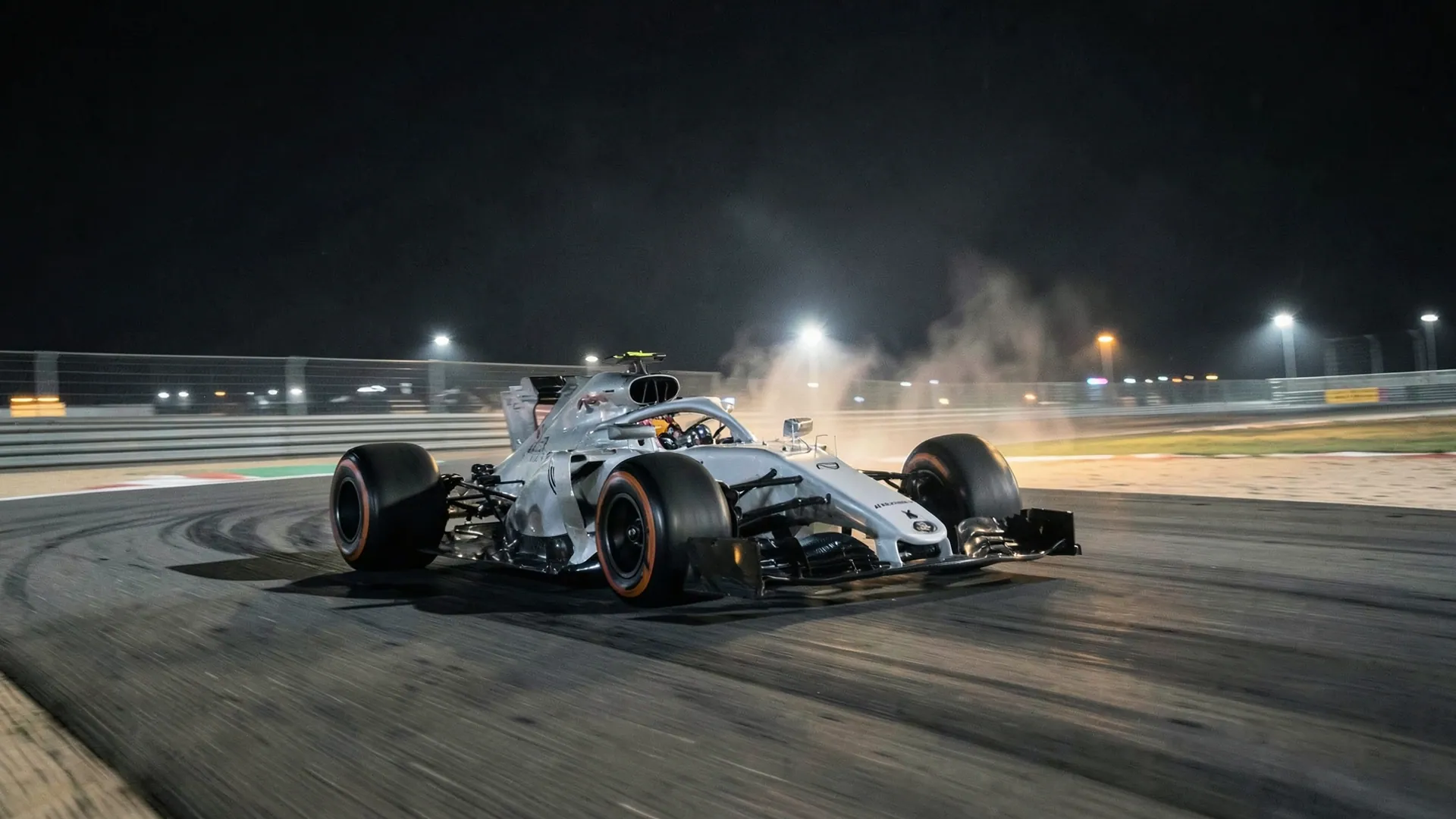
Pirelli has imposed a maximum of 27 laps on each set of tyres for Sunday’s Qatar Grand Prix, the 22nd and penultimate round of the 2026 season. Over a race distance of 57 laps, that rule makes a one-stop race impossible and forces every driver to stop at least twice. Andrea Kimi Antonelli and Mercedes have already secured the titles, so the cap will not decide a championship. It could still decide plenty beneath them.
Why Lusail keeps getting a lap limit
This is the third time in four seasons that Lusail has run under a stint cap. The circuit is a sequence of long, fast corners linked by short straights, so the tyres carry heavy lateral load for most of the lap and get little time to recover. Few tracks on the calendar ask a tyre’s construction to work this hard for this long.
The precedent dates from 2023, when Pirelli found that the high pyramid kerbs were damaging sidewalls and capped stints at 18 laps. The result was a three-stop sprint in brutal heat that left several drivers physically wrecked. The kerbs were changed afterwards, but when Formula 1 returned in 2025, Pirelli again judged the risk high enough to set a 25-lap maximum.
The 2026 figure of 27 laps is slightly more generous. That suggests the supplier is a little more comfortable with how this year’s narrower tyres and lighter-loaded cars treat the surface. It does not suggest Pirelli is comfortable enough to leave strategy to the teams. For the teams, the sporting consequence is the same: the most important variable of a normal Grand Prix, how long a driver can make a set last, has been taken out of the drivers’ hands.
The arithmetic of 57 laps
The maths is simple. Two stints of 27 laps cover 54 laps, three short of the full distance, so every car needs three sets and two stops. That has several knock-on effects.
First, tyre management loses most of its value. In a normal race, a driver who can nurse a set for an extra five laps opens up an overcut or skips a stop altogether. Here, there is no reward for preserving rubber beyond the cap. Drivers can attack for the whole of each stint, which turns the race into three short sprints rather than one long exercise in conservation.
Second, the pit windows bunch together. With everyone working to the same ceiling, the realistic stopping laps fall into a narrow band. That makes the undercut, which depends on fresh tyres being faster than worn ones, the main tool for gaining places in the pits. Teams will spend Friday trying to work out how strong that effect is on each compound.
Third, a neutralisation becomes enormously valuable. A driver who pits on lap three has 54 laps left, exactly two full 27-lap stints. In practice, any safety car or virtual safety car from lap three onwards offers a cheap stop that still leaves the driver needing only one more visit to the pits. The whole field will know this. The question is whether every pit wall reacts quickly enough.
Last year’s race showed what happens when one doesn’t. An early safety car brought most of the field into the pits for a discounted stop, while McLaren kept Oscar Piastri and Lando Norris out. Because everyone had to stop twice regardless, the cars that pitted gained a stop at a fraction of the usual cost, and McLaren’s drivers had to make two full-price stops later on. Max Verstappen won, and McLaren spent the following week explaining a decision that looked defensible in isolation and costly in context. Every strategist heading to Lusail this week will have studied that afternoon.
Las Vegas showed how quickly an order can scramble
The cap arrives straight after a race in which grid position counted for little. In Las Vegas on Sunday, Verstappen converted pole into victory, but much of the field behind him was reshuffled.
- Piastri started 17th and finished third.
- Carlos Sainz climbed from 20th to eighth, scoring four of Williams’ 16 points for the season.
- George Russell started second and finished ninth.
- Isack Hadjar started fourth and finished 15th, out of the points.
- Arvid Lindblad started fifth and retired.
Lusail is harder to overtake on than the Las Vegas street circuit, and the comparison should not be stretched too far. Still, a mandated two-stop race adds two more moments per car when positions can change without a pass on track. A driver starting in the midfield on an offset strategy, or one who benefits from a well-timed neutralisation, can gain places that pure pace would never deliver.
That matters because the fights below the champions are unusually close.
| Battle | Positions | Gap |
|---|---|---|
| Drivers’ third place | Hamilton 267, Russell 264, Norris 264, Leclerc 250 | 17 points cover four drivers |
| Constructors’ third place | Red Bull 440, McLaren 431 | 9 points |
| Constructors’ fifth place | RB 114, Alpine 87 | 27 points |
| Constructors’ seventh place | Haas 31, Audi 28 | 3 points |
The drivers’ fight for third is the most open contest left. Lewis Hamilton leads Russell and Norris by three points, with Charles Leclerc 17 points behind Hamilton. With two Grands Prix remaining, any of the four can still finish on the podium of the standings. In a race where the order is shaped as much by the pit wall as by the cockpit, the driver whose team calls the stops best has a real chance to finish the year in third.
The constructors’ battle for third may be the bigger prize, given what each championship position is worth in prize money. Red Bull’s nine-point cushion over McLaren is fragile. Verstappen is carrying most of the load, and Hadjar’s scoreless afternoon in Las Vegas showed how exposed Red Bull is when its second car stumbles. McLaren has two drivers who finished on the podium on Sunday, and the 2025 lesson gives the team a particular reason to get the safety car call right this time.
Further down, Alpine’s 18-point haul in Las Vegas from Pierre Gasly and Franco Colapinto has brought it within 27 points of RB. That is a big gap to close in two races, but not an impossible one if Liam Lawson and Lindblad endure another difficult weekend. Haas and Audi, separated by three points, are fighting for seventh, and a single top-10 finish could settle it.
Freedom for the champion, pressure on Red Bull
Antonelli arrives with nine wins and 402 points, 98 clear of Verstappen. He has nothing left to protect, and that is a strategic advantage: Mercedes can let him run a bold strategy without worrying about the championship. The team will also want to add to its 12 wins before the season finale. Russell’s slide from second to ninth in Las Vegas gives Mercedes a more direct interest in his result, because he sits only three points behind Hamilton.
Red Bull faces the opposite situation. Verstappen’s win in Las Vegas was his fourth of the season, and he won this race a year ago, partly because Red Bull read the safety car correctly while McLaren did not. Now Red Bull must keep the pace that won in Las Vegas, get Hadjar back into the points and avoid a strategic mistake while defending third place in the constructors’ standings. A stint cap removes the margin a fast car would usually have to recover from a poorly timed stop.
A safety rule that hands the race to the pit wall
There is no serious case against Pirelli setting a limit when its data shows structural risk. A tyre failure at Lusail’s speeds would be far worse than a constrained race. Even so, a cap that dictates the minimum number of stops is a blunt instrument. Lusail is becoming a race where strategy is decided in advance and the result often depends on when the safety car appears. The long-term answer is a tyre construction that can handle this circuit without a lap limit, and Pirelli should treat a third capped race in four years as a problem to eliminate, not a routine.
For this weekend, the rule favours teams willing to commit early. The team that pits at the first neutralisation will most likely beat the team that hesitates, and McLaren and Alpine have the strongest reasons to take that gamble. Expect the fight between Red Bull and McLaren for third place in the constructors’ standings to be decided on Sunday evening in Lusail, not a week later at the season finale, and expect it to be won by the team that makes the better calls during the race.