
Mercedes' Stalled Upgrade Gives Ferrari and Red Bull an Opening Before 2027
Karun Chandhok's warning about Mercedes' latest aerodynamic package matters less for Andrea Kimi Antonelli's 102-point lead than for what a stalled development curve signals to Ferrari and Red Bull heading into 2027.
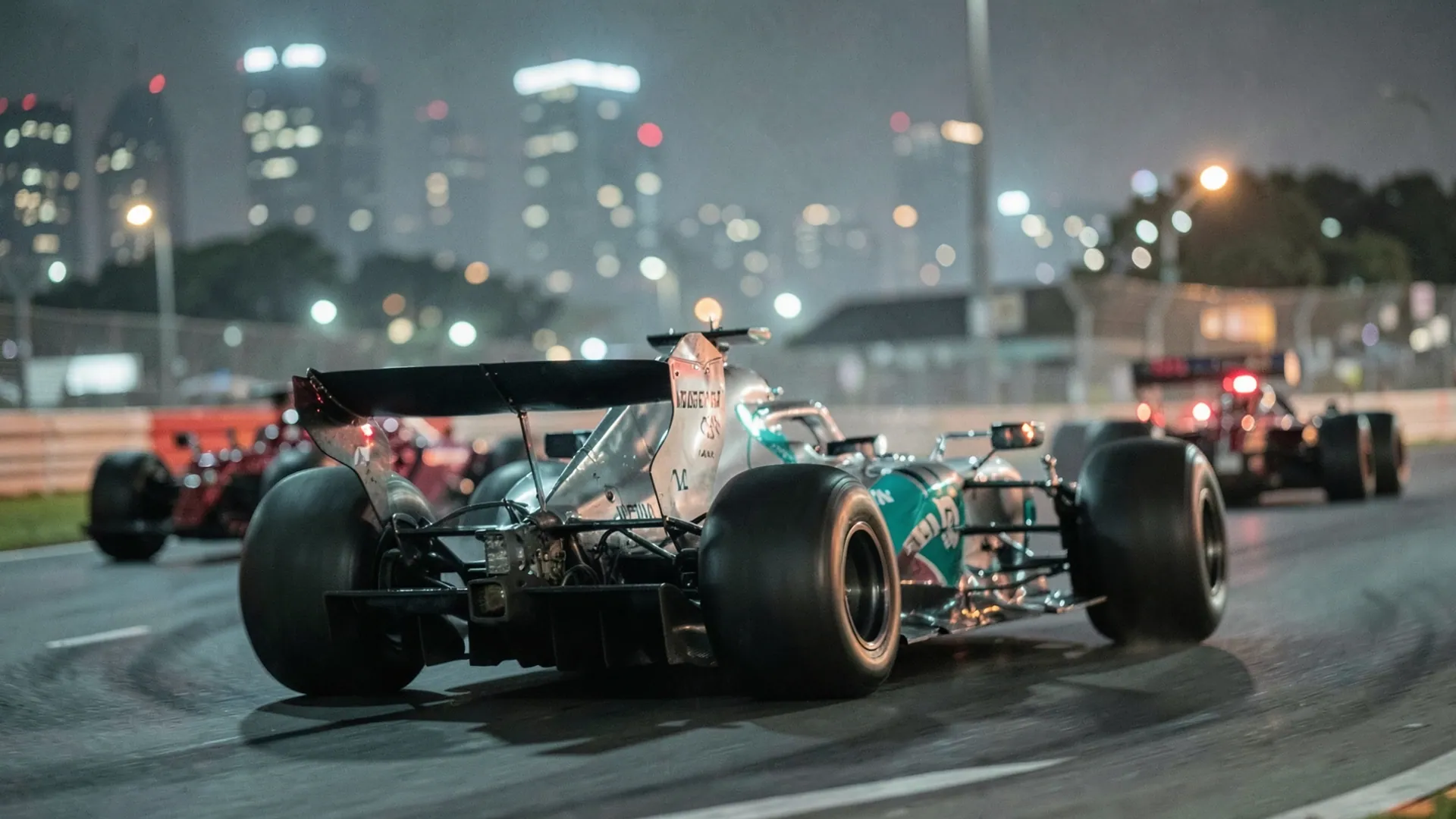
Karun Chandhok has said Mercedes should be “concerned” that its newest aerodynamic package has not delivered the step in performance the team expected, after a Singapore Grand Prix in which Andrea Kimi Antonelli started fourth and finished third. The Sky Sports pundit’s assessment, reported by Motorsport.com, follows a race in which Antonelli was beaten by Max Verstappen and Charles Leclerc. Antonelli’s title lead remains enormous. The more serious question is whether the car that has won 11 of 17 rounds has stopped getting faster while its rivals have not.
What Marina Bay did and did not prove
Taken on its own, Singapore looks like a routine weekend for a team that has dominated 2026. Antonelli collected 15 points, extended his lead over George Russell and left Marina Bay with 340 points to his team-mate’s 238. Look more closely, though, and the picture is less comfortable for Brackley.
Mercedes did not have a car on the front row. Verstappen took pole and converted it into his second win of the season, Leclerc started alongside him and Lewis Hamilton put the second Ferrari third on the grid. Antonelli was the quickest Mercedes in qualifying, and only the fourth-fastest car overall. Russell started 19th and recovered to ninth, which salvaged two points but told us little about the car’s ultimate pace.
On the day, Mercedes scored 17 points. Ferrari and Red Bull scored 26 apiece, and McLaren 22. For a team that has won almost two-thirds of the races this year, that is the haul of a team in the pack, not a dominant force.
Two caveats deserve weight. First, Singapore is an outlier: a slow street circuit defined by traction, kerb-riding and mechanical grip, where aerodynamic gains tend to be blunted and set-up compromises loom larger. A package designed to add load in medium- and high-speed corners can look flat around Marina Bay and come alive elsewhere. Second, a single result is a weak sample. Chandhok’s concern is plainly about the trend rather than one Sunday, and that is the more persuasive reading. Upgrades are meant to widen a gap or defend it. If this one has done neither, the margin Mercedes enjoyed earlier in the season is eroding in real time.
Antonelli’s lead is safe, Mercedes’ trajectory is not
There is no realistic threat to Antonelli’s championship from outside his own garage. Hamilton is third on 229 points, Verstappen fourth on 221 and Leclerc fifth on 215. All three are more than 110 points adrift with six rounds remaining. Russell, 102 behind, is the only driver with a plausible mathematical route, and even he would need to outscore Antonelli by an average of more than 17 points a weekend from Austin to the finale. Singapore actually moved that target further away: Antonelli gained 13 points on his team-mate there.
The constructors’ table tells a similar story. Mercedes leads Ferrari by 134 points, 578 to 444, with McLaren (339) and Red Bull (332) further back. Singapore cut Ferrari’s deficit by nine points. Repeat that six times and Mercedes still wins comfortably.
So why should Mercedes worry? Because the final third of a season is when teams reveal where their development is heading, and the order of the last few races is often a better predictor of next year than the order of the first dozen. When the rules carry over from one season to the next, the concepts that are improving fastest in October are usually the ones that start the following year strongest.
Mercedes’ 2026 advantage was built on getting the new regulations right out of the box. The cars were new, the power units were new, and the team that best understood the package banked points while others were still learning. That kind of edge decays naturally as rivals converge. If, at the same moment, Mercedes’ own updates stop producing measurable gains, the convergence accelerates from both directions.
Brawn, Ferrari and Red Bull: how leaders lose their grip
Formula 1’s history offers several versions of this pattern, and none is reassuring for a team that has stopped moving forward.
The closest parallel is Brawn in 2009. Jenson Button won six of the first seven races in a car that had exploited a new rulebook more cleverly than anyone else’s. Brawn then lacked the resources to keep developing at the pace of its rivals, and Red Bull won three of the last five races. Button still became champion, as Antonelli surely will, but the momentum had passed to Milton Keynes. Red Bull carried it into a run of four straight titles.
Upgrade failures have also tripped up bigger teams more recently. Ferrari’s 2024 floor revision, introduced in Spain, induced bouncing and forced a partial reversion, costing the team valuable weeks in a season it had hoped to fight for wins. Red Bull’s development lost direction in the same year, its balance problems deepened and McLaren overhauled it to claim the constructors’ title. Verstappen won the drivers’ crown largely because he had built his lead before the slide began. Mercedes itself spent much of 2022 and 2023 trying to make a flawed concept work, and the lesson from that period was how long it can take to understand why parts that look good in the wind tunnel don’t translate on track.
The common thread is correlation. When a new component disappoints, the first question is whether the part is wrong or the tools that predicted its gain are wrong. The first is a few weeks’ problem. The second can undermine an entire winter’s work.
Mercedes faces an additional structural headwind. The sliding scale of aerodynamic testing allowances gives the championship-leading constructor the smallest share of wind-tunnel and CFD time, with more going to those further down the order. Ferrari, McLaren and Red Bull all have more testing capacity than Mercedes for the rest of the year. A leading team can absorb that handicap when its development is efficient. If its updates are missing their targets, it has fewer opportunities than its rivals to diagnose why.
The choice Mercedes faces before Austin
This leaves Mercedes with a genuine trade-off for the remaining six rounds. One path is to keep running the new parts, collect data and work out whether the package is flawed or misunderstood. That carries a short-term cost in a constructors’ fight it is overwhelmingly likely to win anyway. The other is to revert to the previous specification wherever it is quicker, protect results and divert resources fully to the 2027 car. The danger there is closing the file on a problem that may resurface next season.
With a 134-point constructors’ cushion and a 102-point drivers’ lead, the team can afford to treat the rest of 2026 as a test programme with points attached. The worst outcome would be to run the parts without learning from them, and Mercedes’ 2022 experience showed how expensive persistence without understanding can be.
The United States Grand Prix on 25 October is the right place to find out. The Circuit of the Americas, with its fast opening sector and long changes of direction, should reward the kind of aerodynamic load a new package is meant to deliver in a way Singapore never could. If Antonelli and Russell are back on the front row there, Chandhok’s concern will look premature. If Verstappen and the Ferraris are again setting the pace on a circuit that should suit the upgrade, the problem is real.
My view is that Antonelli will be champion, and probably before the finale. But Ferrari and Red Bull are not racing for 2026 any more. They are racing for the opening rounds of 2027, and on the latest evidence they are closing faster than Mercedes is moving away. Austin will show whether that is a Singapore quirk or the start of a shift in the competitive order.