
Fuel Flow Meter Patent Lawsuit Lands in Texas as F1 Heads to Austin
A patent claim over F1's fuel flow sensors, Christian Horner's verdict on Andrea Kimi Antonelli's status at Mercedes and confirmation that 2027's shorter races will last one season lead the build-up to Austin.
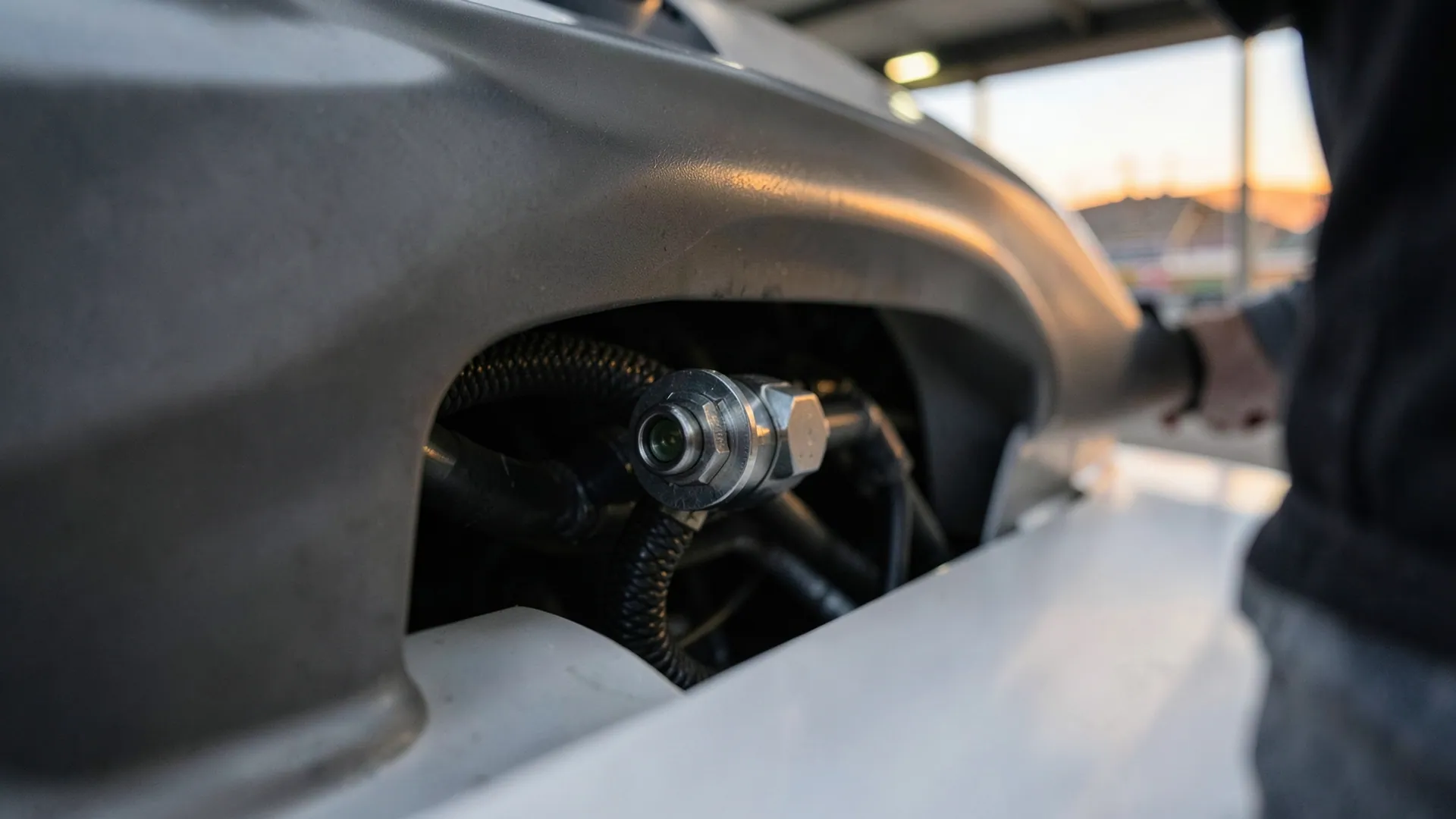
Sentronics Holdings Ltd, Formula 1’s former fuel flow meter supplier, has taken the company that replaced it to court in Texas, claiming that the sensors now fitted to every car on the grid infringe its patent. The filing lands days before the United States Grand Prix at the Circuit of the Americas, where Round 18 takes place on Sunday. Elsewhere, the FIA has confirmed that next year’s shorter race distances will last a single season, and Christian Horner has weighed in on the pecking order at Mercedes.
Sentronics takes the fuel flow fight to a Texas court
Motorsport.com and RacingNews365 both report the case. Its core is simple: Sentronics argues that the technology inside the current homologated sensor is covered by its own patent. The identity of the defendant matters less to the paddock than the component in question, because the fuel flow meter is one of the most politically sensitive parts on a modern Formula 1 car.
That sensitivity has a long history. In 2014, the first season of the hybrid era, Daniel Ricciardo was disqualified from second place on his Red Bull debut in Melbourne after the team chose to rely on its own fuel flow model rather than the official sensor’s readings. Red Bull argued the device was unreliable and lost the appeal. Five years later, the FIA’s scrutiny of Ferrari’s power unit turned on fuel flow measurement. A technical directive arrived on the eve of the 2019 race at this very circuit, a second sensor followed, and the matter ended in a confidential settlement in early 2020.
The 2026 rules have made the meter more important, not less. The limit is now framed around the energy the fuel delivers rather than simply its mass, so the sensor is the referee for the most closely guarded number in each engine department.
Why Sunday’s race is unaffected
In sporting terms, the case probably changes nothing. Patent disputes move at the pace of courts, not race weekends, and there is no indication that the cars will run with anything other than the sensors they have used all season. The choice of venue reflects Texas’s standing as a well-trodden destination for patent litigation, and the timing guarantees attention.
The longer-term question is commercial. If a court eventually finds for Sentronics, the consequences fall on a supplier and potentially on the governing body’s procurement, not on lap times. Even so, the FIA will want this resolved cleanly. A dispute over the integrity of the measuring device, however narrow, is unwelcome when that component has already been at the centre of two of the hybrid era’s biggest technical rows.
Antonelli, Russell and the number-one question at Mercedes
Horner, the former Red Bull team principal, told Motorsport.com that Andrea Kimi Antonelli has “earned” the right to be Mercedes’ outright number one. On the numbers, that is hard to dispute. The 20-year-old has 340 points and eight wins from 17 rounds, and leads George Russell by 102 points with six grands prix remaining.
To put that gap in Sunday terms, Russell would need to outscore his team-mate by an average of 17 points per race to draw level. That is the difference between winning and finishing sixth, every weekend, until the season finale. Antonelli’s third place in Singapore, while Russell recovered from 19th on the grid to ninth, widened the margin further. Barring something extraordinary, Antonelli will become the youngest world champion in the sport’s history, comfortably beating the record Sebastian Vettel set at 23.
Why formal status changes little this year
The more interesting point is whether a declared number one is necessary at all. Toto Wolff’s Mercedes have always preferred equal treatment, even when it cost the team. The Lewis Hamilton–Nico Rosberg years produced the collision in Barcelona in 2016. The Hamilton–Valtteri Bottas era showed that a clear hierarchy tends to emerge on track before any memo is written.
That is what has happened here. Russell remains second in the championship with three wins, which is precisely the return a team wants from its other driver. Mercedes have 578 points and a 134-point lead over Ferrari. Imposing a pecking order now would solve no problem the team actually has.
The question becomes real in 2027 if Russell closes the gap. Antonelli’s season has earned him leverage, but Mercedes’ best asset over the past 12 months has been two drivers scoring heavily without needing to be managed. I would expect Wolff to protect that arrangement rather than formalise anything.
Four winning teams, and the budget cap debate
A reader comment featured by RaceFans argues that the cost cap is not to blame for the shortage of winning teams, and the 2026 season supports that view. Four teams have won races (Mercedes 11, with Ferrari, McLaren and Red Bull on two apiece), and the concentration at the top follows the familiar pattern of a regulation reset. Mercedes in 2014 and Red Bull in 2022 and 2023 both converted new rules into dominance. The cap did not create that advantage. If anything, together with the sliding scale of aerodynamic testing time, it limits how long such an advantage can be bought and extended.
Ferrari’s final upgrade and the scramble for second
GPfans reports that Ferrari will bring their last notable upgrade of the season to Austin before switching fully to the 2027 car, for which the team is reportedly planning a significant change. That is a rational call. Ferrari sit second in the constructors’ standings on 444 points, 105 clear of McLaren. With the regulations carrying into next year, a lesson learned in October transfers directly to the new car.
The drivers’ fight behind Antonelli is where the upgrade could matter. Only 37 points separate second from sixth:
| Position | Driver | Team | Points | Wins |
|---|---|---|---|---|
| 2 | George Russell | Mercedes | 238 | 3 |
| 3 | Lewis Hamilton | Ferrari | 229 | 1 |
| 4 | Max Verstappen | Red Bull | 221 | 2 |
| 5 | Charles Leclerc | Ferrari | 215 | 1 |
| 6 | Lando Norris | McLaren | 201 | 2 |
Singapore told two stories for Ferrari. Charles Leclerc converted second on the grid into second at the flag. Hamilton started third and dropped to sixth. Max Verstappen, meanwhile, controlled the race from pole for his second win of the year and moved within 17 points of Russell.
My view is that Verstappen is the most dangerous of the chasing group over the final six rounds. His Red Bull has been inconsistent, but when the car works he converts, and he has often outperformed his machinery late in a season. Ferrari’s upgrade gives Hamilton and Leclerc a chance to respond. Austin’s mix of high-speed direction changes and heavy braking zones will quickly show whether it works.
Shorter races in 2027, with an expiry date already written in
The FIA’s newly published regulations confirm that grand prix distances will be shortened for 2027 because of changes to the power units. They also stipulate that full distances return in 2028. RacingNews365 and RaceFans both report the reversal, which is unusual mainly for being legislated in advance.
The rationale follows from how the 2026 engines work. With a near-even split between combustion and electrical power and a strictly limited energy allowance, any adjustment to that balance changes how hard a car can be driven over a full race. Shortening the race is the bluntest way to keep the product competitive while the engineering catches up.
The sunset clause is the right approach. The 305-kilometre standard has defined a grand prix for decades, and promoters, broadcasters and fans buy into that length. Writing the restoration into the rules gives everyone a date to plan around and stops a temporary measure from drifting into permanence.
F1 has reversed bad ideas quickly before. Double points at the 2014 finale lasted one season, and the elimination qualifying format of 2016 was abandoned after two races. The difference this time is that the governing body has admitted the compromise before it starts. That honesty deserves credit, provided 2028 really does bring the full distance back without a fresh round of exceptions.
Red Bull’s Racing Bulls puzzle
Crash.net highlights the decision Red Bull still face over their 2027 line-up at Racing Bulls. The current pairing gives the senior management a genuine choice rather than an obvious one.
- Liam Lawson is ninth in the championship on 75 points and finished seventh in Singapore. After being dropped from the senior team two rounds into 2025, he has rebuilt his reputation with steady scoring.
- Arvid Lindblad, in his first full season, has 38 points and sits 11th. He qualified ninth in Singapore but slipped to 15th, a lapped finish that reflected a difficult race rather than a lack of pace over one lap.
- Isack Hadjar, now at Red Bull, has 97 points and climbed from 22nd on the grid to tenth in Singapore, so the senior seat beside Verstappen looks settled for the moment.
Racing Bulls are fifth in the constructors’ championship on 100 points, 32 ahead of Alpine. That is a meaningful position for a team whose purpose is partly to develop talent and partly to earn prize money.
Red Bull’s history argues against patience. Pierre Gasly, Alexander Albon and Lawson have all been moved on quickly when results dipped. My view is that Lawson’s consistency has earned another year, and that retaining both drivers would give Racing Bulls a stability the programme rarely enjoys. The pressure comes from the juniors queuing behind them, and Red Bull have never been shy about making room.
Godzilla, MotoGP and UNO: the rest of the Austin build-up
- MotoGP comes to COTA’s paddock. MotoGP machines will be on display at the United States Grand Prix, the first joint appearance since Liberty Media completed its takeover of the championship’s owner. Expect more of this cross-promotion in markets where both series race.
- Godzilla returns at Haas. The team will run another version of its Godzilla livery in Austin. It is a commercial flourish, but one with real appeal in Haas’s home market.
- IndyCar heads for Barcelona. PlanetF1 reports that Alex Palou is set for a home IndyCar race in Barcelona. It gives the multiple champion a homecoming and shows IndyCar’s growing interest in European venues.
- Norris loses at cards. A super-sized game of UNO between Gasly, Lando Norris and Oscar Piastri, posted by F1, passed 320,000 views in under a day. Norris finished last.
- McLaren versus Red Bull for third. Only seven points separate McLaren (339) and Red Bull (332) in the constructors’ standings. With Norris and Piastri both scoring in Singapore and Verstappen winning, this is the closest fight among the top four teams. I expect Red Bull to edge it before the season finale if Verstappen carries his Singapore form into Austin.