
Mercedes Gives Antonelli First Run of ADUO Turbo Upgrade as Russell Waits
Mercedes will debut its ADUO turbo upgrade at the Las Vegas Grand Prix on Andrea Kimi Antonelli's car alone, a choice that says as much about 2027 as about the team's hierarchy.
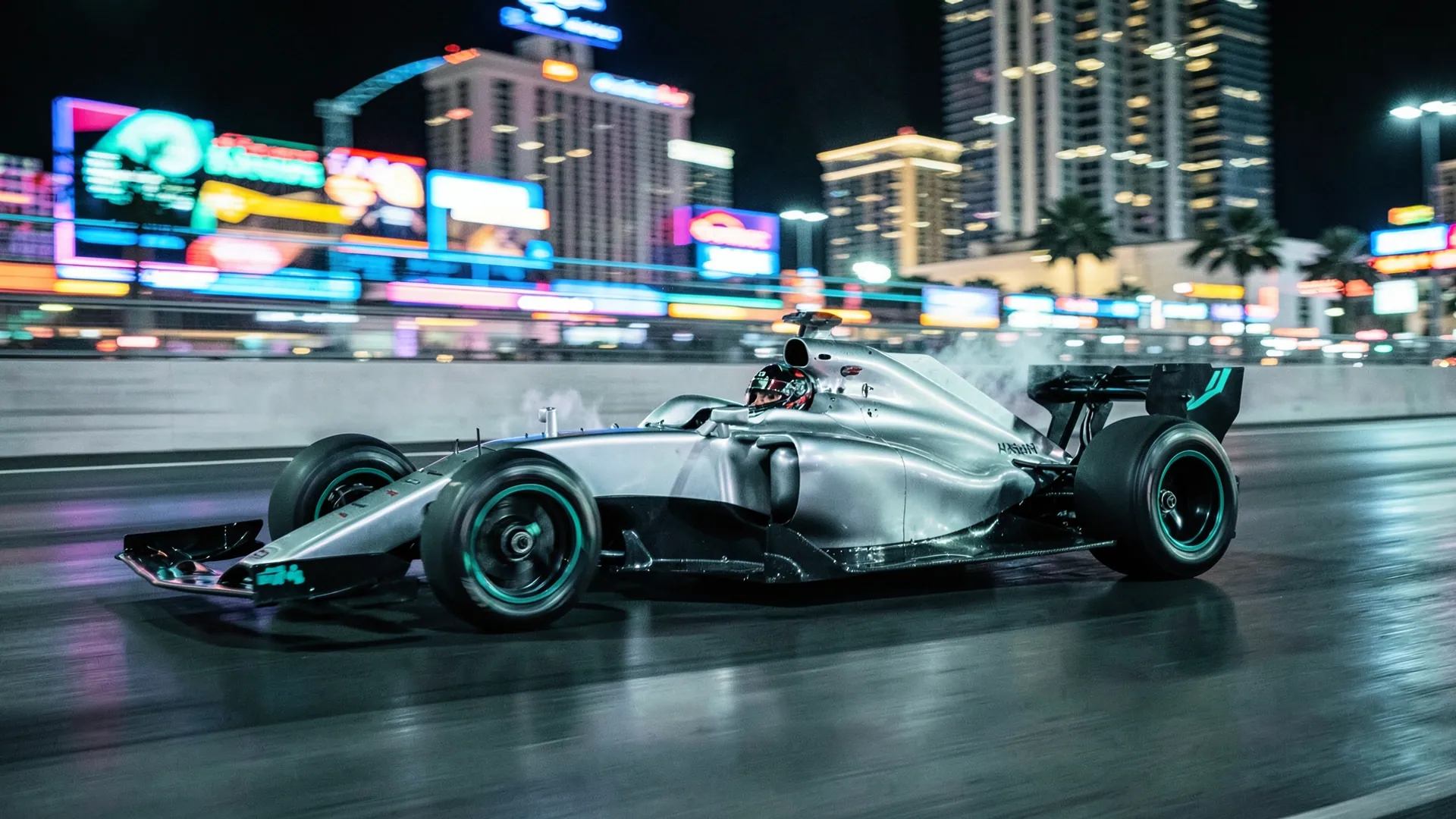
Mercedes will introduce its long-awaited ADUO turbo upgrade at this weekend’s Las Vegas Grand Prix, but only on Andrea Kimi Antonelli’s car, leaving George Russell to start round 21 without it. Sky Sports F1 and RacingNews365 have both reported that the part is ready for the Strip, and Crash.net has examined why Russell misses out. On its own, a staggered introduction is ordinary engineering. Coming from the team that has dominated 2026, and arriving with the drivers’ title already decided, it raises questions about who Mercedes is building around next year.
The arithmetic of a settled title
Start with where the championship stands, because it changes how this decision should be read. Antonelli has 390 points and nine wins from 20 rounds. Max Verstappen, second on 279, is 111 points behind with three rounds left. Three grands prix offer at most 75 points, and adding sprint points would still not reach 111. Antonelli is champion in everything but the ceremony.
The constructors’ fight is almost as one-sided. Mercedes has 652 points and 12 wins, 142 clear of Ferrari. On grand prix points alone, Ferrari could not close that gap even with one-two finishes in all three remaining races and Mercedes scoring nothing. So Mercedes heads to Las Vegas with nothing meaningful left to defend at team level.
That matters here. A team still fighting for a title rolls out new hardware cautiously and evenly, because a reliability failure on either car can cost the championship. A team that has already won it can treat the last three rounds as something closer to a development programme with points attached.
What ADUO exists to do
ADUO, the Additional Development and Upgrade Opportunities scheme, is one of the less glamorous parts of the 2026 power unit rules, but it shapes this story. Engine development under the new regulations is tightly controlled through homologation. That protects budgets, but it also risks locking in any early performance gap for years. ADUO is the safety valve. The FIA assesses combustion-engine performance at set points, and manufacturers judged to be below the benchmark earn extra chances to upgrade, with some additional budget headroom.
Mercedes’ use of an ADUO part shows that the FIA’s measure of internal-combustion output and the championship table are different things. Under these rules, a team can win 12 of 20 grands prix without having the strongest pure combustion unit on the grid. Chassis performance, energy recovery and deployment, and drivability carry enormous weight, and Mercedes has clearly got those right. The turbo upgrade is its chance to strengthen the one area where it was judged to be behind.
Las Vegas is a fitting venue for a first run. The Strip has long, flat-out stretches, and the cold night-time conditions put a premium on how efficiently an engine makes power. If the new turbo is worth anything on the clock, this circuit will show it. If it has a weakness, three long straights per lap will expose that too.
Why the champion’s car goes first
There are three usual reasons for a single-car introduction, and they often overlap.
- Supply. New hardware frequently arrives in very small numbers, and having only one unit ready for a race weekend is not unusual.
- Allocation. Power unit elements are limited per driver per season. Fitting a new component can push a driver past their allowance and trigger a grid penalty, and each driver’s usage differs.
- Risk. A new part carries reliability unknowns that are best absorbed by the driver with least to lose.
The third reason points firmly at Antonelli. A failure on race night would cost him a result and nothing else. His title cannot be taken away, and his car can serve as a well-instrumented test bed in front of a full grid. Had Mercedes put an unproven turbo in Russell’s car and it failed, the team would have damaged the only championship position it still has a stake in.
On that reading, keeping Russell on the known specification protects him. But that holds only if the upgrade proves more fragile than fast. If the new turbo delivers a meaningful gain on the straights in Las Vegas, Russell will race with a power deficit to his own team-mate on a weekend that may decide his fight for second.
Russell’s fight for second just got harder
That fight is the most interesting championship contest left in 2026. Behind Antonelli, five drivers are covered by 33 points:
| Position | Driver | Team | Points |
|---|---|---|---|
| 2 | Max Verstappen | Red Bull | 279 |
| 3 | George Russell | Mercedes | 262 |
| 4 | Lewis Hamilton | Ferrari | 261 |
| 5 | Charles Leclerc | Ferrari | 249 |
| 6 | Lando Norris | McLaren | 246 |
Russell is 17 points behind Verstappen and a single point ahead of Lewis Hamilton. Verstappen arrives with momentum after climbing from 21st on the grid to second in Brazil, the drive of the weekend. Lando Norris won at Interlagos from pole and has closed to within 16 points of Russell. A bad night in Las Vegas could drop Russell from third to sixth.
Brazil also showed that Russell is not simply making up the numbers. He started seventh and finished fourth, while Antonelli dropped from second on the grid to fifth. Over the season, Antonelli has been clearly the stronger Mercedes driver, with nine wins to Russell’s three and a 128-point margin. On the most recent evidence, though, Russell was the team’s stronger performer on race day.
Second place in the championship is a footnote for the team, but not for Russell. It is the measure of his season, and a driver who has spent the year being beaten by a younger team-mate would value it. If he loses it to Verstappen by a handful of points while Antonelli has the newer engine part, the decision will look worse in hindsight than it does now, whatever the engineering logic.
Formula 1 has seen this before. At Silverstone in 2010, Red Bull moved its only updated front wing from Mark Webber’s car to Sebastian Vettel’s after Vettel’s failed. Webber won anyway, and his “not bad for a number two driver” line has outlived the race result. Mercedes under Toto Wolff built much of its reputation on the opposite principle. Through the Hamilton-Rosberg years it treated equal machinery as close to sacred, believing that open competition between two well-equipped drivers made the team stronger. A single-car turbo introduction does not abandon that principle, but it does show it giving way to other priorities when nothing is at stake for the team.
A 2027 decision dressed as a Las Vegas one
The bigger point is what Mercedes wants from these last three rounds. The 2026 rules are in their first year, and next season’s car and power unit are already well advanced. Every lap the ADUO turbo completes in race conditions produces data that a dyno cannot fully reproduce: heat cycles on a street circuit, behaviour in the cold, and the way the extra power interacts with energy deployment on long straights. That data will shape the specification Mercedes takes into 2027.
Gathering it on Antonelli’s car makes sense if Antonelli is the reference point for 2027 development. He is the champion and will carry the number one into next season, and his driving preferences will increasingly decide where the team spends its effort. Engineers listen hardest to the driver whose feedback they are building the next car around. Giving him the newest hardware first, even for practical reasons, strengthens that relationship.
None of this means Russell is being sidelined. It does mean Mercedes is now organised around Antonelli, and the turbo is the clearest sign of it so far.
The real test comes at round 22, not in Las Vegas. If the part runs cleanly this weekend and Russell has it for the final two races, this will be remembered as routine engineering sequencing that briefly looked political. If Russell finishes the season without it and loses second place to Verstappen, Mercedes will have told its senior driver exactly where he stands, and Russell will take that message into 2027.