
Mercedes' Interlagos Post-Mortem Is About 2027, Not the Titles Nearly Won
Mercedes has investigated a Brazilian Grand Prix in which, for the first time in 2026, neither W17 reached the podium, and the lessons matter more for next year's car than this year's crowns.
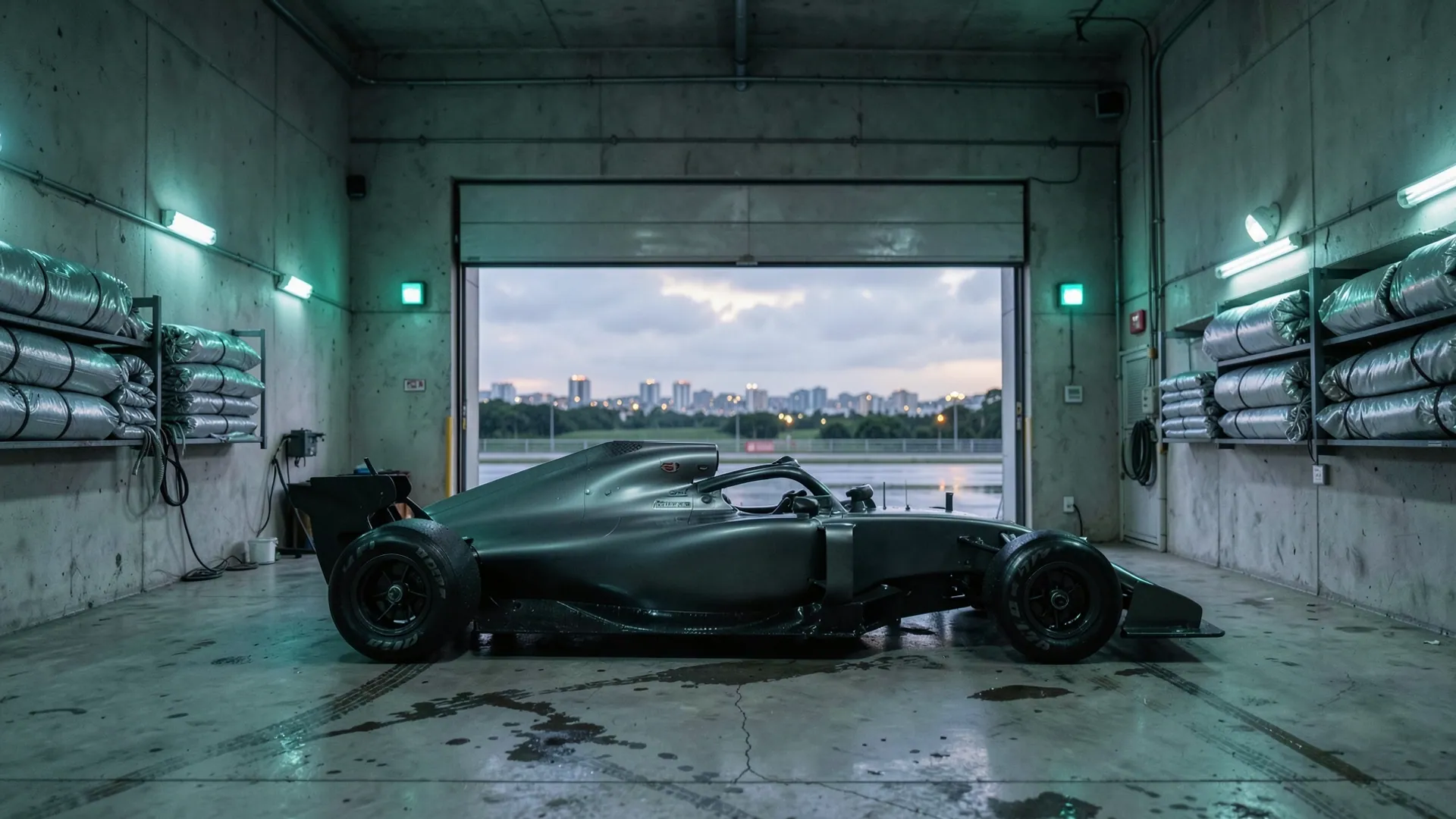
Mercedes has completed an investigation into its Brazilian Grand Prix of 8 November, where, for the first time in 2026, neither of its drivers finished on the podium. George Russell was fourth at Interlagos and championship leader Andrea Kimi Antonelli fifth. As PlanetF1 reported, the team has now shared its findings into what went wrong across the weekend.
With both titles all but beyond its rivals’ reach, the investigation will have little effect on this season. Its real value lies in what it tells Brackley before the 2027 car is finalised.
A fourth and a fifth that ended a 19-race run
The scale of Mercedes’ season makes the Brazil result stand out. Across the first 19 rounds, Mercedes put at least one W17 on the podium every weekend. It has won 12 of the 20 grands prix so far, with nine for Antonelli and three for Russell, and no other team has more than three.
The standings reflect that run. Antonelli leads the drivers’ championship on 390 points, 111 clear of Max Verstappen with three rounds to go. That margin is larger than the 75 points that three grand prix victories would give Verstappen. Russell is third on 262 points, a single point ahead of Lewis Hamilton. In the constructors’ championship, Mercedes has 652 points to Ferrari’s 510. That 142-point lead is more than the 129 points a Ferrari one-two at all three remaining races would recover.
Against that background, a fourth and fifth would usually count as a tidy points haul. Mercedes left Brazil with 22 points, but Red Bull and McLaren each scored 33. On points scored, Mercedes was the third-strongest team on the day in a season it has otherwise led comfortably.
Antonelli’s lost front-row start and Verstappen’s charge
The classification gives a clear picture of the weekend’s main threads.
| Driver | Team | Started | Finished |
|---|---|---|---|
| Lando Norris | McLaren | 1 | 1 |
| Max Verstappen | Red Bull | 21 | 2 |
| Isack Hadjar | Red Bull | 5 | 3 |
| George Russell | Mercedes | 7 | 4 |
| Andrea Kimi Antonelli | Mercedes | 2 | 5 |
Antonelli’s race is the more revealing of the two. He started on the front row alongside Lando Norris, the strongest grid position Mercedes had all weekend, and finished three places lower. Verstappen, Hadjar and his own team-mate all came home ahead of him. Russell started five places behind and still beat him. When a driver starting second is beaten by a team-mate who started seventh, the cause is usually a car problem, a strategic split or an execution issue. That is exactly the kind of question an internal review exists to answer.
Russell’s afternoon was more positive but still limited. He gained three places from seventh, finishing ahead of Liam Lawson, Nico Hülkenberg and Oliver Bearman, all of whom had qualified well and then faded. None of the three finished in the top six. Beyond that, Russell had no answer to the cars ahead, and he lost a place to Verstappen.
Verstappen’s drive is the clearest benchmark. He climbed from 21st to second, close to a repeat of his win from 17th on the grid at the same circuit in 2024. A car that can do that through Interlagos traffic has good traction out of the slow corners and enough energy for the long uphill run from Junção to the line. Hadjar’s third from fifth in the sister car suggests Red Bull’s pace was not down to one driver alone. Norris, meanwhile, converted pole into his third win of the year. McLaren had the pace to control the race from the front, which Mercedes never managed.
Why a settled season still needs answers
Investigating a fourth and fifth while leading both championships comfortably could look like over-thinking. It is the correct approach, and the reason lies in how the next car gets built.
The 2026 regulations brought a complete reset of the chassis and power unit rules, and Mercedes clearly read them better than anyone. In 2027 teams will be working to largely the same framework, so the W18 will be a development of the W17 rather than a fresh design. Any weakness built into this year’s concept will carry over unless it is understood and designed out over the winter.
Interlagos tends to expose such weaknesses. The circuit sits around 800 metres above sea level, where thinner air reduces downforce, makes cooling harder and asks more of the turbocharger. The surface is bumpy, the lap is short and the infield is full of low-speed traction zones. A car that is sensitive to ride height, or that depends on running a precise platform to make its downforce, will often struggle at Interlagos before it struggles anywhere else.
That is why the findings matter for 2027. If Mercedes has traced the problem to something specific to this weekend, such as a set-up choice, a reliability fault or a strategy call, it can file the lesson and move on. If the root cause lies in the car’s basic characteristics, the team needs that answer now, while the W18’s design is still open to change. A dominant season can hide flaws simply because the car wins anyway. A weekend where it does not win offers a rare, clear view of where it falls short.
There is a resource issue too. Under F1’s sliding scale for aerodynamic testing, the team that finishes first in the constructors’ championship gets the least wind tunnel and CFD time. Mercedes will therefore start its 2027 development with a smaller allocation than its rivals. With fewer runs available, it cannot afford to spend them on the wrong problem.
The 2022 lesson Brackley has not forgotten
Recent history explains why a leading team would take one off-weekend this seriously.
Mercedes won eight consecutive constructors’ titles from 2014 to 2021. It then started the 2022 ground-effect era with a car that bounced violently on the straights and never really recovered. That season the team’s only win came at Interlagos, with Russell. Mercedes knows from experience how quickly a dominant position can disappear when a new car’s flaws are misdiagnosed.
Red Bull offers the more recent warning. In 2023 it won 21 of 22 grands prix, and its car appeared to have no weaknesses. By mid-2024 the RB20’s narrowing operating window was costing it badly, and McLaren went on to take the constructors’ title. In hindsight, the warning signs appeared at specific circuits well before they became a trend, and those who dismissed them as one-off bad weekends were proved wrong.
Mercedes is not in Red Bull’s 2024 position, and one podium-less weekend is not a slump. The pattern is still familiar, though. A championship-winning team is most at risk when it assumes that what won this year will keep winning next year. Investigating Brazil properly is the opposite of that assumption.
Las Vegas as the first test of the findings
The next opportunity to see whether Mercedes has learned anything comes quickly. Round 21 in Las Vegas takes place on 22 November, at a circuit that is almost the reverse of Interlagos. It is a low-grip street track with very long straights and cold night temperatures, which make it hard to bring tyres into their working window. A car that lacked traction or platform control in Brazil could look quite different on the Strip.
That contrast makes Las Vegas a useful test, though not a conclusive one. If both Mercedes drivers return to the podium in Nevada, it will suggest Brazil was a set of circumstances rather than a structural problem. If Red Bull and McLaren stay ahead again, the investigation’s findings will look more urgent.
Our expectation is that Mercedes returns to the front in Las Vegas, and that Antonelli seals the title soon after. The more important outcome of this review will not be visible until next March, because what the team took from Interlagos will shape the W18 over the winter. A team that investigates its first bad weekend this closely, with both titles nearly secured, is preparing to defend its position in 2027 rather than relying on this year’s advantage.