
Waché Explains How Red Bull Turned Its First Own-Engine Car Into a Winner
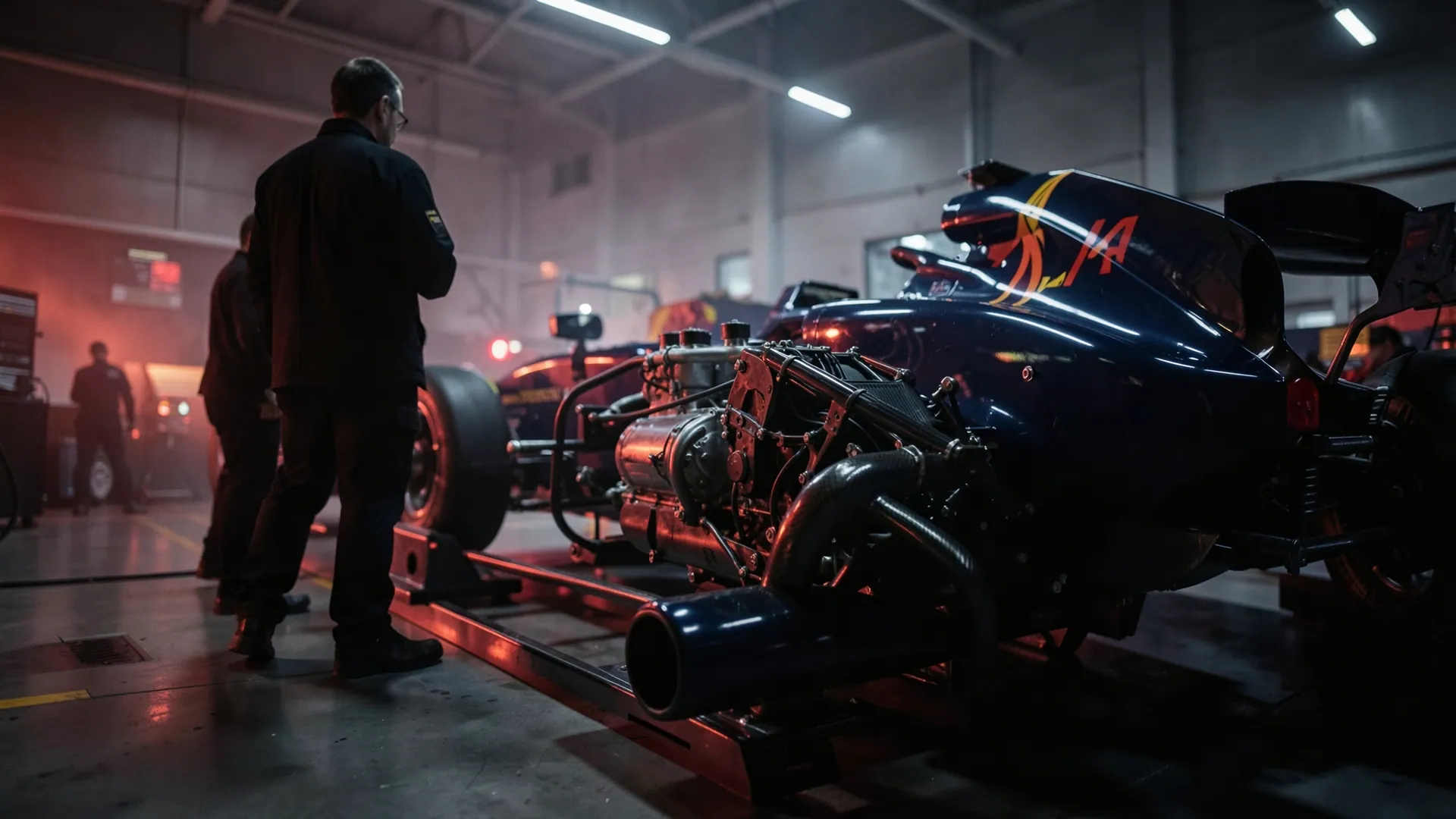
Red Bull technical director Pierre Waché has explained how the team corrected the RB22’s weaknesses and integrated its first in-house power unit, speaking to PlanetF1 a week after Max Verstappen won the Singapore Grand Prix from pole. It was Verstappen’s second win of 2026 and Red Bull’s second of the season. In the year the team stopped buying engines and started building them, that is a more significant achievement than fourth place in the championship suggests.
Waché’s account covers three threads: the shortcomings the team had to address in the car, the integration of the Red Bull Powertrains unit developed with Ford, and the steady closing of the gap to the front. None of that is unusual for a technical director to discuss. What is unusual is that Red Bull has done all three at once, under new regulations, against a Mercedes team that has won 11 of the 17 rounds so far.
Pole, track position and a clean night at Marina Bay
Singapore rewarded the strengths Red Bull has built into the RB22 over the summer. Verstappen started from pole and finished first, with Charles Leclerc second from second on the grid. Marina Bay is a circuit where qualifying decides a great deal, and the result reflected that: the top two started and finished in the same order.
The wider classification showed how much grid position counted. Lewis Hamilton started third and dropped to sixth, while Andrea Kimi Antonelli rose from fourth to third. George Russell, starting 19th, salvaged two points in ninth, and Isack Hadjar recovered from 22nd on the grid to take the final point in 10th. Antonelli’s 15 points stretched his championship lead over Russell to 102.
For Red Bull, the significance lay less in the points than in how the win was achieved. Verstappen converted pole into victory on a street circuit full of slow corners, traction zones and heavy braking. Under the 2026 rules, those are exactly the places where a car’s energy recovery and deployment decide lap time. Winning there from the front, rather than through a strategic gamble or another team’s misfortune, is the clearest sign yet that the chassis and power unit now work together as intended.
What building your own engine changes
The 2026 power units are a sharp break from the previous decade. The MGU-H is gone, the split between combustion and electrical power is close to even, and the cars run on sustainable fuel. That makes energy management the central performance problem: when to harvest, when to deploy and how to avoid running the battery flat at the end of a straight.
A customer team receives a power unit and a set of operating parameters, then designs its car around both. A works team can negotiate those parameters internally. Cooling layouts, packaging, gearbox mounting and the software that governs deployment can be traded against one another by engineers in the same buildings. That is the strategic case Red Bull made when it set up Red Bull Powertrains and signed Ford as a partner, and it is the context for Waché’s point about integration. The engine was never going to be judged in isolation. Its value depends on how well it is married to the chassis.
The trade-off is risk. A first-time manufacturer has no back catalogue of reliability data and no supplier to share the blame when something fails. Red Bull reduced that exposure by running the same unit in the sister team’s cars, which effectively doubles the mileage and data gathered every weekend. RB F1 Team’s results are also a useful check on the engine itself. The team sits fifth in the constructors’ championship on 100 points, clear of Alpine on 68, which switched to Mercedes customer power this year. Liam Lawson’s seventh place in Singapore was the latest evidence that the Milton Keynes unit is competitive beyond the senior team’s garage.
The precedents Red Bull wanted to avoid
Formula 1’s recent history offers two clear lessons about new engine regulations. The first is 2014, when Mercedes arrived at the start of the hybrid era with a car and power unit designed together from the outset and won 16 of 19 races. The second is 2015, when Honda’s return with McLaren showed how badly a manufacturer can struggle when it arrives late and the chassis and engine programmes are not properly aligned.
This season has echoes of both. Mercedes’ 11 wins, eight of them for Antonelli, look much like the advantage a well-prepared works team enjoyed in 2014. Aston Martin, now Honda’s works partner, is 10th in the constructors’ championship with seven points. The causes are almost certainly spread across car and engine, but the table shows how harsh these rules are on anyone who gets the integration wrong.
Red Bull has landed between the two extremes, which for a debut manufacturer is an excellent outcome. It has not matched Mercedes, and Waché’s own framing of the season as a process of closing the gap concedes as much. But it has avoided a lost year. Verstappen has two wins, the same number as Lando Norris, and Red Bull’s victory tally equals those of Ferrari and McLaren. Ferrari has a far deeper history of building its own power units, and McLaren buys its engines from the benchmark manufacturer.
The comparison is fairer still given what Red Bull lost on the way. The team that dominated 2023 did so with Honda-designed power. This year it had to replace that knowledge with its own while also adapting to a new aerodynamic rulebook. Doing that without a damaging drop in competitiveness is the strongest argument yet that the Powertrains project was the right call.
A second seat that still lags behind
The limits of the recovery show up in the second car and in the constructors’ standings. Verstappen is fourth in the drivers’ championship on 221 points, 119 behind Antonelli. Hadjar is eighth on 97, less than half of his team-mate’s total. His drive from 22nd to 10th in Singapore was resourceful, but a team cannot fight for a constructors’ title when one car regularly scores so much less than the other.
That matters because the fight Red Bull can still win is a close one. Ferrari is second on 444 points, 112 clear of Red Bull, a margin that is out of realistic reach with six rounds remaining. McLaren, however, is third on 339, only seven points ahead of Red Bull’s 332. Norris finished fourth and Oscar Piastri fifth in Singapore, further evidence that McLaren’s strength lies in scoring heavily with both cars on most weekends, even when neither wins.
The RB22 has clearly become a car that can win when conditions suit it. Its next test is whether it can score with both cars at circuits that suit it less. Over the final six rounds, third place in the constructors’ championship will be decided by the gap between Red Bull’s second car and McLaren’s, not by who wins at the front.
Austin will show how complete the RB22 has become
The drivers’ title is effectively settled in Antonelli’s favour. Russell, his nearest challenger, is 102 points behind, and Verstappen’s 119-point deficit with six rounds left is the equivalent of nearly five race wins. Red Bull’s targets for the rest of 2026 are narrower: more wins, a consistent second car and third place ahead of McLaren.
The United States Grand Prix at the Circuit of the Americas on 25 October is a useful next test. Verstappen won there three years in a row from 2021 to 2023, but COTA asks different questions from Marina Bay. It has high-speed direction changes in the first sector, a long back straight that stretches energy deployment, and a bumpy surface that punishes a car with a narrow operating window. If the RB22 can challenge for victory there, Waché’s claim that the team has addressed its weaknesses, rather than simply found a circuit that hides them, will look well founded.
The longer-term verdict is already becoming clear. Red Bull bet its future on becoming a full manufacturer at the most disruptive rule change in a decade, and within 17 races it has a car and engine capable of beating Mercedes on merit. If the team uses the winter to close the remaining gap in energy management and raise the level of its second car, 2027 is when the in-house project should be judged on championships rather than individual wins.