
Verstappen Wins Chaotic Las Vegas Grand Prix as Russell Crash Prompts 'Karma' Jibe
Max Verstappen converted pole into victory in a frantic Las Vegas Grand Prix, as George Russell's late crash and an intra-Ferrari incident reshaped a suddenly congested fight for third.
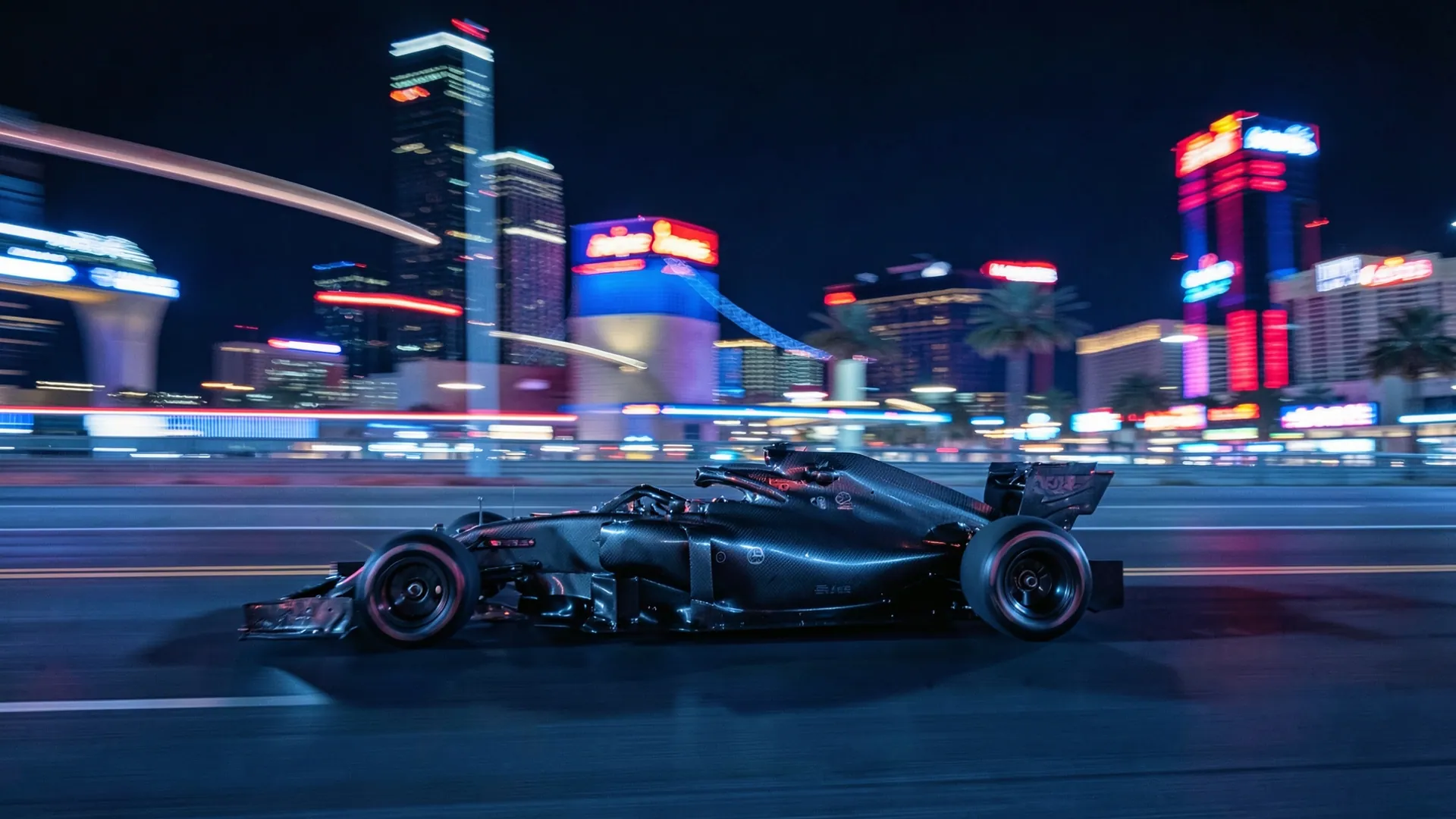
Max Verstappen won the Las Vegas Grand Prix from pole position on Sunday, finishing ahead of Lando Norris and Oscar Piastri after 50 laps of near-constant place-swapping on the Strip. It was the Red Bull driver’s fourth victory of the season, and it came on a night when almost everyone who started near him ran into trouble: Andrea Kimi Antonelli lost power while chasing him on the final lap, George Russell crashed from a podium place with three laps remaining, and Isack Hadjar’s challenge ended with a front wing failure. Antonelli’s 98-point lead is larger than the points still available. Las Vegas therefore mattered further down the order, where third place in the championship is now a four-way contest.
How Verstappen controlled a race that refused to settle
Formula 1 counted 352 overtakes in Las Vegas. RaceFans’ lap charts show drivers trading places twice or more in a single lap, a pattern the site aptly described as “yo-yo racing”. Norris was unconvinced by the headline number, observing that some of those overtakes were not really overtakes.
He has a point, and the reason lies in how the 2026 cars use their energy. With far more of the power unit’s output coming from the battery, a pass on one of Las Vegas’s long straights often costs the attacker the charge he needs to defend on the next. The car that has just been passed, with energy still in hand, simply drives back past. A tally of 352 measures how often cars changed order, not how often one driver genuinely beat another. The sport should resist treating the figure as proof that the racing was good. Much of it resembled the DRS swaps of the previous era, with the roles reversed every few hundred metres.
Verstappen stood apart because he seemed to understand that rhythm better than anyone. Telemetry analysis published since the race points to deliberate technique rather than raw pace: whenever he came under attack, he had energy available at the moment it was needed. In a race where leads routinely evaporated, he converted pole into victory. That is the clearest sign of how well he has adapted to these regulations, even in a season that has belonged to Mercedes.
Where the win leaves Verstappen and Red Bull
- Verstappen moves to 304 points, consolidating second in the championship.
- Lewis Hamilton, now third, is 37 points behind him with two rounds left. Outscoring Verstappen will not be enough; Hamilton needs the Red Bull driver to have a poor weekend.
- Red Bull’s 25 points all came from Verstappen, which matters in a constructors’ battle with McLaren that is now separated by nine points.
Mercedes take 14 points from a winning position
Mercedes had Russell second on the grid and Antonelli sixth. They left with 14 points, 12 of them Antonelli’s.
Antonelli’s race was the more frustrating of the two. He had worked his way into a position to challenge Verstappen for the win on the last lap when a power issue ended the attack, and he finished fourth. He has since explained what went wrong. With the title effectively settled, a lost victory in Las Vegas costs him nothing in the standings. Even so, a power fault at the decisive moment is precisely the kind of reliability question Mercedes will want closed before the final two weekends, and before a winter in which their opponents will be studying every weakness.
Russell’s evening was costlier. He was running on the podium until he crashed with three laps remaining. He was still classified ninth, but at least 15 points became two. That leaves him level with Norris on 264, three behind Hamilton. In a fight that close, three laps in Nevada may decide where he finishes.
The ‘karma’ remark
Verstappen described Russell’s crash as “karma”, and he went further in his criticism of the Mercedes driver after the race. The two have had an uneasy relationship for some time, with a series of on-track disputes behind them. That history explains the remark but does not justify it. Verstappen had just driven one of his most controlled races of the year. The jibe added nothing to that, and it shifted attention from his performance to a feud. Russell has given his own explanation of the accident, which is the more useful conversation for anyone trying to understand what happened.
For Mercedes as a team, the bigger picture is settled. They lead the constructors’ championship by 149 points with two rounds to run, which puts the title out of reach.
Ferrari’s internal friction becomes a points problem
Charles Leclerc received a 10-second penalty for an incident involving Hamilton, and the stewards have since published their reasoning. Hamilton finished seventh and Leclerc 10th. That gave Ferrari seven points on a night when McLaren took 33 and Red Bull 25.
The individual consequences are clear. Hamilton moves up to third in the championship on 267 points, and Leclerc drops to sixth on 250, 17 behind his team-mate. Each has won once this season.
Jacques Villeneuve has argued that Leclerc “lost” the leadership of Ferrari once Hamilton arrived. That is a sweeping judgement to hang on a single season. The standings give it some support, though not as much as the headline suggests. Leadership in a team is not settled by a 17-point gap. It rests on who shapes the car’s development, whom the engineers trust, and who delivers when the team is under pressure.
The more pressing issue is collective. When team-mates in a car capable of points finishes collide, or come close to it, the team pays in the standings. Ferrari remain second in the constructors’ championship on 517 points, 77 clear of Red Bull and 86 ahead of McLaren. That cushion is substantial but not yet mathematically secure. Another weekend like Las Vegas in Qatar would turn a comfortable position into an anxious one heading into the finale.
McLaren’s team play turns 17th into a podium
The most impressive recovery of the night belonged to Piastri, who started 17th and finished third. Norris went one better, climbing from third on the grid to second. Andrea Stella singled out the way the two drivers worked together during the race, saying their collaborative approach made a surprise result possible.
That collaboration makes sense under these rules. In a race where passes are routinely reversed, two team-mates fighting each other waste energy that both need to make progress against everyone else. Cars running together without attacking each other can save that energy for the drivers around them. It requires trust between the drivers and clear direction from the pit wall, and McLaren managed both.
The result matters on two fronts:
- Constructors’ third place: McLaren scored more points than any other team in Las Vegas and now trail Red Bull by nine, 440 to 431. With Red Bull relying heavily on Verstappen, that battle is genuinely open.
- Drivers’ third place: Norris is level with Russell on 264 and three points behind Hamilton.
For Piastri, the podium is overdue relief. He is seventh in the standings on 167 points and has yet to win in 2026. A drive from 17th to third will not change his season, but it is the kind of performance he can carry into the final two rounds.
Red Bull and Racing Bulls pay for promising grids
Hadjar started fourth and was in contention for victory before a front wing failure ruined his race. He finished 15th without a point and admitted the failure had damaged his motivation. That is an honest reaction from a young driver who saw a possible first win disappear through no fault of his own. Red Bull’s task now is to make sure the disappointment does not affect his final two races. He is eighth in the championship on 122 points, and his results count in the constructors’ fight with McLaren.
Racing Bulls had an even more painful evening. Arvid Lindblad started fifth and was in a position to fight for a top-five finish when he spun out. He described a “very strange” problem in the moments before the spin. Liam Lawson started seventh and finished 14th. A team that began the race with two cars in the top seven ended it with nothing.
That matters for fifth in the constructors’ championship. Racing Bulls are on 114 points. Alpine, whose drivers Pierre Gasly and Franco Colapinto finished fifth and sixth, took 18 points and now sit on 87. A 27-point gap with two rounds left is still Racing Bulls’ to lose. But Alpine have shown they can score heavily with both cars, and the margin is smaller than it should be after the grid Racing Bulls had in Las Vegas.
Qatar next, and the fights further back
- Qatar next Sunday: Round 22 takes place at the Lusail International Circuit on 29 November. Its fast, sweeping layout will place very different demands on the cars’ energy systems from the straights of Las Vegas.
- Sainz’s recovery: Carlos Sainz climbed from 20th to eighth for four points. Williams are ninth in the constructors’ championship on 16 points, and his was one of the most efficient drives of the night.
- Haas against Audi: Haas lead Audi 31 to 28 in the fight for seventh. Oliver Bearman recovered from 22nd to 13th, while Nico Hülkenberg and Gabriel Bortoleto finished 11th and 12th, just outside the points.
- Aston Martin and Cadillac: Fernando Alonso retired and Lance Stroll finished 17th, leaving Aston Martin on seven points. Cadillac are still waiting for their first point after Valtteri Bottas finished 18th, and only two races remain.
- Stewarding under scrutiny: The Las Vegas classification was revised after the race, when the stewards issued post-race penalties. With four drivers separated by 17 points in the fight for third, every decision in Qatar will carry extra weight.