
How Verstappen Outthought a Faster Mercedes to Win an Energy-Poor Las Vegas
Max Verstappen won in Las Vegas on a circuit that should have punished Red Bull's first-season Ford engine, using a deliberate energy plan that Mercedes, for all its pace, never managed to break.
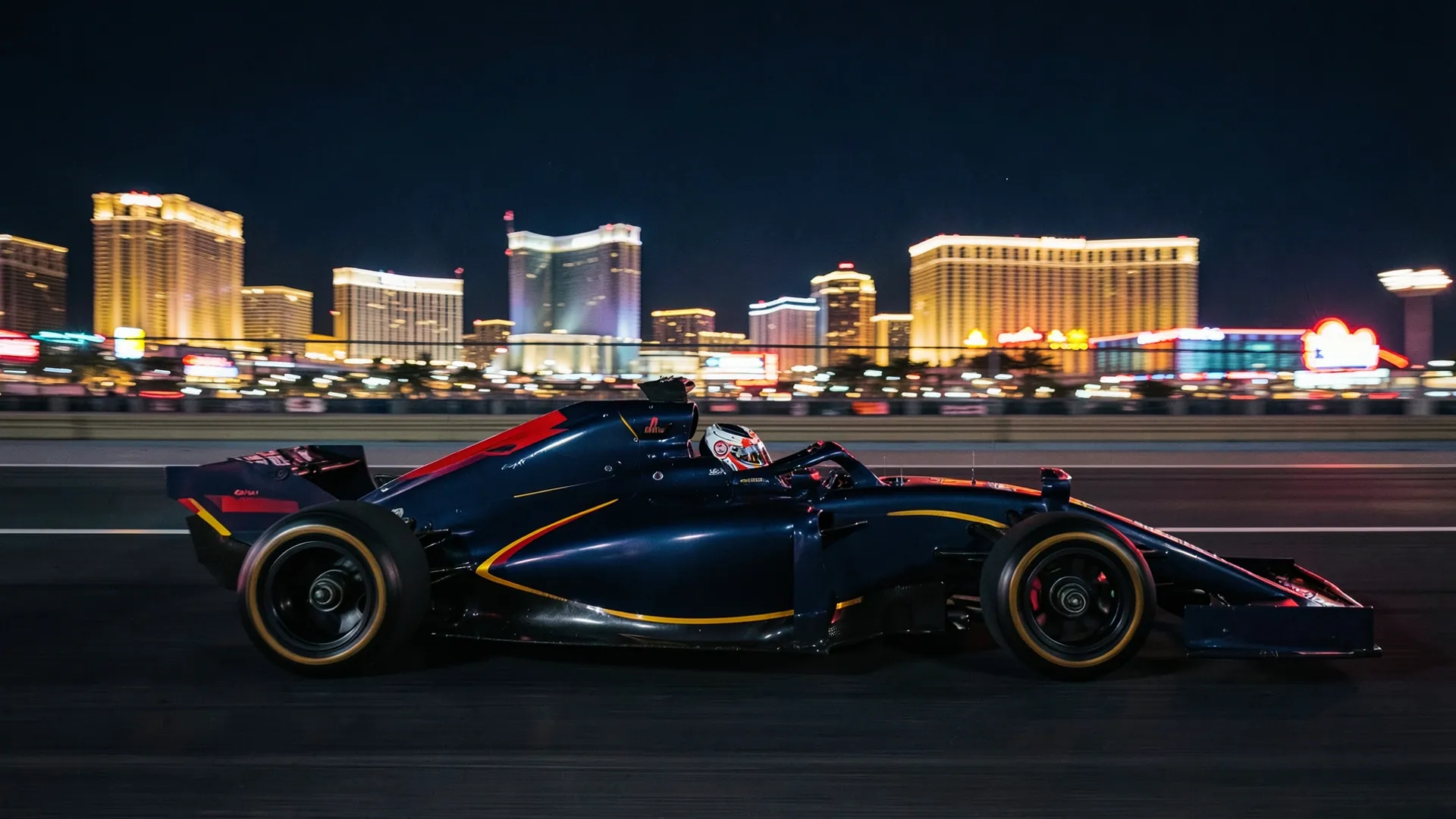
Max Verstappen won the Las Vegas Grand Prix from pole position on 22 November, finishing ahead of Lando Norris and Oscar Piastri on a circuit that should have exposed the Red Bull Ford power unit. Team principal Laurent Mekies said afterwards that Verstappen had “outsmarted” his rivals with a deliberate energy-deployment plan, and published telemetry analysis backs that account. It was the Dutchman’s fourth victory in six races. In a season Mercedes has dominated, it was also among the most cerebral.
Why Las Vegas looked like a Mercedes circuit
Under the 2026 regulations, roughly half of a car’s peak output comes from electrical power. The MGU-H has gone, so nearly all the energy that feeds the battery must be recovered by the MGU-K, mostly under braking. A circuit with frequent heavy stops recharges the battery generously. A circuit built around long, flat-out runs does the opposite: it drains the battery faster than it can be refilled, and cars begin to lose electrical assistance before the end of the straights.
Las Vegas is the clearest example on the calendar. The run along the Strip is one of the longest full-throttle stretches in Formula 1, and much of the rest of the lap is made up of slow, right-angled corners that offer only limited harvesting in return for what the straights consume. Paddock shorthand calls it “energy-poor”. Above all, it rewards the power unit that recovers and deploys energy most efficiently.
On the evidence of this season, that power unit is Mercedes’. The works team has won 12 of 21 rounds, and the result in Las Vegas showed how far the advantage extends to its customers. Seven of the top nine finishers drove Mercedes-powered cars: both McLarens, both Alpines, both works Mercedes and the Williams of Carlos Sainz, who climbed from 20th to eighth.
The other Red Bull Ford cars had a miserable night. Isack Hadjar started fourth and finished 15th, Liam Lawson fell from seventh to 14th, and Arvid Lindblad retired after starting fifth. Not all of those results can be blamed on the engine, but together they show how little the package had in hand. Verstappen was the only Red Bull Ford driver to score.
Spending the battery like a budget
Under these rules, a driver no longer simply has a fixed amount of power to use. He has an energy budget to spend, with real choices about when to spend it. He can lift a fraction earlier into a corner to harvest more, accept a slower exit where it costs little, or hold charge back for a section where the time is worth more. The following car can also use overtake mode, which gives extra electrical deployment to a driver running within a second of the car ahead. That makes defending a lead an energy problem as much as a driving one.
The leader’s dilemma is that he cannot match the attacker’s boost everywhere. If he deploys evenly around the lap, he will be caught short at precisely the point where a rival chooses to strike. Mekies’ description of a deliberate scheme suggests Verstappen solved that problem in advance. He saved energy where giving up time was cheapest and kept it in reserve for the stretches where an attack was most likely. PlanetF1’s reading of the telemetry reaches the same conclusion: whenever a rival closed in, Verstappen had something left to respond with.
According to Motorsport.com, one aspect of the execution surprised even Red Bull. That is revealing. Teams model energy strategies in detail before a race, but a model cannot run the plan in traffic, under pressure, lap after lap, while adjusting to what the cars behind are doing. Verstappen did all of that, having already produced the qualifying pace to start from pole.
There is precedent for this. Alain Prost built a reputation in the fuel-limited turbo era of the 1980s by finishing races with fuel to spare while rivals ran dry. Verstappen’s win at Suzuka in 2025, where he held off two quicker McLarens from pole, rested on the same principle. When a faster car cannot find a moment where you are vulnerable, its extra pace counts for little. Las Vegas has now given Verstappen three wins in four editions, and this was the hardest of them to construct.
The final-lap chase that never came
The pressure was real. Andrea Kimi Antonelli started sixth and worked his way into position to challenge Verstappen on the final lap, which is exactly the scenario overtake mode was designed to create. Then a power issue on his Mercedes ended the chase. By the chequered flag he had dropped to fourth, behind both McLarens.
Because of the fault, the duel never happened, and it would be unfair to Antonelli to assume he would have lost it. He has been the outstanding driver of the season. Still, the context matters. To pass, he would have had to beat a car whose energy had been managed specifically for that kind of attack. On a circuit where every driver was spending and recovering from the same limited supply, Verstappen had already chosen where his reserves would go.
George Russell’s evening added to Mercedes’ frustration. He started on the front row alongside Verstappen and finished ninth. From second and sixth on the grid, the team took 14 points, while McLaren took 33. Mercedes’ constructors’ title was secure long before Las Vegas, so the damage is limited to pride. Even so, the fastest car and the best engine left without the win because their opponents used the same rules more effectively.
What four wins in six say about Red Bull Ford
All four of Verstappen’s wins this season have come in the last six rounds. For a team building its first power unit, in partnership with Ford, that curve says more than any single result. Red Bull spent the first two-thirds of the year adapting to the new rules. It is now beating Mercedes at circuits where Mercedes should win, even if the car does not yet appear to match the Mercedes-powered field on outright performance.
How much of the gain comes from hardware and how much from deployment software is hard to judge from outside. In this formula, though, the two are closely linked. Energy management is one of the few areas where development is limited mainly by imagination, and a team that understands it well can recover a deficit without new parts.
The weakness is just as obvious: Red Bull is relying on one driver. Hadjar sits eighth in the championship on 122 points, 182 behind his team-mate. That gap matters because Red Bull’s third place in the constructors’ championship is now under real threat.
| Constructors’ battle | Points | Gap |
|---|---|---|
| 3. Red Bull | 440 | — |
| 4. McLaren | 431 | 9 behind |
McLaren outscored Red Bull by 33 points to 25 in Las Vegas, with both Norris and Piastri on the podium, and cut the gap to nine points. Piastri’s climb from 17th to third was one of the drives of the night.
Qatar and the fights still open
Antonelli is champion. His 98-point lead over Verstappen cannot be overturned with only 50 points left to play for, and his nine wins have made 2026 his season. The remaining contests are further down the order, and they are close.
Verstappen holds second on 304 points. Lewis Hamilton is 37 behind, and Russell and Norris are tied on 264, 40 behind. Hamilton would need to outscore Verstappen by 38 points across the final two rounds, so it would take a dismal fortnight for Verstappen to lose the position, but it is not yet settled.
Lusail, which hosts Round 22 on 29 November, is a very different test from Las Vegas. Its long sequences of fast, flowing corners reward aerodynamic stability and tyre management more than clever battery strategy, so the Las Vegas advantage may not carry over. That puts the focus on Hadjar. If he brings home a solid haul in Qatar, Red Bull should hold third. If he does not, McLaren’s stronger pairing will probably take it.
Our view is that Las Vegas should worry Mercedes more than the result suggests. Rivals can copy an aerodynamic concept within a season. Red Bull’s command of energy deployment is harder to replicate because it depends on how the team uses the rules rather than on any single part. If Red Bull Ford closes even half of its remaining hardware deficit over the winter, Mercedes will start 2027 facing a genuine rival.