
Las Vegas Grand Prix Preview: Five Drivers Chase Second Behind Champion Antonelli
With Mercedes and Andrea Kimi Antonelli already out of reach, Las Vegas hosts a fight among five drivers covered by 33 points for runner-up, plus a tight Red Bull-McLaren duel for third.
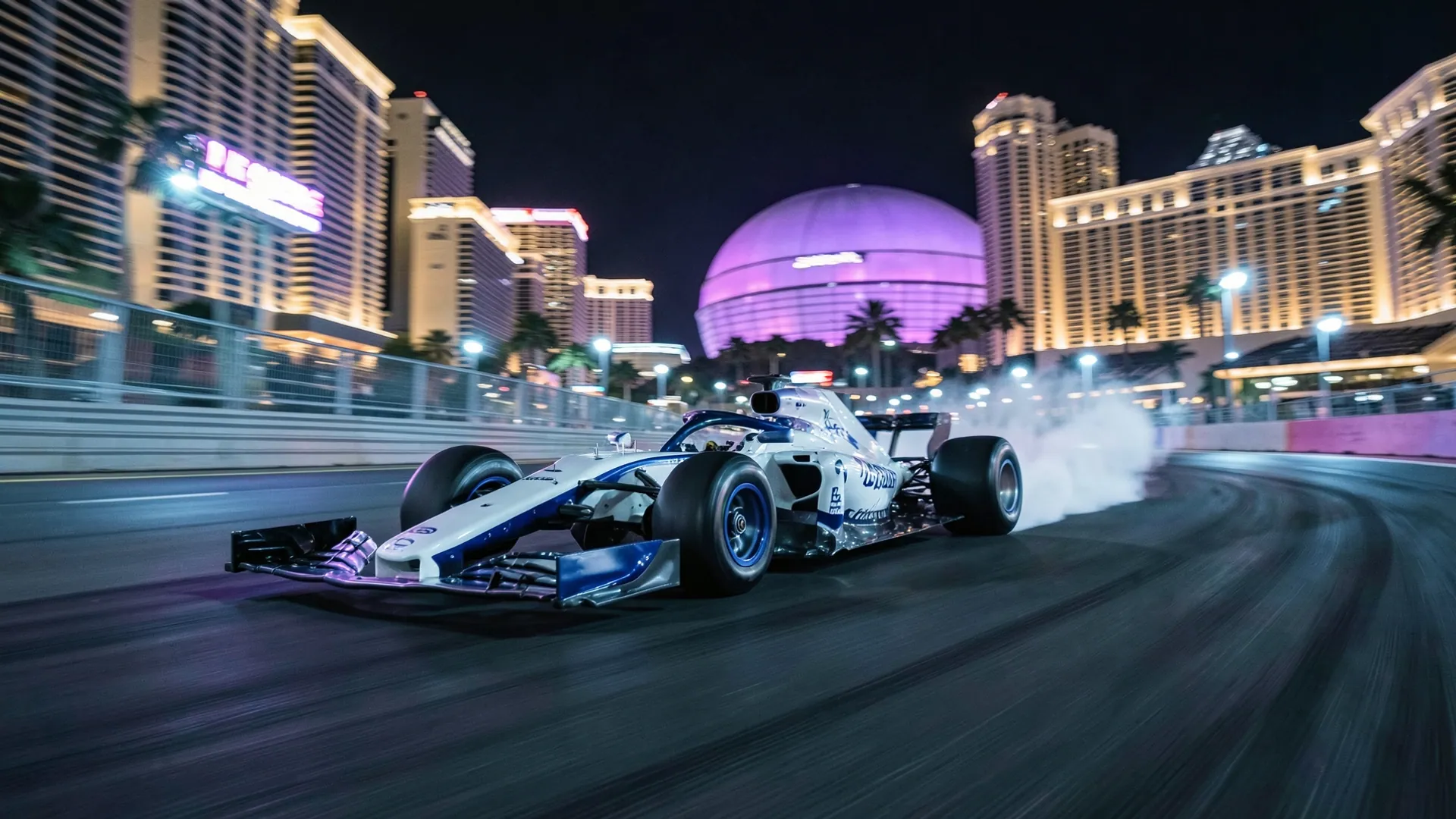
Formula 1 races on the Las Vegas Strip on Sunday 22 November for round 21 of 23, with both 2026 championships already settled in Mercedes’ favour. Andrea Kimi Antonelli leads Max Verstappen by 111 points with 75 left on offer from the final three Grands Prix, so the drivers’ title is his. Mercedes are 142 points clear of Ferrari, beyond the 129 that a perfect run of Ferrari one-twos could claw back. The prizes now are the places behind them, and those fights are closer than the headline numbers suggest.
Mercedes have finished the job, but the order behind them has not settled
Antonelli has 390 points and nine wins from 20 rounds. Mercedes have won 12 of those races, with George Russell taking the other three. That is the clearest measure of how well the team read the new regulations, and it means neither title fight will come down to the season finale.
Brazil showed that the order beneath them is still fluid. Lando Norris converted pole into victory, Verstappen climbed from 21st on the grid to second, and Isack Hadjar finished third for Red Bull. Antonelli started second and dropped to fifth, one place behind Russell. Ferrari scored only six points: Charles Leclerc came eighth from 14th, and Lewis Hamilton was lapped in ninth after starting 20th. On a weekend when Verstappen and Norris both scored heavily, that cost Ferrari’s drivers ground in the race for second.
Long straights, cold asphalt and energy sums
The Las Vegas Strip Street Circuit runs anticlockwise over 6.2 kilometres and 17 corners, and the race is 50 laps. Its signature is the run along Las Vegas Boulevard, close to two kilometres at full throttle, which ends in the heavy stop for the Turn 14 chicane. That braking zone, the tight left at Turn 1 and the stop at Turn 5 after the Koval Lane straight are where most passes happen. The section that loops around the Sphere is fast and flowing but offers little to a driver trying to attack.
Under the old rules this was a low-downforce, top-speed circuit, and teams trimmed their wings hard. The 2026 cars change the sums. Active aerodynamics shed drag on the straights, so teams can carry more wing for the corners without paying as heavy a penalty on the Strip. The larger concern is energy. Roughly half of a 2026 power unit’s output is electrical, and a lap dominated by long flat-out stretches drains the battery faster than the braking zones can refill it. A car that runs short of deployment before the end of the Strip loses speed exactly where it is most exposed. The heavy stops at Turns 14, 5 and 1 are the main chances to recover energy, so how each team splits harvesting and deployment across the lap may decide more positions here than at almost any other venue. The manual overtake mode, which gives a following car extra electrical boost, will count for a lot on straights this long.
The other constant is temperature. The race runs late at night in November, and in the three previous editions the track has been cold and short of grip. Tyres struggle to reach their working window, graining is common, and a driver on a cooled tyre after a safety car restart is vulnerable. Teams that generate tyre temperature easily have tended to do well here. The bumpy, low-grip surface also punishes cars that run too low. In 2025 both McLarens were disqualified for excessive plank wear, so ride height is a risk as well as a source of performance.
History is a weak guide in a year of new cars, but it is not irrelevant. Verstappen won here in 2023 and 2025, and Russell won from pole in 2024.
Five drivers, 33 points and second place
The race for runner-up is the liveliest contest left in the season:
| Pos | Driver | Team | Points | Gap to 2nd |
|---|---|---|---|---|
| 2 | Max Verstappen | Red Bull | 279 | — |
| 3 | George Russell | Mercedes | 262 | 17 |
| 4 | Lewis Hamilton | Ferrari | 261 | 18 |
| 5 | Charles Leclerc | Ferrari | 249 | 30 |
| 6 | Lando Norris | McLaren | 246 | 33 |
Verstappen holds the advantage, and Brazil showed why he is hard to dislodge. Turning 21st on the grid into 18 points is the sort of damage limitation that wins this kind of fight. If Norris won all three remaining races, he would reach 321. Verstappen could stay ahead of him simply by finishing second each time, which would take him to 333. Norris and Leclerc therefore need Verstappen to have at least one poor weekend; beating him on track will not be enough.
Russell is best placed to exploit one. He has a car that has won 12 times this season, and a single victory for him while Verstappen finishes off the podium would almost wipe out a 17-point gap. He also won here two years ago, although in a car built to very different rules. Hamilton, a point behind Russell, needs Ferrari to recover from Brazil quickly. Leclerc and Norris, 30 and 33 points back, need more than one good result. Each would have to outscore Verstappen by 10 or 11 points a weekend, which in practice means winning while he finishes outside the top three.
Red Bull and McLaren meet again in the fight for third
In the constructors’ standings, Ferrari’s second place looks safe but not certain. Red Bull are 95 points behind, and closing that gap would need a margin of nearly 32 points per race, which only a Ferrari collapse would allow.
Third place is a genuine contest. Red Bull have 415 points to McLaren’s 398, a gap of 17. Both teams scored 33 in Brazil, which illustrates how evenly matched they are. Red Bull rely heavily on Verstappen, but Hadjar’s podium was a strong contribution and suggests the second car is now scoring reliably. McLaren’s case depends on Oscar Piastri, who finished sixth in Brazil and is still without a win this season. With Norris winning races, McLaren need their second driver to finish close behind him, and a minor points finish will not do.
Further back, the money at stake in the lower positions keeps several fights alive. Haas lead Audi by three points, 31 to 28, for seventh. Williams have 12 points to Aston Martin’s seven. Cadillac are still waiting for their first point. RB F1 Team, fifth on 114, are 45 clear of Alpine and should hold that place.
Who needs Las Vegas most
Ferrari. Six points in Brazil was a poor return in a close fight, and both drivers started outside the top 10. Hamilton and Leclerc each have a realistic chance of finishing second in the championship. Ferrari’s history here is respectable, but this weekend is about whether the team can extract a clean qualifying session from a car it has struggled to optimise on recent weekends.
Oscar Piastri. He is seventh on 152 points, 30 ahead of Hadjar, and that gap is not large if Red Bull’s form continues. Ending the season without a win would leave an uncomfortable impression after the expectations of recent years. A circuit that rewards precise braking and patience on cold tyres should give him an opportunity.
Isack Hadjar. A podium in Brazil from fifth on the grid is the strongest argument yet for Red Bull’s decision to promote him. Another result like that would help in the constructors’ fight and keep pressure on Piastri.
Andrea Kimi Antonelli. The title is secure, but finishing fifth from the front row in Brazil made for a quiet weekend. Champions who back off late in a season often find the narrative turns against them the following year. A strong performance here would settle that argument early.
The midfield. Liam Lawson qualified third in Brazil and finished seventh, while Nico Hülkenberg turned fourth on the grid into a single point for Audi. Oliver Bearman dropped from sixth to 17th. Strong qualifying positions have not always produced matching race results, and on a long lap where energy deployment varies, battery management could separate the points finishers from the rest.
What to watch under the lights
- Energy at the end of the Strip. Watch for cars losing speed late on the long straight. Any team that has to slow down to recover energy will be easy to pass into Turn 14.
- Tyre warm-up after restarts. Cold conditions make the first lap after a safety car dangerous for anyone whose tyres cool quickly. Championship positions could change at these moments.
- Ride height and plank wear. After last year’s McLaren disqualifications, every team will treat the floor set-up conservatively. Anyone who runs too low risks losing a result after the race.
- Verstappen’s grid slot. He showed in Brazil that a poor qualifying position does not end his weekend, but a clean start from the front would make his rivals’ task much harder.
- Haas against Audi. Three points separate them for seventh, and a single top-10 finish could decide it.
The likeliest outcome is that Verstappen extends his lead over the rest of the field behind Antonelli: he has won here twice and has repeatedly scored heavily on difficult weekends. The more open question is Ferrari. If Hamilton and Leclerc leave Las Vegas still within a single good weekend of Verstappen, Qatar and Abu Dhabi will settle second place. If they repeat Brazil, Russell will be the only realistic challenger.