
Penalties Put Hamilton and Verstappen 20th and 21st for Brazilian Grand Prix
Power-unit penalties leave Hamilton 20th and Verstappen 21st in Brazil, two points apart in the fight for second, at a circuit where both have won from deep on the grid.
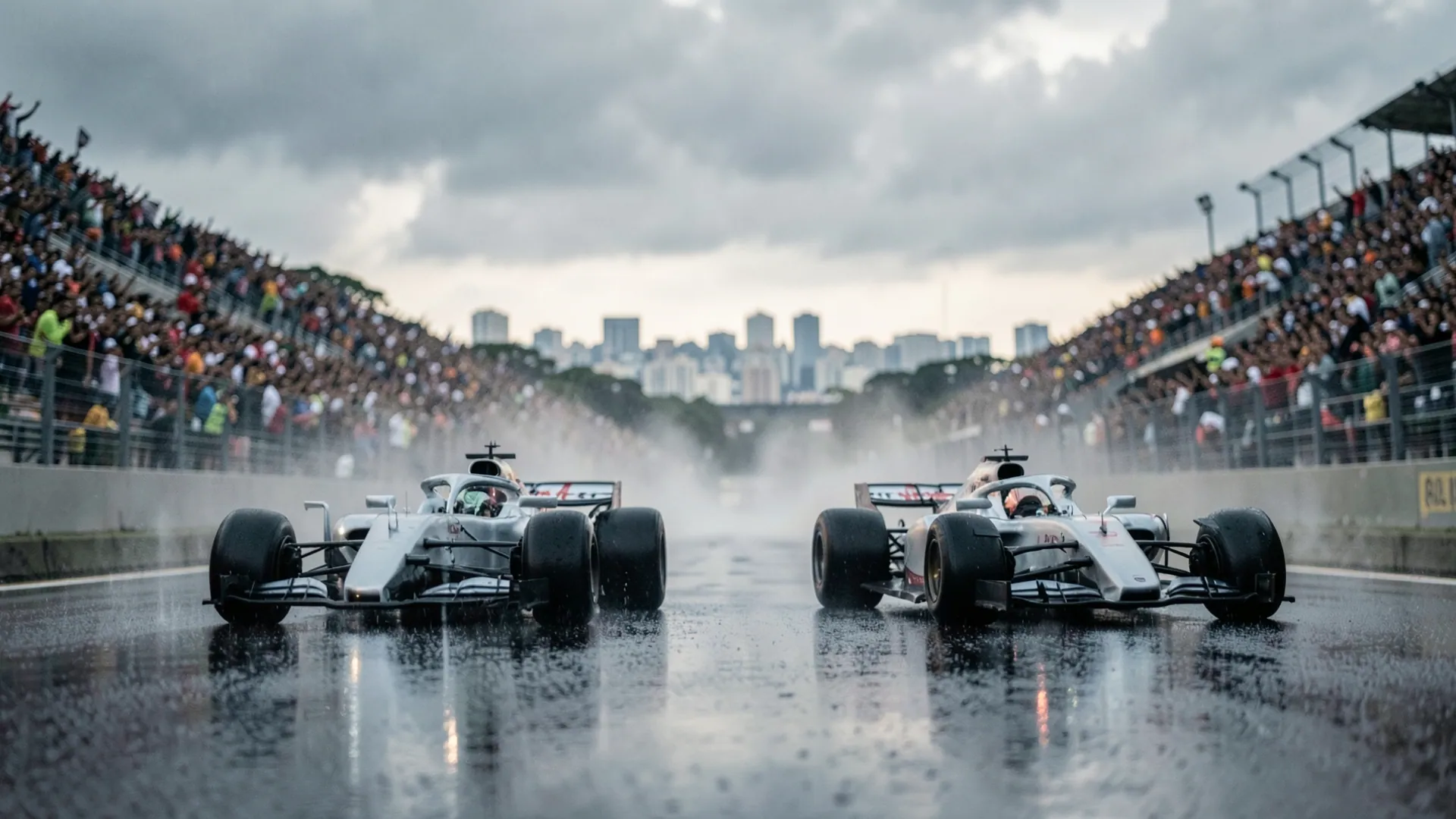
Lewis Hamilton and Max Verstappen will start today’s Brazilian Grand Prix from 20th and 21st on the grid after power-unit penalties pushed both towards the back at Interlagos. They arrive in São Paulo separated by two points in the fight for second in the drivers’ championship, with George Russell and Charles Leclerc close enough behind to profit from any stumble. Winning from the 10th and 11th rows is a huge ask. But this is the one circuit on the calendar where both men have done something very like it before.
A grid rewritten by the penalty sheet
The grid as qualified bears little resemblance to the grid that will form up this afternoon. Hamilton and Verstappen took the heaviest sanctions, but RacingNews365 reports that two further drivers have also been handed grid penalties. That leaves the midfield order unusually scrambled for a weekend this late in the season.
The timing is no accident. With four rounds left, teams are weighing whether their remaining power-unit allocations will last to Abu Dhabi. When a fresh element becomes unavoidable, the question is where to take the hit, and Interlagos is the obvious answer. The lap is short, the run from Junção up the hill and through the final kinks into Turn 1 is long, and a car with a pace advantage can pass on track rather than relying on strategy. Las Vegas, Qatar and Abu Dhabi follow, and none of them offers quite the same blend of overtaking opportunity and chaos.
Red Bull made exactly this calculation here in 2024, and it produced one of the drives of Verstappen’s career. Ferrari will hope the same logic serves Hamilton. In the short term, though, both teams have accepted a significant cost. Points that might have been banked from the front now have to be won back one car at a time.
Hamilton in 2021, Verstappen in 2024
Interlagos has form for this. In 2021 Hamilton was disqualified from qualifying because of a rear-wing irregularity. He started the sprint from the back and climbed to fifth, then took a five-place engine penalty that put him 10th for the Grand Prix. He won it, passing Verstappen late on in a race that turned that title fight. It remains the clearest modern example of a driver making a grid penalty irrelevant through sheer pace.
Verstappen’s 2024 victory was even more extreme. He qualified 12th in a rain-hit session, dropped to 17th with a five-place penalty, and won comfortably in the wet as rivals spun, misjudged the conditions or were caught out by the timing of the red flag. A year later he started from the pit lane after Red Bull changed his car’s set-up, and still finished third behind Lando Norris and Andrea Kimi Antonelli. Go back further and his 2016 drive is still talked about: a late tyre gamble dropped him to 16th in torrential rain, and he recovered to the podium in the closing laps.
The pattern has two parts. A fast car in the hands of an elite driver can carve through this field quickly, because the midfield is often compressed and the track offers more than one passing place. And the São Paulo weather frequently does the rest. A storm is threatening today’s race. Rain at Interlagos tends to arrive quickly and unevenly, bringing safety cars, red flags and strategic coin tosses, all of which help the cars at the back more than those at the front.
What a win from 20th actually requires
History makes the comeback plausible. The 2026 competitive picture makes it difficult.
Mercedes have won 12 of the 19 Grands Prix so far, nine of them through Antonelli. A recovery to the podium is one challenge; beating a Mercedes that starts at or near the front and runs in clean air is another altogether. In Mexico last Sunday Verstappen won from fifth and Hamilton finished second from pole, so both cars have the pace to contend on the right day. But starting fifth and starting 21st are very different propositions. Every lap spent behind slower cars burns tyre life and costs time.
The 2026 regulations cut both ways. The new cars’ electrical deployment, including the overtake mode that replaced DRS, gives a chasing driver a boost that can make passing easier on a track with a long, flat-out approach to Turn 1. The same rules punish a driver who drains the battery too aggressively in traffic and is then left defenceless or short of energy on the next straight. Managing that over the first 20 laps, while picking off the midfield, will matter as much as raw pace.
For a dry-race victory, three things probably have to go right:
- A quick first stint. Reaching the top 10 within the opening 15 laps keeps the leaders within reach for the first round of stops.
- A well-timed neutralisation. A safety car or virtual safety car that arrives just as the leaders pit, or that allows a cheap stop, can wipe out half a minute at a stroke.
- Tyre life in reserve. Overtaking burns tyres, and a driver who arrives at the front with nothing left will not hold off a Mercedes on fresher rubber.
In the wet, the equation changes. Grip becomes the great leveller, driver skill and judgement count for more, and the race tends to be decided by whoever makes the right call at the right moment. Verstappen in particular has shown, here more than anywhere, that he can turn a wet Interlagos into a personal showcase. If the storm arrives, he becomes a genuine contender rather than a long shot.
Realistically, a dry race should give both men a chance of a podium and a points haul that limits the damage. Victory needs help.
Second place, two points and two team-mates
The prize that may matter more than the race win is the runner-up spot. Antonelli has 380 points and nine wins, a 119-point lead with four rounds to run, and the title is all but his. Behind him, the battle for second is the tightest fight in the championship:
| Position | Driver | Team | Points | Gap to 2nd |
|---|---|---|---|---|
| 2 | Max Verstappen | Red Bull | 261 | – |
| 3 | Lewis Hamilton | Ferrari | 259 | 2 |
| 4 | George Russell | Mercedes | 250 | 11 |
| 5 | Charles Leclerc | Ferrari | 245 | 16 |
The penalties shift the balance towards Russell and Leclerc, who carry no such handicap. A Mercedes podium could put Russell ahead of both. Leclerc starts well ahead of his penalised team-mate, which gives him a clear chance to close the 16-point gap to second.
There is an intra-team edge too. Hamilton out-scored Leclerc by six points in Mexico, and the two Ferrari drivers are only 14 points apart. A strong afternoon for Leclerc could reverse the internal hierarchy at Maranello for the final three rounds. With Ferrari 126 points behind Mercedes in the constructors’ standings, the team has little to gain collectively from managing its drivers, which leaves both free to race for themselves.
Isack Hadjar’s role at Red Bull also deserves attention. Ninth in Mexico and eighth in the standings on 107 points, he is not in the fight for second himself. His result could still decide whether Red Bull, on 382 points, hold third in the constructors’ championship from McLaren, 17 points behind on 365.
The arithmetic beyond today favours whoever took the penalty. Hamilton and Verstappen should now be covered for Las Vegas, Qatar and Abu Dhabi, while Russell and Leclerc may yet face similar decisions at circuits where recovery is harder. If Ferrari and Red Bull have timed this well, the cost of starting 20th or 21st could be repaid with interest over the final three rounds.
Why Verstappen has the better shot
Of the two, Verstappen has the better chance of winning today, especially if the storm materialises. He has won here in conditions that broke everyone else, and Red Bull’s recent pace, on the evidence of Mexico, gives him the tool to do it again. Hamilton’s 2021 drive shows he is capable of the same, but this Ferrari has won only twice all season, and only once in his hands.
In a dry race, expect both to reach the top six and neither to win. Second in the championship would then come down to three rounds in which fresh power units give them an edge, provided they lose no more than a handful of points to Russell and Leclerc this afternoon.
If the rain arrives, the forecast changes: Verstappen becomes the likeliest winner from the back row, and he could leave Brazil with a firm grip on second place in the championship.