
Ferrari's Mexico Opportunity Meets a Limitation Leclerc Cannot Fix in Time
George Russell expects altitude to favour Ferrari in Mexico City, but with Charles Leclerc conceding a persistent weakness, the weekend could reshape a battle for second where nine points separate four drivers.
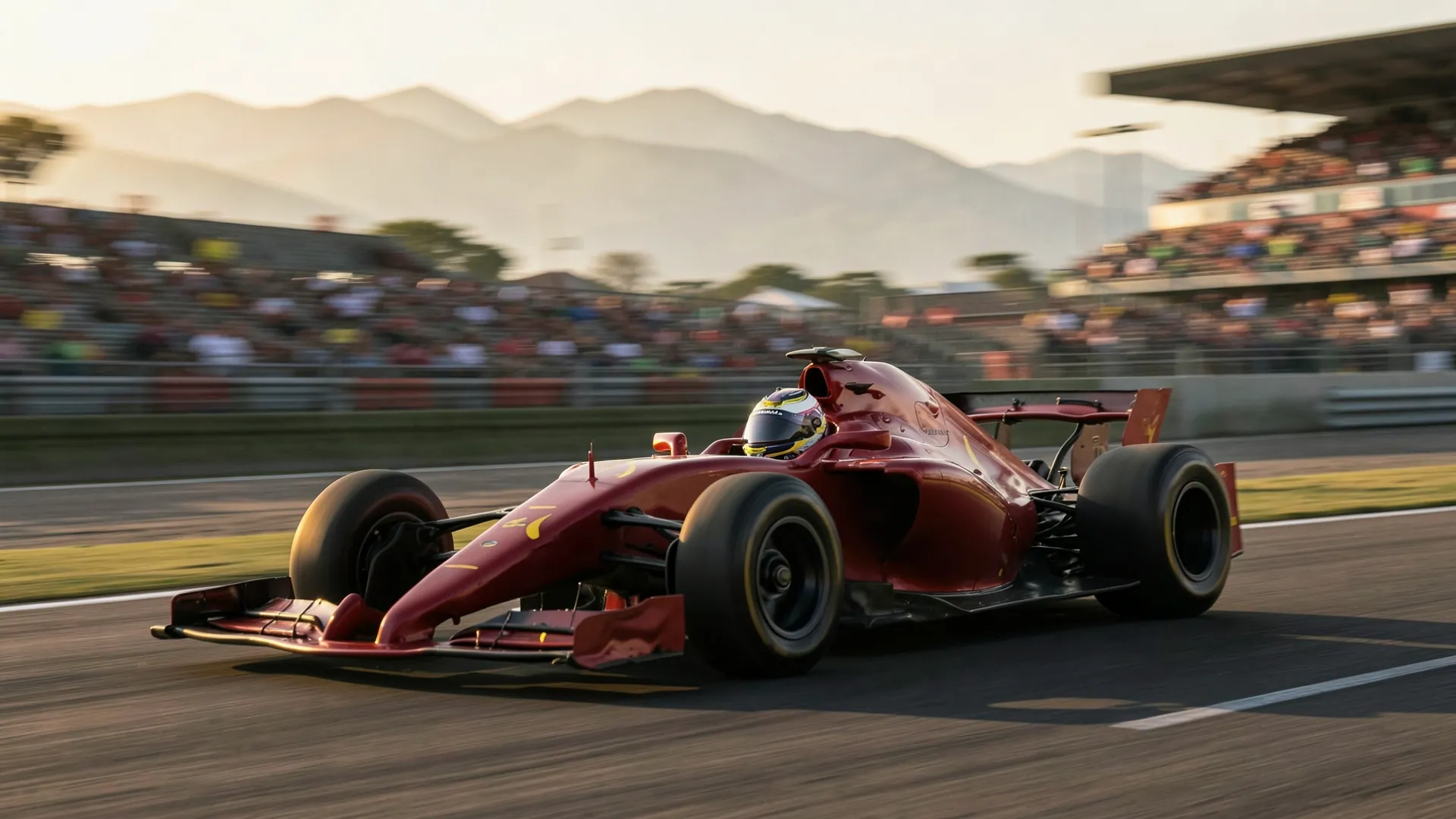
George Russell has tipped Ferrari to enjoy an altitude-related advantage at this weekend’s Mexico City Grand Prix. Charles Leclerc, meanwhile, has admitted that the limitation holding the team back has no obvious short-term fix. Both claims matter because Ferrari arrive at Round 19 with two drivers inside a nine-point window for second place in the championship, and Mexico is the kind of circuit that can reorder a tight fight in a single afternoon.
Nine points, four drivers, one runner-up spot
Andrea Kimi Antonelli has the title in hand. His victory from pole in Austin was his ninth of the season and took him to 365 points. With five Grands Prix left, his 123-point lead over Russell is worth almost five wins. Barring a collapse of historic proportions, the Mercedes driver will be champion, and the question of who finishes behind him has become the most competitive storyline left in 2026.
| Pos | Driver | Team | Points | Gap to 2nd |
|---|---|---|---|---|
| 2 | George Russell | Mercedes | 242 | – |
| 3 | Lewis Hamilton | Ferrari | 241 | 1 |
| 4 | Max Verstappen | Red Bull | 236 | 6 |
| 5 | Charles Leclerc | Ferrari | 233 | 9 |
| 6 | Lando Norris | McLaren | 211 | 31 |
Austin compressed this group further. Leclerc climbed from fourth on the grid to second, Lewis Hamilton came home fourth from fifth, and Max Verstappen took third. Russell, by contrast, slipped from sixth to eighth and scored only four points. That was a poor return for a driver in a car that had just won the race. Ferrari outscored Mercedes by 30 points to 29 on a weekend when Mercedes won, which says as much about the state of Russell’s season as it does about Ferrari’s pace.
Russell’s three wins this year are the most of anyone in this group, yet a run of thin weekends has left him only one point clear of Hamilton. Seen that way, his comments about Ferrari read as an honest assessment and a handy piece of positioning. Naming Ferrari as favourites shifts the expectation onto the team whose drivers are chasing him.
Why thin air could suit Ferrari
The Autódromo Hermanos Rodríguez sits roughly 2,240 metres above sea level, where the air is around a fifth less dense than at most venues. That one fact distorts almost every engineering trade-off a team makes.
Less dense air produces less downforce for a given wing angle, so teams bolt on their highest-downforce configurations and still end up with grip levels closer to those of a low-downforce circuit. It also produces less drag, which is why top speeds on the long run to Turn 1 are among the highest of the year. Cooling becomes harder too, because thinner air carries away less heat from radiators, brakes and electrical components, and teams often have to open up bodywork at the cost of aerodynamic efficiency.
The 2026 regulations add another layer. The combustion engine relies on its turbocharger to compensate for the thin air and works harder to do so, while the electrical side of the hybrid system, which now supplies a much larger share of total output, is unaffected by air density. A car whose package copes well with heat rejection, and whose energy management holds up over a long straight, has a genuine opening here.
Russell did not need to spell out his reasoning for the logic to be clear. Mexico dilutes the importance of raw aerodynamic load and rewards cars that are stable on low grip, efficient through the stadium section and robust on cooling. If Ferrari’s weakness lies in an area that altitude neutralises, the team could find itself closer to Mercedes than at any point this autumn.
History offers some encouragement, though the 2026 rule reset limits its value. Carlos Sainz won here for Ferrari from pole in 2024, with Leclerc third, and Leclerc finished second behind Lando Norris last year. Red Bull’s record is stronger still: Verstappen won five times in Mexico between 2017 and 2023, and he arrives only six points off second place.
The weakness Leclerc cannot wish away
Leclerc’s candour is the counterweight to Russell’s optimism. He has acknowledged that the limitation which has repeatedly cost Ferrari is still present, and that he is unsure it can be addressed in the short term. With five races left, the short term is all that remains of this season.
There are sound structural reasons for his caution. Every team is operating under a cost cap, and by late October most of the aerodynamic development budget for 2026 has either been spent or redirected to next year’s car. The sliding scale for wind-tunnel and simulation time also works against the teams at the front: as second in the constructors’ standings, Ferrari receive less testing allocation than those below them. Fundamental characteristics of a car, such as how its floor behaves or how it manages tyre temperatures over a stint, tend to be set early in a design cycle and are rarely transformed by an upgrade in the final quarter of a season.
So Ferrari’s approach in Mexico will be about working around the problem rather than solving it, through set-up compromises, tyre preparation and race strategy. The risk is that a circuit which flatters Ferrari in one respect exposes them in another. Thin air already makes tyres prone to sliding and overheating, and any car that struggles to keep its rubber in the right window will find the long, low-grip stints of a Mexico race unforgiving.
Hamilton has predicted an unusual experience for the drivers this weekend and has made clear he wants to be fighting at the front. That ambition is reasonable given his Austin result. But Ferrari’s record this year shows how far encouraging form is from winning: two victories from 18 rounds, one apiece for Hamilton and Leclerc, against Mercedes’ 12.
Two Ferrari drivers, one prize
Ferrari’s position in the constructors’ championship is secure. Their 474 points leave them 119 clear of Red Bull and McLaren, who are tied on 355, and 133 adrift of Mercedes. With nothing realistic to gain or lose in that table, the drivers’ standings become the team’s main sporting objective for the run-in.
That creates a familiar dilemma. Hamilton is eight points ahead of Leclerc and one behind Russell. A Ferrari driver finishing as runner-up would be the team’s best championship result since Leclerc’s second place in 2022, and for Hamilton it would be a meaningful marker in his second season with the Scuderia. Yet if Ferrari’s two drivers take points from each other while Russell or Verstappen strings together a couple of clean weekends, both could end the year outside the top two.
It is too early for team orders, and Ferrari would be right to resist them while the gaps remain this small. A misjudged call in Mexico could easily backfire if the order flips a week later. The more useful step is ensuring that strategy does not compromise one car to protect the other on a circuit where track position is valuable and the run to Turn 1 rewards a strong getaway.
Why Sunday is a race Ferrari must convert
Russell is probably right that Mexico suits Ferrari better than most of the remaining venues, and Leclerc is almost certainly right that the team’s underlying weakness will not disappear before the season ends. Ferrari are not going to become a different car over the next five weekends. What they have is a circuit where their weak points may matter less than usual.
That makes Sunday a race Ferrari must convert rather than merely contest. If Hamilton or Leclerc leaves Mexico City ahead of Russell in the standings, the momentum shifts towards a team that looked the closest challenger to Antonelli in Austin. If Ferrari come away with another podium but no lead, the four-way fight for second will likely be settled by whichever of Russell, Verstappen and the Ferrari pair makes the fewest mistakes. On this season’s evidence, that is not a contest Ferrari should expect to win by default.