
Piastri's Las Vegas Radio Outburst Exposes McLaren's Unresolved Team-Order Tension
Oscar Piastri's profane demand that McLaren stop urging caution while he fought Lando Norris in Las Vegas reopens a question the team has never settled: when its drivers are free to race.
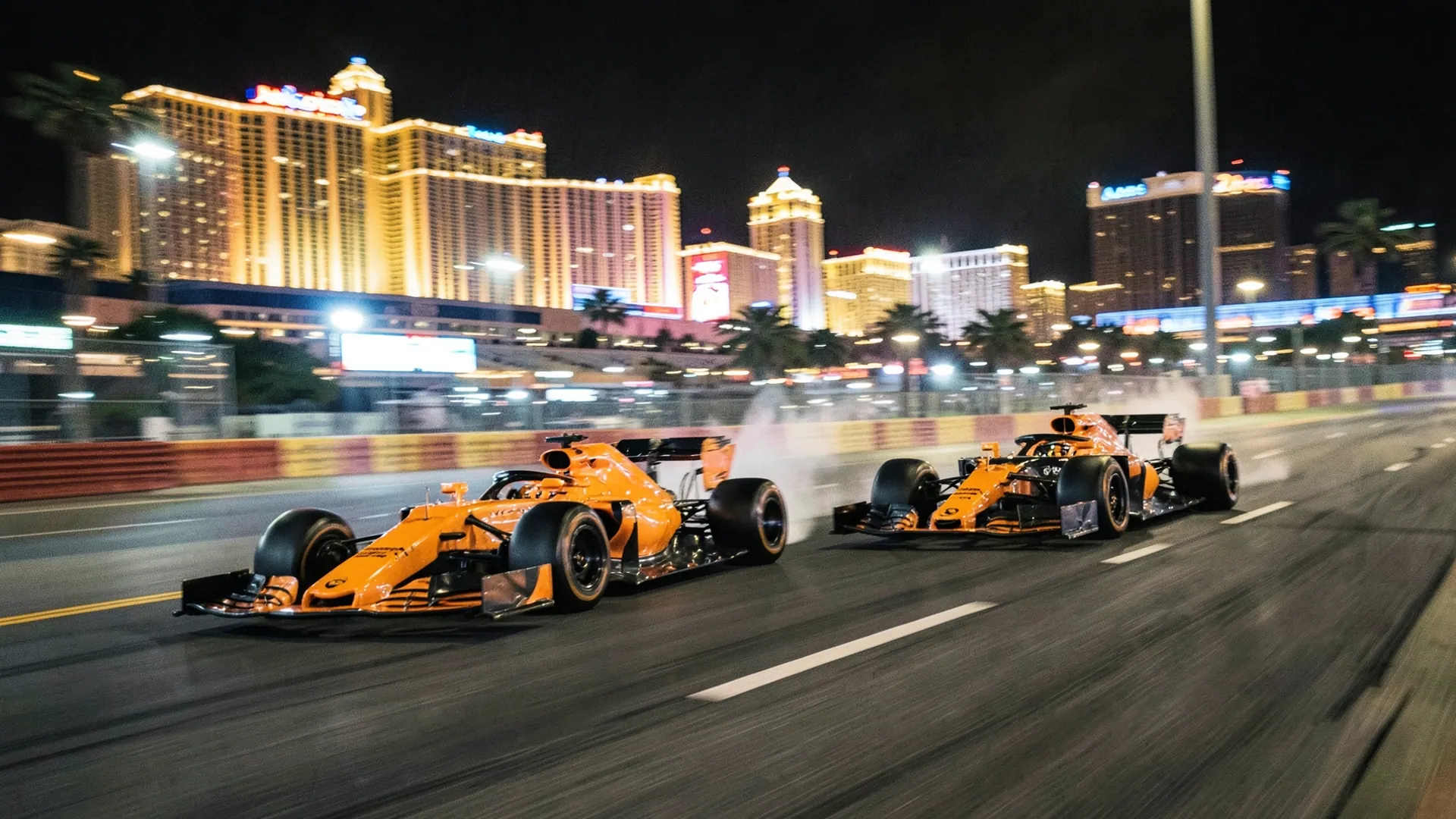
Oscar Piastri told McLaren to “stop telling me to be careful”, with an expletive in the middle, as he fought team-mate Lando Norris during Sunday’s Las Vegas Grand Prix. He had started 17th and finished third, one place behind Norris, in a race Max Verstappen won from pole. McLaren has since responded publicly to the message, PlanetF1 reported. The exchange will probably fade quickly, but the tension it exposed is older than this weekend.
From 17th to the podium, with a voice in his ear
Measured on the stopwatch and in the classification, this was one of Piastri’s best drives of a difficult season. Climbing 14 places on a street circuit, where track position is hard to win back, takes pace and patience. By the time he caught the car in the other papaya livery, the one he had been chasing all along, he had already done the hard part.
That context matters when reading the radio call. A driver who has spent an hour taking risks to pass midfield cars is suddenly told to manage risk at the one moment it might pay off most. The frustration in his voice was less about Norris than about the instruction. Piastri was not asking for a position to be handed to him. He was asking to be left alone to try.
Norris held second. The team left Nevada with 33 points, a double podium and two intact cars. On the narrow measure of outcome, the caution worked. The question is what it costs over time.
A 17-point gap to Red Bull: why McLaren wanted calm
McLaren’s nervousness has a clear commercial and sporting logic. The constructors’ championship pays out on finishing position, and the fight for third is close:
| Position | Team | Points |
|---|---|---|
| 2 | Ferrari | 517 |
| 3 | Red Bull | 440 |
| 4 | McLaren | 431 |
Before Las Vegas, McLaren trailed Red Bull by 17 points. Verstappen’s win brought Red Bull 25, but Isack Hadjar fell from fourth on the grid to 15th and scored nothing. McLaren’s haul of 33 cut the deficit to nine. Had Piastri and Norris touched, that eight-point gain could easily have become a loss of 20 points or more. With two rounds remaining, Qatar on 29 November and the season finale after it, there is little room to recover from a self-inflicted zero.
There is a drivers’ championship angle too. Norris sits on 264 points, level with George Russell and three behind Lewis Hamilton in third. The title itself is effectively settled: Andrea Kimi Antonelli’s 98-point lead over Verstappen is out of reach with only two Grands Prix left. Third place is still open, though, and Norris is the McLaren driver in contention for it. Piastri, seventh on 167 points and 97 behind his team-mate, is not.
None of this needed saying on the radio, but it is the arithmetic every pit wall in the paddock would have been running. Seen that way, “be careful” was a reasonable request. Repeating it to a driver mid-fight was the error.
The long shadow of 2025
This exchange touched a nerve because McLaren has been here before, repeatedly, and has never quite resolved the issue.
In Hungary in 2024 the team asked Norris to give the lead back to Piastri after the pit sequence had swapped them, and he did so only after a prolonged and public delay. Last year the “papaya rules” philosophy, which promised equal treatment and freedom to race within limits, was tested again and again. At Monza a slow pit stop dropped Norris behind Piastri, and the team asked Piastri to let him back through. He complied, but the decision divided opinion because it rewarded one driver for a team failure. In Singapore, lap-one contact between them left Piastri complaining over the radio that his team-mate had avoided another car by moving into him. No swap followed, and the inconsistency was obvious.
That season ended with Norris world champion by two points from Verstappen, and Piastri third after leading the standings for much of the summer. McLaren could argue that its approach had worked: it had won the title without imposing a number-one driver. The more uncomfortable reading is that its rules were never fully defined. Instead, they were adjusted race by race to suit the circumstances, and both drivers spent the year unsure exactly where the lines were.
Formula 1 history offers better and worse examples of how to manage this. Mercedes ran Hamilton and Nico Rosberg under explicit rules of engagement from 2014 to 2016, and when those rules broke down, notably in Spain in 2016, the team dealt with it openly and moved on. Red Bull’s “Multi 21” order in Malaysia in 2013, which Sebastian Vettel ignored to pass Mark Webber, showed what happens when instructions exist but carry no authority. McLaren’s own history with Ayrton Senna and Alain Prost is the extreme case of two drivers left to settle matters themselves. The common thread is that clarity, even when one driver dislikes it, ages better than ambiguity.
Piastri’s frustration runs deeper than one radio call
It would be easy to dismiss the outburst as heat-of-the-moment profanity of the sort F1 radio produces every weekend. That would miss the point. Piastri’s season has given him plenty to be frustrated about. He has no wins in 2026, while Norris has three, and he has been outscored by nearly a hundred points. Las Vegas was a rare race in which he had the faster car in the closing phase and a genuine chance to beat his team-mate on merit.
That is exactly when a driver most needs to feel the team trusts him. Piastri’s reputation, built since he joined McLaren, is for precise, low-drama racing. He has no record of collisions with his team-mate. Being told repeatedly to take care, at the moment he was best placed to make a move, can easily read as doubt about his judgement rather than a general reminder of what was at stake.
There is a fair counter-argument. Teams speak to both drivers in these situations, and a reminder about the stakes is not an order to hold position. McLaren’s engineers are paid to protect the team’s result, and in a tight fight with Red Bull they were right to keep the bigger picture in mind. But the way an instruction is delivered matters as much as what it says. One clear message before the cars converge, setting out what is and isn’t acceptable, is management. A stream of reminders during the fight itself is interference, and drivers of Piastri’s calibre feel the difference.
What McLaren has to settle before 2027
The immediate priority is obvious. Qatar and the finale will decide whether McLaren finishes third or fourth in the constructors’ standings, and the team will want both drivers scoring heavily and cleanly. Expect the same caution to apply, and expect it to be justified.
The longer-term question matters more. McLaren now has two seasons of evidence that its equal-status philosophy works best when the car is dominant and the prize is a championship, and frays when the team is fighting for third and one driver is clearly behind. It needs a framework that holds in both situations: written down, agreed before the cars leave the garage and applied consistently, so that a driver battling his team-mate already knows the boundaries and does not need reminding over the radio.
Piastri’s comment in Las Vegas was a warning delivered at full volume. A driver who has spent a winless year being outscored by his team-mate, and who then feels restrained on the one night he could fight back, will eventually begin to ask whether McLaren is the right place to rebuild his title hopes. The team should answer that question with a clear set of rules this winter. If it doesn’t, he may start looking for the answer elsewhere.