
McLaren Warned Over Team-Mate Clash as Red Bull Closes to Seven Points
Zak Brown has told Lando Norris and Oscar Piastri not to collide again with Red Bull seven points behind, while Rwanda moves to return F1 to Africa and Max Verstappen gains a new engineer.
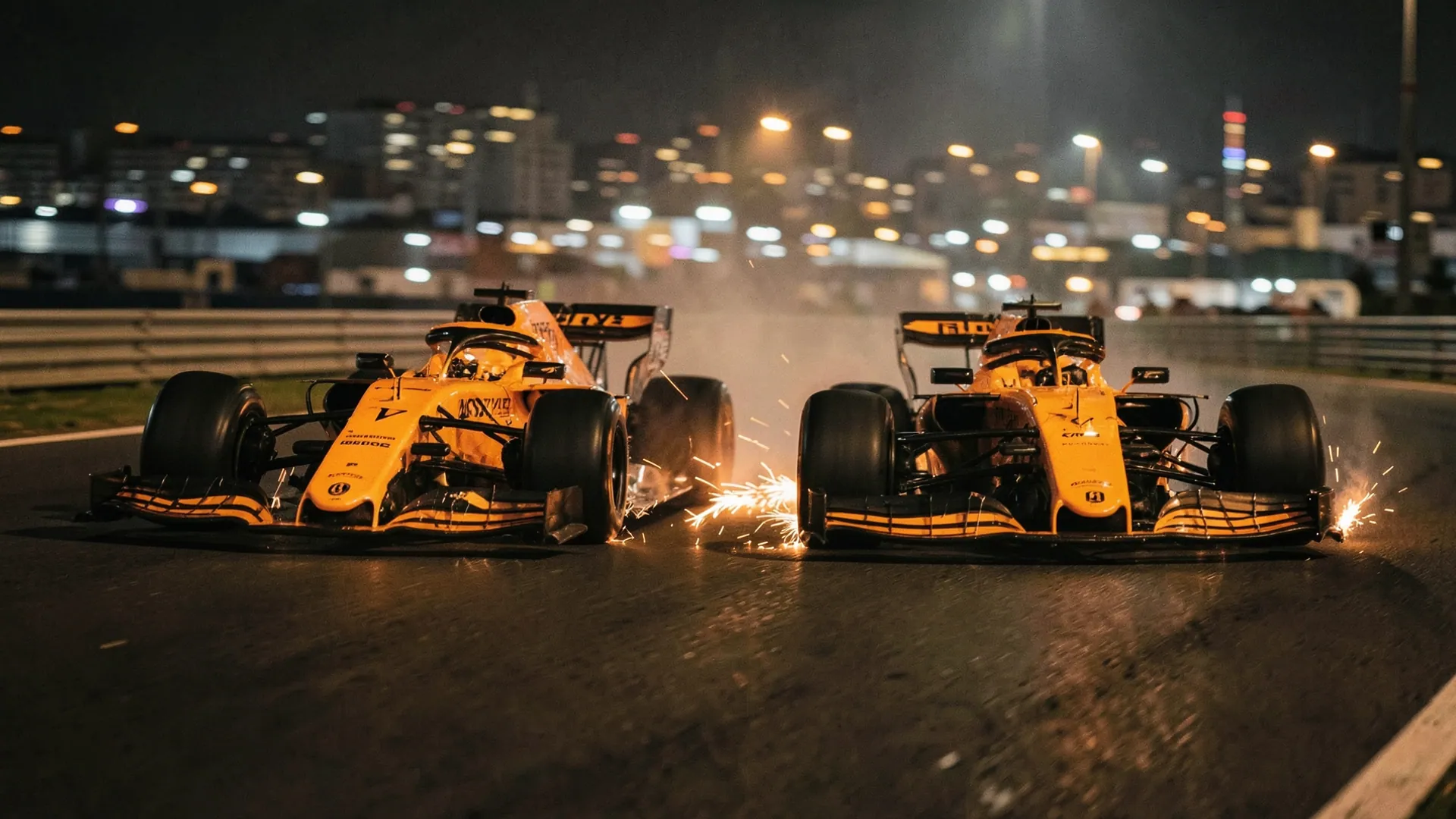
Zak Brown has told Lando Norris and Oscar Piastri there can be no repeat of their contact at Sunday’s Singapore Grand Prix, with Red Bull now seven points behind McLaren in the fight for third in the constructors’ championship. The warning comes as Andrea Stella concedes that the car’s handling cannot be properly fixed until 2027. Elsewhere, Rwanda is set to bring Formula 1 back to Africa for the first time since 1993, and Max Verstappen will arrive in Austin with a new race engineer.
Seven points, two drivers and one instruction
The arithmetic explains Brown’s tone. McLaren left Marina Bay on 339 points to Red Bull’s 332. Verstappen’s win from pole and Isack Hadjar’s recovery from 22nd on the grid to 10th earned Red Bull 26 points. Norris in fourth and Piastri in fifth brought McLaren 22. An 11-point cushion became seven in a single evening. With six rounds left, one bad weekend would wipe out the rest of it.
According to Crash.net, Brown’s message to both drivers was simple: collisions between team-mates cannot happen. The contact in Singapore did not prove disastrous, since both cars still finished in the points. It did show how thin the margin has become. A team fighting a rival that wins races cannot afford to lose points to itself.
There is precedent here, and McLaren knows it better than most. Its policy of letting its drivers race was tested hard in 2025, most memorably when Norris ran into the back of Piastri in Montreal. Further back, the Senna-Prost years remain the sport’s standard example of what happens when two drivers in the same garage stop trusting each other. The situation in 2026 is less charged, because neither McLaren driver is fighting for the title. That makes the instruction easier to give and harder to justify ignoring. Third place in the constructors’ table is worth millions in prize money, and neither driver is racing for a personal prize big enough to outweigh that.
Stella’s 2027 admission
The more revealing story came from Stella. Speaking to Motorsport.com, the team principal conceded that McLaren cannot improve the car’s handling characteristics without fundamental changes, and that those changes will not be possible until next year.
That is a candid admission, and a logical one. A car’s basic handling traits come from decisions made early in the design cycle: weight distribution, suspension layout, and how the aerodynamic platform behaves as the car pitches and rolls. Changing any of that mid-season means new parts across the car, which is very hard to justify under the cost cap with resources already committed to 2027. McLaren will instead tune around the problem with set-up work and smaller upgrades until Abu Dhabi.
That raises the stakes on Brown’s order. If the car has a ceiling for the rest of the year, McLaren cannot expect to out-develop Red Bull. It has to beat Red Bull on execution, and lost points between team-mates are the most avoidable failure of all. The standings also suggest the car’s traits suit one driver more than the other. Norris has 201 points and two wins, while Piastri is winless on 138. A 63-point gap between team-mates in the same car points to more than bad luck.
Rwanda and the road back to Africa
Formula 1 is preparing to return to Africa, with Rwanda set to join the calendar. Africa has been the obvious gap on the sport’s map for more than three decades. The last world championship race on the continent was the 1993 South African Grand Prix at Kyalami, won by Alain Prost on his way to a fourth title.
Before that, Africa’s history in F1 was rich but scattered. Morocco hosted a championship race in 1958, when Mike Hawthorn’s second place behind Stirling Moss at Ain-Diab secured the title by a single point. South Africa staged grands prix at East London and Kyalami across several decades. The championship’s withdrawal during the apartheid era and its brief return in the early 1990s mean Kyalami carries a complicated legacy as well as a sporting one.
Rwanda’s bid has been building for some time. Kigali hosted the FIA’s annual general assembly and prize-giving in 2024, a deliberate signal of intent. Talks over a South African revival repeatedly stalled, which left the door open for a smaller country with government backing to move first.
Three issues will shape how this lands:
- Calendar space. The schedule is capped at 24 races. A new event means either rotation or another venue dropping out, and the European races with the weakest finances will feel exposed.
- Scrutiny. Rwanda will face the same questions about governance and press freedom that followed Bahrain, Saudi Arabia and Qatar. F1 should expect them and answer them openly rather than wave them away.
- Audience. The commercial case is long-term. Africa is a young, fast-growing market where the sport has very little presence, and a grand prix is the most direct way to change that.
A race in Africa is overdue, and the decision is sound in principle. Whether Rwanda proves a lasting home or a one-off will depend on the quality of the circuit and how the event is run, not on the announcement.
Verstappen’s new voice for Austin
Verstappen’s victory in Singapore was a reminder of what he can still do with a car that is not the class of the field. Starting from pole and holding off Charles Leclerc, he took his second win of the season. That moved him to 221 points, fourth in the championship and 119 behind the leader. The title is realistically out of reach. The pride of beating both Ferraris and both Mercedes is not.
His next race brings a significant change. Crash.net reports that Gianpiero Lambiase’s replacement as Verstappen’s race engineer will make his debut at the United States Grand Prix on 25 October. Lambiase has been Verstappen’s engineer since 2016, through every one of his titles. Their radio exchanges, blunt and often dryly funny, became part of how fans understood him.
A race engineer is the main channel between a driver and the team’s strategy. He filters information, gives instructions and manages the driver’s frustration when things go wrong. Lewis Hamilton’s first season at Ferrari in 2025 showed how closely a new partnership can be picked apart over the radio while it settles in. Verstappen is famously direct, and his new engineer will quickly learn how much detail he wants and when to stay quiet. Austin is a sensible place to start: a familiar circuit, a team with nothing to defend in the drivers’ standings, and a points fight with McLaren that gives the partnership an immediate purpose.
A Mercedes in Portimão
Verstappen’s appetite for racing beyond F1 continues. GPfans reports that he is confirmed in a Mercedes GT3 car on a 61-car entry list at Portimão. RacingNews365 has also published onboard footage of him lapping the Algarve circuit, with its blind crests and rollercoaster elevation changes. A Red Bull driver in a car carrying the Mercedes star will prompt some jokes, but it is another sign of a driver who treats racing as a passion rather than a contractual obligation.
Cadillac’s brakes and Singapore’s heat
At the other end of the grid, Cadillac’s first season continues to be defined by its brakes. Valtteri Bottas told Motorsport.com he “had to lift and coast on lap two” in Singapore, an extraordinary admission so early in a race, though he described the overheating problem as “almost solved”. Bottas finished 19th, a lap down and two places behind Sergio Pérez in 17th. The team remains on zero points after 17 rounds.
Singapore is the harshest test of a brake package on the calendar. It combines repeated heavy stops, high air temperatures and humidity, and very little straight-line running to cool the discs. A car with a marginal cooling design will be exposed there more than anywhere else.
The 2026 rules make the problem harder to solve. With the MGU-H gone and the MGU-K’s output raised sharply, far more energy is recovered under braking. The rear brake-by-wire system has to balance the electric motor’s harvesting with the friction brakes on every corner entry. If the friction brakes are running too hot, a team loses performance in two ways at once: the driver cannot brake as late, and the energy-recovery strategy is compromised. For a new team building its first car, getting that integration right is among the hardest engineering tasks.
Cadillac’s position is not unusual for a newcomer, and the realistic goal for the final six races is reliability and a first point when attrition allows. Aston Martin’s season offers some perspective: the established team has only seven points, and in Singapore Lance Stroll retired while Fernando Alonso finished 16th. Cadillac’s mistakes are first-year mistakes, but they need to be fixed before the 2027 car is designed.
Hill’s 1996 title, and the one Antonelli is closing on
Thirty years ago today, on 13 October 1996, Damon Hill won at Suzuka to take the world championship after Jacques Villeneuve, his Williams team-mate and only rival, retired having lost a wheel. As RacingNews365 recalls, the timing was remarkable: Hill had already lost his Williams seat for 1997, with Heinz-Harald Frentzen confirmed in his place. He became world champion as a driver without a future at his team, then moved to Arrows. In doing so he became the first son of a world champion, Graham Hill, to take the crown himself.
The contrast with this season is striking. Andrea Kimi Antonelli leads the championship on 340 points with eight wins, 102 clear of his Mercedes team-mate George Russell. His third place in Singapore extended the gap again, as Russell could only recover from 19th on the grid to ninth. Mercedes, meanwhile, leads the constructors’ championship by 134 points from Ferrari.
To overturn the deficit, Russell would need to outscore Antonelli by more than 17 points per round over the remaining six. That is roughly the difference between winning and finishing outside the top five every weekend. If Antonelli seals it, he will break Sebastian Vettel’s record as the sport’s youngest champion by some distance. Mercedes backed him as a teenager when others thought he needed more time. Hill’s story shows that teams do not always reward the drivers who win for them. Mercedes looks set to be proved right about its own.
Loose ends before Austin
- Alonso’s defence of Singapore. RacingNews365 reports that Alonso defended the Marina Bay race, using a joke at Hamilton’s expense to make his point. Criticism of the circuit’s processional racing has become an annual ritual, and Alonso’s view carries weight from a driver who has seen most of its history.
- Hamilton’s view on wet racing. GPfans highlights Hamilton’s comments on racing in the rain, part of a long-running debate between those who want more wet running and those who prioritise visibility and safety. It will resurface the first time a race is delayed by weather.
- A gatecrasher’s expensive mistake. According to Crash.net, a ticketless fan who entered restricted areas in Singapore could face prison. The city-state’s strict approach to security is well known, and paddock access at the remaining races is likely to be watched more closely as a result.
- Antonelli’s celebrity sideline. Motorsport.com notes that Kim Kardashian has revived her viral “towel” exchange with Antonelli. It is light relief, but it shows how far the championship leader’s profile has grown beyond the sport.
- Austin as McLaren’s test. The United States Grand Prix on 25 October is the first race since Brown’s order and the first for Verstappen’s new engineer. If McLaren’s drivers keep clear of each other, the team should hold third. One more lapse could hand the place to Red Bull.