
Zak Brown's Singapore Warning Puts McLaren's Papaya Rules Back Under Strain
Zak Brown's firmer response to the Norris-Piastri sprint collision in Singapore exposes renewed tension at McLaren, with third place in the constructors' championship and Norris's top-three hopes both at stake.
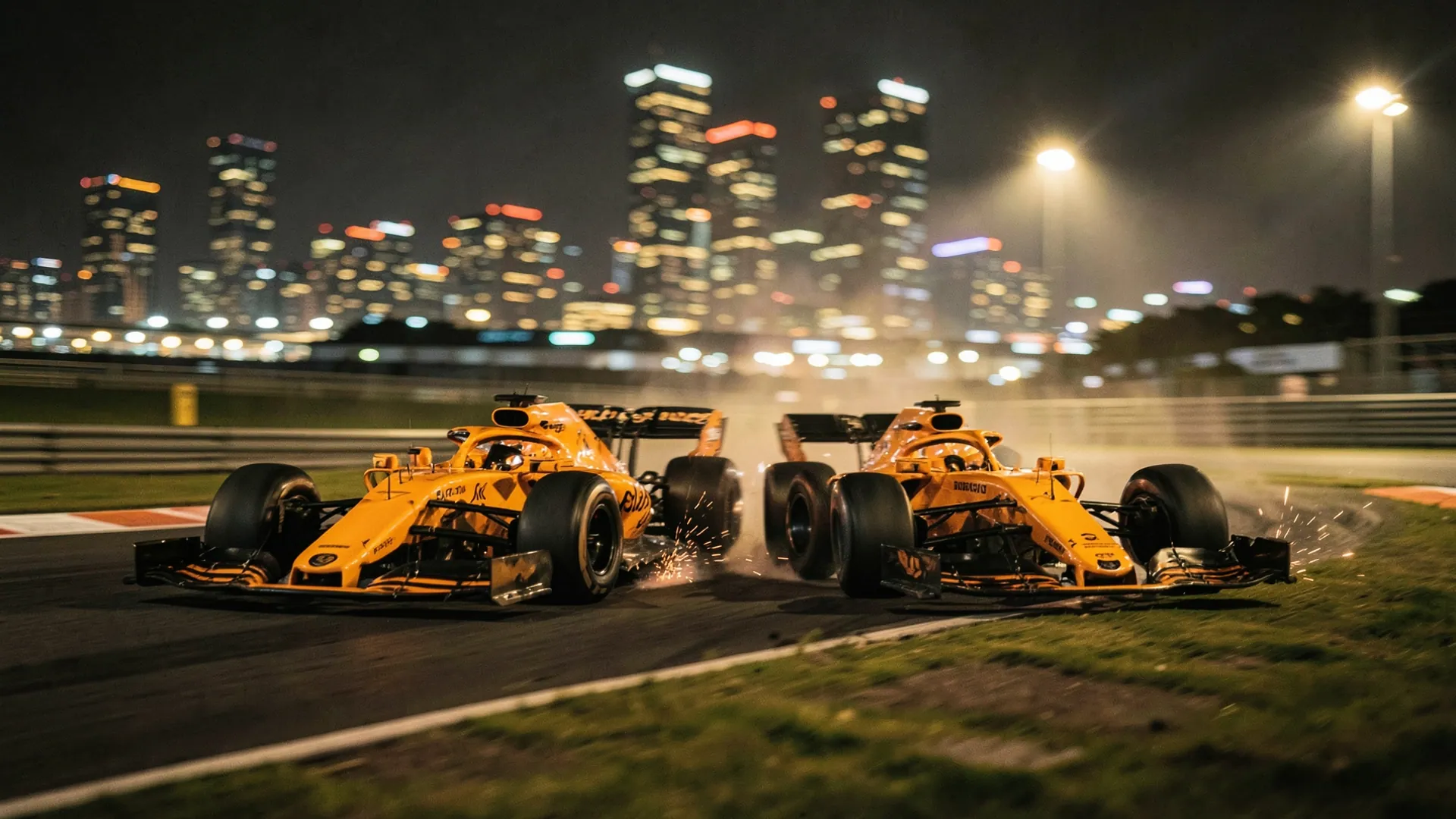
McLaren chief executive Zak Brown has issued a pointed warning to Lando Norris and Oscar Piastri after the team-mates collided late in the Singapore Grand Prix sprint, taking a noticeably firmer line than team principal Andrea Stella. Stella said the team was still in discussion with both drivers. Brown, according to Motorsport.com, was rather less patient. With six rounds remaining and McLaren clinging to third in the constructors’ championship by seven points, the difference in tone matters more than it might appear.
Two voices from the same pit wall
McLaren’s leadership has generally spoken with one voice about its drivers. Stella is the architect of the so-called papaya rules, the loose framework that lets Norris and Piastri race each other on the understanding that they never make contact and that the team’s interests come first. His instinct, visible again after Singapore, is to keep these matters inside the debrief room. He prefers to establish what happened, agree on it with both drivers and move on without public theatre.
Brown’s role is different. As chief executive of McLaren Racing he answers to shareholders and sponsors, and his public interventions tend to come when he believes a message needs to land beyond the engineering office. A stern word from the chief executive carries a weight that a team principal’s measured assessment does not. That he chose to deliver one suggests McLaren’s senior management sees this collision as more than a racing incident to be filed away.
The two approaches may be complementary rather than contradictory. A firm warning from the top gives Stella room to handle the detail without looking soft. But the divergence is real, and it hints at a leadership group that has lost a little patience with a problem it believed it had solved.
Seven points and a Red Bull in the mirror
The numbers explain Brown’s irritation. McLaren sit third in the constructors’ standings on 339 points, with Red Bull on 332. Ferrari are 105 points clear in second, and Mercedes, with 11 wins from 17 rounds, have long since disappeared. Third is the realistic fight left for McLaren, and it is worth a substantial sum in prize money as well as prestige.
Singapore showed how quickly that margin can erode. Max Verstappen converted pole into victory, and Isack Hadjar climbed from 22nd on the grid to take the final point in 10th. Red Bull left the Grand Prix with 26 points to McLaren’s 22, as Norris finished fourth and Piastri fifth. When Red Bull can outscore McLaren even on a solid afternoon for both papaya cars, the two of them touching each other is a luxury the team cannot afford.
The drivers’ championship adds a second layer. Norris is sixth on 201 points, but the three places above him are tightly bunched:
| Position | Driver | Points | Gap to Norris |
|---|---|---|---|
| 3 | Lewis Hamilton (Ferrari) | 229 | 28 |
| 4 | Max Verstappen (Red Bull) | 221 | 20 |
| 5 | Charles Leclerc (Ferrari) | 215 | 14 |
| 6 | Lando Norris (McLaren) | 201 | — |
Twenty-eight points over six Grands Prix is a gap Norris can close, particularly against a Ferrari pairing that has taken points off each other all year. Piastri’s position is starker. He is seventh on 138 points without a win this season, 63 behind his team-mate and comfortably clear of Hadjar in eighth. He has little to chase personally, which is exactly the situation in which a team starts to wonder whether one driver should be helping the other.
That is the tension the papaya rules were designed to keep out of the garage, and Singapore has dragged it back in.
A rulebook written in collisions
McLaren’s intra-team code did not arrive fully formed. It has been rewritten in response to incidents. In Hungary in 2024, Norris was asked to hand the lead back to Piastri after a strategy call had put him ahead, and complied only after a lengthy and very public radio exchange. At Monza that September, Piastri’s opening-lap move on Norris prompted an internal rethink at a time when Norris was chasing Verstappen for the title.
The 2025 season brought sharper tests. In Canada, Norris ran into the back of Piastri late in the race and retired, accepting full responsibility afterwards. At Monza, a slow pit stop for Norris led the team to ask Piastri to give the place back, which he did. And in Singapore last year, Norris made contact with Piastri on the opening lap, drawing an angry radio response from the Australian and no position swap from the team. Marina Bay has now produced friction between the McLaren drivers in two consecutive seasons.
Norris went on to win the 2025 title, which allowed McLaren to argue that their approach had been vindicated. But that argument rested on a dominant car that could absorb the occasional self-inflicted wound. This season McLaren are the third-fastest team at best, and the margin for error has shrunk accordingly.
The wider history of the sport is instructive. Red Bull’s handling of Sebastian Vettel and Mark Webber after their collision in Turkey in 2010 left lasting resentment inside the team. Mercedes tolerated escalating clashes between Lewis Hamilton and Nico Rosberg until both cars ended up in the gravel on the opening lap in Barcelona in 2016, and Toto Wolff threatened team orders after another collision in Austria later that year. Mercedes survived because their car was so far ahead of the field. McLaren in 2026 enjoy no such cushion.
Why Brown has the stronger case
Stella’s patience has served McLaren well. His refusal to impose a rigid hierarchy kept two ambitious drivers committed through a title-winning campaign and avoided the corrosive favouritism that has damaged other teams. There is a reasonable argument that a public dressing-down risks making both drivers more guarded and less willing to own their mistakes in private.
But rules without consequences become suggestions. The papaya framework works only if both drivers believe that breaking it carries a cost greater than the place they might gain. Repeated incidents that end in private conversations erode that belief. Brown’s intervention restores the sense that there is a line, and that someone senior is watching where it falls. With a seven-point constructors’ margin, that clarity is worth more than the risk of bruised feelings.
Where McLaren should be careful is in the next step. The tempting response is to name Norris the priority driver for the run-in, given that he alone has a top-three finish to fight for. That would be a mistake. Piastri’s season has been difficult enough without turning him into a rear gunner for six races, and McLaren will need him fully motivated for 2027. Norris has the pace to beat Leclerc and Hamilton on his own merits. He does not need his team-mate moved aside to do it.
The better message is narrower: the constructors’ fight with Red Bull comes first, both drivers are free to race, and contact between them is the one outcome the team will not tolerate.
Turn 1 in Austin
Austin will test that immediately. The Circuit of the Americas opens with a long, wide run up to a tight uphill hairpin, a corner that invites optimistic lunges and has produced first-lap chaos for years. If Norris and Piastri go into Turn 1 side by side on 25 October and come out of it without touching, McLaren will have taken Brown’s warning seriously. If they touch again at any point before the Abu Dhabi finale, Red Bull will be well placed to take third, and the papaya rules will need rewriting once more.