
McLaren's Fight for Third Rests on Discipline as Handling Fix Waits for 2027
Andrea Stella's admission that McLaren's handling cannot be fundamentally fixed until 2027, and Zak Brown's warning to his drivers after Singapore, leave the team defending a seven-point lead over Red Bull.
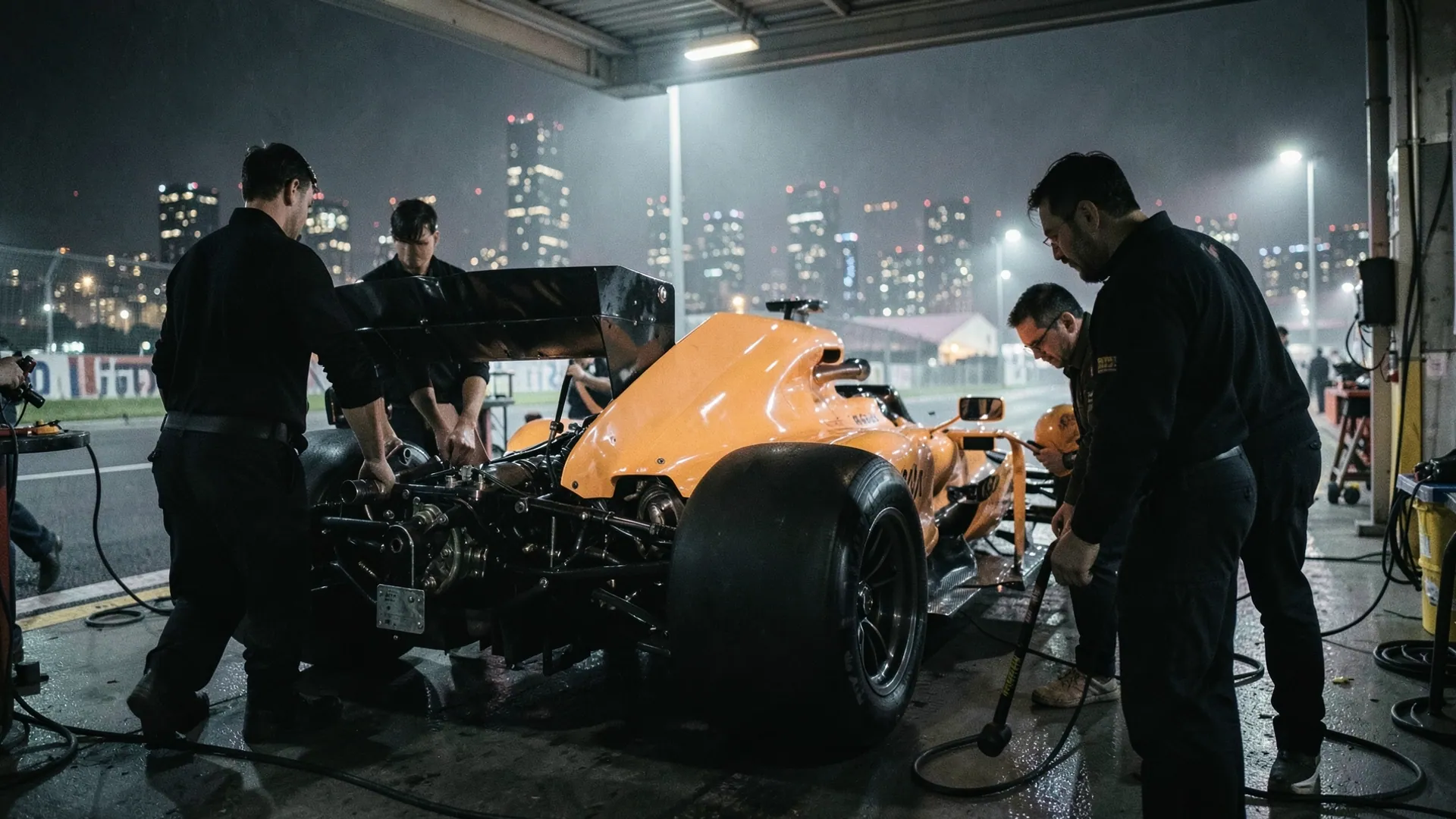
McLaren team principal Andrea Stella has conceded that the team cannot improve its car’s handling without fundamental changes that will not be possible until 2027. Separately, chief executive Zak Brown has told Lando Norris and Oscar Piastri that collisions between them cannot happen, after the pair clashed at the Singapore Grand Prix on 11 October. The two messages come from different men, but they describe the same predicament. McLaren is fighting Red Bull for third in the constructors’ championship with a car it cannot transform and a driver pairing it cannot afford to see collide.
Seven points and a shrinking cushion
The numbers explain the urgency. McLaren leaves Singapore on 339 points, Red Bull on 332. Six Grands Prix remain, starting with the United States Grand Prix at the Circuit of the Americas on 25 October.
Singapore itself narrowed the gap. Max Verstappen converted pole into his second win of the season, and Isack Hadjar recovered from 22nd on the grid to take the final point in 10th. That gave Red Bull 26 points for the weekend. Norris finished fourth and Piastri fifth for a combined 22, so McLaren arrived in Singapore 11 points clear and left only seven ahead.
Above them, the order is settled for all practical purposes. Mercedes has 578 points and 11 wins from 17 rounds, and Andrea Kimi Antonelli leads team-mate George Russell by 102 points in the drivers’ standings. Ferrari sits second on 444, 105 points clear of McLaren. With a maximum of 43 points available to a team per Grand Prix, McLaren would need a near-perfect run and a Ferrari collapse to close that gap. Third is the realistic prize, and it is now a genuine contest.
For a team that won the constructors’ title in 2024 and 2025, finishing fourth would be an unwelcome marker of how far the 2026 regulation reset has shuffled the order. It would also cost prize money, which matters more than ever under a cost cap.
Why the handling cannot be fixed this year
Stella’s comments are unusually frank. Every driver on the grid has had to adapt to the 2026 cars, which brought new chassis and power-unit rules at the same time. McLaren’s admission goes further than adaptation, though. The team is saying that the limitation is built into the concept, and that development within this season will not remove it.
That distinction matters because of how modern Formula 1 development works. Aerodynamic upgrades such as new floors, wings and bodywork can arrive race by race, and they can change a car’s competitiveness quickly. McLaren knows this better than anyone. Its 2023 season began with a car well off the pace, and an aero-led upgrade package from mid-season turned it into a regular podium contender.
Handling traits that stem from a car’s underlying architecture are a different matter. If the root cause lies in the chassis, the suspension layout or the way the aerodynamic platform interacts with the mechanical side, the fix may require a new monocoque or substantially redesigned components. Under the cost cap, every pound spent on that kind of mid-season overhaul is a pound taken away from next year’s car. A new chassis also has to pass FIA crash tests before it can race. With six rounds left, the trade-off is not close. McLaren is better served taking the lesson into the 2027 design than spending heavily to patch a car with weeks of competitive life remaining.
There is precedent for the opposite approach going badly. Mercedes spent much of the previous ground-effect era trying to make its slim-sidepod concept work before conceding that it needed to change direction. That process consumed time and resources that would have been better spent starting again sooner. Stella appears determined not to repeat it. Drawing the line publicly also manages expectations, both for his drivers and for anyone hoping for a late-season resurgence.
There is a quieter irony in the standings. The sliding scale of aerodynamic testing allocation gives teams lower in the constructors’ order slightly more wind-tunnel time. Finishing fourth rather than third would hand McLaren a marginally larger allowance for exactly the 2027 work Stella describes. No team would trade a championship position for that, and McLaren will not. Even so, the competitive cost of losing third is smaller than it first appears, while the commercial cost is real.
Brown’s order and McLaren’s history of friendly fire
If the car cannot be made faster, points have to come from elsewhere: clean races, sound strategy and two cars finishing where their pace allows. That is the context for Brown’s warning. A collision between team-mates is the most avoidable way to lose points, and in a seven-point fight it could decide the outcome on its own.
McLaren has been here before. Its “papaya rules” approach of letting Norris and Piastri race, within agreed limits, produced several flashpoints during the 2025 title fight. In Canada, Norris ran into the back of Piastri late in the race and retired, before apologising. In Singapore that year, the pair made contact on the opening lap, prompting Piastri to complain over the radio. The team absorbed those incidents because it had enough of a margin to do so. It has no such margin now.
The wider history of the sport points the same way. Mercedes lost both cars on the first lap in Barcelona in 2016, when Lewis Hamilton and Nico Rosberg collided while fighting for the lead. Red Bull lost both in Baku in 2018, when Verstappen and Daniel Ricciardo came together, and the team publicly required both drivers to apologise. In each case, management responded by tightening the rules of engagement. Brown is doing the same, earlier and more explicitly.
This year’s clash in Singapore did not cost McLaren a finish, as both cars completed the race in fourth and fifth. Brown’s intervention is therefore preventive rather than punitive, and that is the correct instinct. Waiting for a double retirement to lay down the law would be waiting too long.
Red Bull’s one-car problem is McLaren’s opportunity
McLaren’s most valuable asset in this fight is the depth of its line-up. Norris has 201 points and two wins; Piastri has 138, which places him seventh in the drivers’ standings despite a winless season. Both score regularly. Red Bull’s total, by contrast, leans heavily on Verstappen. He has 221 points and Hadjar has 97, a gap of 124 points between team-mates. Hadjar’s recovery to 10th in Singapore was impressive, but Red Bull has generally relied on one car to carry the scoring.
That shapes how each team can win the battle. Red Bull’s route is Verstappen winning or finishing on the podium, as he did in Singapore, while hoping Hadjar can add points from behind. McLaren’s route is two cars in the points every weekend, with little to separate them. Over six races, consistent double scores are worth more than a single excellent result, provided they are not given away through contact between team-mates.
The danger is that two closely matched drivers in a car without the pace to win will often find themselves fighting each other. When neither McLaren can challenge the cars ahead, the most competitive battle on track can easily be the one between Norris and Piastri. Brown’s message effectively tells them that this battle cannot become a risk to the team. It may also mean holding position in situations where both drivers would rather race.
That is a difficult ask for a driver in Piastri’s position. He is still looking for his first win of 2026, and he may now be asked to put the team’s result ahead of his own opportunities. McLaren will need to handle that carefully. Clear, consistent rules applied to both drivers will matter more than any individual instruction.
Austin as the first test of Brown’s warning
The United States Grand Prix should show whether Singapore was simply a weekend on which the circuit suited Red Bull and Verstappen, or the start of a late-season charge. McLaren cannot expect its car to improve significantly before the end of the season, so its operational execution has to be close to flawless. That means two clean starts, sensible strategy calls and no wheel-to-wheel risks between the drivers.
The judgement here is that McLaren keeps third, but only just, and only if Brown’s warning holds for all six races. Red Bull has the single fastest driver in this fight. McLaren has the two-car consistency that tends to win constructors’ battles over a run of races. Stella has already accepted that the car will not be fixed until 2027. The rest of this season will test whether his drivers can stop that limitation from also costing the team third place.