
Las Vegas Overtaking Spree Complicates F1's Path to 2030 V8 Engines
Max Verstappen's 352-overtake win in Las Vegas came a day after F1 agreed a 2030 V8 framework, and McLaren's Andrea Stella is right that one race should not sway the engine debate.
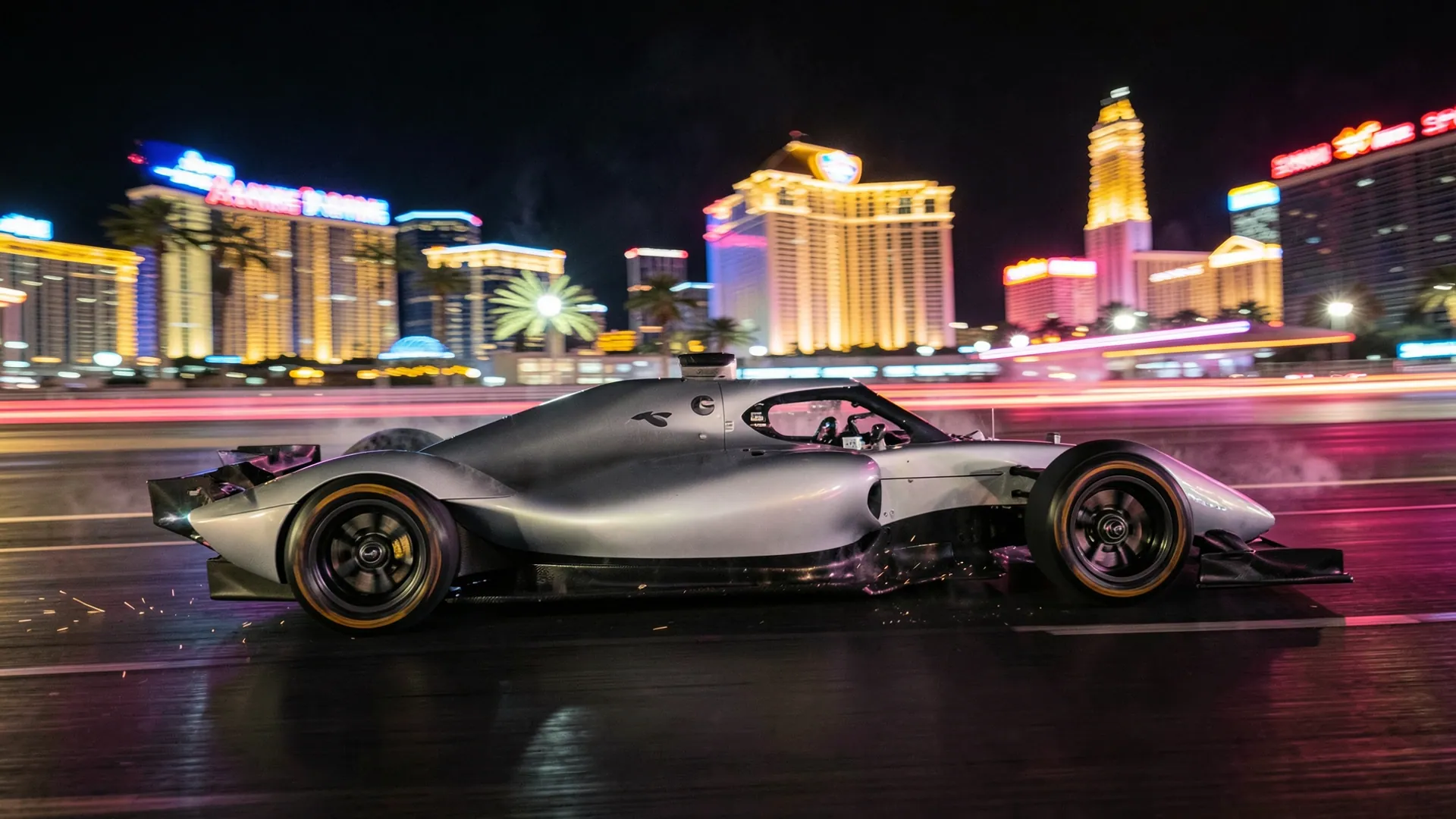
Max Verstappen won the Las Vegas Grand Prix from pole position on 22 November, with Lando Norris second and Oscar Piastri third after starting 17th. Formula 1 has been promoting the race’s tally of 352 overtakes across its channels ever since. The timing is awkward. Barely 24 hours earlier, the FIA had confirmed unanimous agreement on a framework to bring in simpler, 2.1-litre turbocharged V8 engines from 2030.
The sport has just agreed to move away from the current formula, and the current formula has just produced one of the most chaotic races of the season. Both facts are now being used as evidence, in opposite directions.
A podium that changed hands in the final three laps
The classification shows how unstable the order was. George Russell started second and finished ninth. Isack Hadjar started fourth and finished 15th. Liam Lawson went from seventh to 14th, and Arvid Lindblad retired after starting fifth. At the other end, Piastri gained 14 places, Carlos Sainz climbed from 20th to eighth for Williams, and Oliver Bearman rose from 22nd to 13th.
Mercedes felt the late swings most. According to Motorsport.com, both Mercedes drivers dropped out of podium positions in the last three laps. Andrea Kimi Antonelli held on for fourth, while Russell fell all the way to ninth. Toto Wolff still left the circuit delighted, describing the race as “Indy 500, NASCAR and Formula 1 mixed”.
That reaction carries weight. When a team principal whose drivers have just lost two podium places in three laps calls the race thrilling, the show has clearly persuaded people inside the paddock as well as outside it. GPfans framed the race as F1’s first made for the TikTok generation. That is a fair description of how it played: constant passes, rapid reversals and a result nobody could call with five laps left.
What the V8 framework was meant to fix
The 2026 regulations were built around a power unit with a roughly even split between combustion and electrical output. The MGU-H was removed, the fuel became fully sustainable, and a chasing car was given an energy-deployment boost in place of DRS. The criticism has been consistent. Drivers have been managing energy rather than attacking. Straight-line speed depends heavily on battery state. Races can turn on harvesting strategy as much as on driving.
The 2030 framework responds to that. A 2.1-litre V8 would shift the balance back towards the combustion engine and reduce the electrical complexity that defines the current cars. Supporters of the move have argued for years that this means lighter cars, lower development costs, a better sound and an engine formula that is easier for new manufacturers to join. Every party agreed, which matters in a sport where engine rules usually involve years of disagreement.
Las Vegas complicates that story because the features critics dislike may also be what produced 352 overtakes. The Strip straight is long enough for energy differences between cars to become decisive. A car arriving with more charge in hand passes easily, and the order can flip again a lap later. That is a form of overtaking, and it is spectacular. It is also, at least in part, an artefact of the energy rules the V8 plan is designed to move away from.
Stella’s caution, and why counting passes is misleading
McLaren had the best night of any team. Norris and Piastri scored 33 points between them, and Piastri’s run from 17th to third was the drive of the race. That makes Andrea Stella’s intervention more striking. As reported by Motorsport.com, the McLaren team principal warned against a knee-jerk reaction to Las Vegas in the engine debate. The team principal who has just benefited most from the current formula’s most dramatic night is the one telling the sport not to overreact to it.
He is right, for three reasons.
Raw overtake counts do not measure racing quality. A figure of 352 includes every pass, including those reversed on the next straight and those that came from a gap in deployment rather than from braking, positioning or racecraft. Fans in 2011 learned to tell a DRS pass completed before the braking zone from a real duel. The same distinction applies to a pass made because one car had energy and the other did not. Some of the passes in Las Vegas were brilliant. Many were the product of energy states.
Las Vegas is an outlier. Its long straights, low-grip surface and cold night-time conditions make it unlike most of the calendar. A rule set that produces chaos there may produce processional racing at a circuit built around high-speed corners. Judging a long-term engine formula on one street circuit’s numbers is like judging an aerodynamic concept only at Monza.
F1 has made reactive rules before, and it rarely ends well. In 2016, elimination qualifying was introduced, criticised after Australia and Bahrain, and dropped before the third round. In 2014, after complaints in Melbourne about the sound of the new hybrid engines, Mercedes tested a megaphone-shaped exhaust within weeks. Both episodes showed a governing structure reacting to the latest event instead of the underlying trend. An engine formula costs manufacturers hundreds of millions to develop. It should not be redesigned around the mood after a single race.
The opposite mistake is also possible. Las Vegas should not be dismissed. If the current cars can produce racing this open on circuits with long straights, any 2030 regulation should try to keep that variety while reducing the artificial swings. That is a question for the chassis and energy rules that will sit around the V8, not a reason to reverse the engine choice itself.
A season settled at the top but open below it
Las Vegas did not change the championship picture at the front. Antonelli has 402 points, 98 more than Verstappen, with two rounds left, so the title is already beyond Verstappen’s reach. Mercedes lead the constructors’ standings with 666 points, 149 clear of Ferrari, so that title is also decided. Verstappen’s fourth win of the season confirmed his place as Antonelli’s closest challenger, nothing more.
The battles below the leaders are much tighter, and the late shuffle in Las Vegas mattered there. Russell’s drop from a podium position to ninth was expensive:
| Position | Driver | Points |
|---|---|---|
| 3 | Lewis Hamilton (Ferrari) | 267 |
| 4 | George Russell (Mercedes) | 264 |
| 5 | Lando Norris (McLaren) | 264 |
| 6 | Charles Leclerc (Ferrari) | 250 |
Had Russell stayed on the podium, he would have left Las Vegas third in the championship. Instead, he is three points behind Hamilton and level with Norris, whose 18 points pulled him back into contention. Ferrari, meanwhile, scored only seven points. Their lead over Red Bull in the fight for second in the constructors’ standings is now 77 points, with McLaren a further nine points back on 431.
This is where the spectacle argument becomes more difficult. Unpredictability is exciting to watch. For those whose final championship positions now depend on it, the question is whether the results reflected performance or the timing of energy deployment.
Lusail will test the argument
The next race, the Qatar Grand Prix at Lusail on 29 November, is a very different test. Its fast, flowing layout rewards aerodynamic load and tyre management far more than straight-line deployment. If the 2026 cars produce close, varied racing there as well, supporters of the current formula will have a stronger case than one night in Nevada can give them. If Lusail turns into a procession, Las Vegas will look more like a product of its layout than a vindication of the rules.
Neither outcome should change the 2030 decision. The unanimous agreement on a V8 framework rested on far more than a single race, and on the commercial reality of keeping manufacturers committed. The useful lesson from Las Vegas is narrower. The energy rules surrounding the new engine need to preserve the speed differences that make overtaking possible, without letting a battery gauge decide who finishes on the podium. Getting that balance right in the detailed regulations over the next few years is where the sport’s attention should go.