
Russell's Late Las Vegas Crash and Verstappen's 'Karma' Jibe Deepen a Bitter Rivalry
George Russell's crash from a podium position three laps from the end in Las Vegas cost him ground in the fight for second, and Max Verstappen's pointed reaction has reignited their feud.
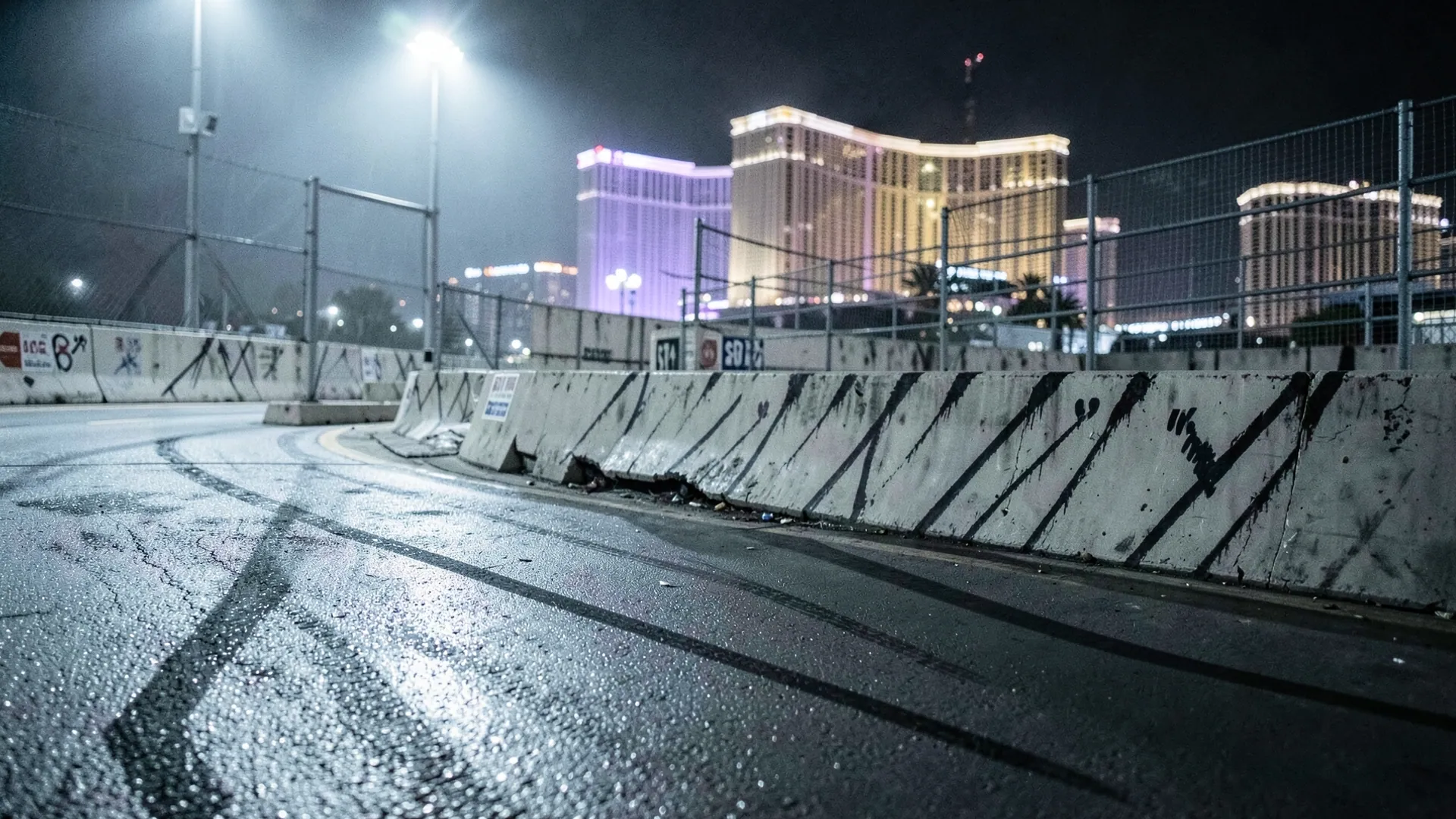
George Russell crashed from a podium position with three laps remaining at the Las Vegas Grand Prix and finished ninth, while Max Verstappen converted pole into his fourth win of the season. Verstappen’s response to his rival’s misfortune, summed up by the word “karma” according to PlanetF1, was the sharpest exchange yet in a feud that had already resurfaced during practice. With two rounds left, the race has also rearranged the battle for runner-up behind Andrea Kimi Antonelli.
Three laps from a podium
Russell started on the front row alongside Verstappen and spent the evening in contention. By the closing stages he was running in a podium position, with the bulk of the points that come with it nearly secured. Then, three laps from home, he crashed. He kept going and took the flag, but ninth place was worth two points rather than the 15 or more he had been on course for.
At least 13 points were lost in a single mistake. In a season decided by fine margins behind the runaway leader, that sum matters.
It would be unfair to assign a cause the evidence doesn’t support. Las Vegas punishes small errors severely. The circuit combines long, low-downforce straights with heavy braking zones, cold track temperatures that make tyre warm-up difficult, and walls that leave no margin. Losing grip on a cooling tyre late in a stint is a familiar hazard there. Even so, the timing is what stings. A driver of Russell’s experience, on the front row and in the frame for the podium, is expected to bring that result home. Mercedes needed the points less than Russell did. The constructors’ title is beyond doubt, with Mercedes on 666 points to Ferrari’s 517. Russell’s own season, however, had little room for another lost opportunity.
The rest of the results sheet makes the error look costlier still. Oscar Piastri climbed from 17th to third, and Carlos Sainz went from 20th to eighth. Fortunes swung all the way down the field. Russell’s swung the wrong way at the worst possible moment.
Why Verstappen reached for ‘karma’
Verstappen won and then made his view of Russell plain. PlanetF1 carried the “karma” remark, and RacingNews365 reported a broader and notably pointed run of comments aimed at the Mercedes driver. Coming after renewed friction in practice, the tone was unmistakable. This was not a throwaway line.
To understand why, go back to Qatar in 2024. Verstappen received a one-place grid penalty for impeding Russell in qualifying. He accused Russell of exaggerating the incident in the stewards’ room to get him penalised, and said he had lost respect for him. The relationship never recovered. At the Spanish Grand Prix in 2025, Verstappen drove into Russell after a dispute over track position and was given a 10-second penalty, which dropped him from fifth to 10th. Weeks later in Canada, Russell won a race that ended with a protest over his driving behind the safety car, which the stewards dismissed, and the episode became another flashpoint between the two camps.
Each episode has hardened positions on both sides. Verstappen sees Russell as a driver who works the stewards and the media as much as the circuit. Russell, for his part, has never accepted that he did anything beyond what any driver would do. Neither view has softened, and Las Vegas gave Verstappen the platform of victory from which to say so.
My view is straightforward. Verstappen is entitled to his grievances, and the history explains them. Celebrating a rival’s crash is still a poor look for a four-time champion who had just driven a faultless race from pole. His win needed no embellishment. The jibe moved the story from his performance to his grudge, and it handed Russell the more sympathetic position at the moment he was most exposed. Rivalries sharpen the sport, but this one has become more about settling scores than racing, and it reflects well on neither man.
The fight for second just got harder for Russell
Antonelli’s title is mathematically settled. On 402 points, he leads Verstappen by 98 with two rounds remaining. The live contest is for second place, and Las Vegas reshaped it.
| Position | Driver | Points | Gap to second |
|---|---|---|---|
| 2 | Max Verstappen | 304 | – |
| 3 | Lewis Hamilton | 267 | 37 |
| 4 | George Russell | 264 | 40 |
| 5 | Lando Norris | 264 | 40 |
| 6 | Charles Leclerc | 250 | 54 |
Before the race, Russell sat 17 points behind Verstappen. He leaves it 40 adrift. Had he held third, the gap would be 27 and he would be third in the standings rather than level on points with Lando Norris, whose second place lifted him alongside. Lewis Hamilton moved ahead of Russell with seventh from 11th on the grid, despite a Ferrari weekend that RacingNews365 characterised as an “unacceptable” crisis. With Hamilton seventh and Charles Leclerc 10th, Ferrari’s drivers finished well below their championship positions. Leclerc’s single point leaves him 54 behind Verstappen with only 50 still available, so he can no longer finish second.
Two Grands Prix at 25 points apiece leave Verstappen as a strong favourite to hold on. Mathematically, Hamilton, Russell and Norris all remain in it. Practically, all three need Verstappen to falter, and Russell now needs it more than Hamilton does.
A season measured against Antonelli
The deeper context is less comfortable for Russell. Antonelli has nine wins and 402 points. Russell has three wins and 264. In the same car, the gap is 138 points. That is not a deficit explained by one bad night in Nevada.
Russell entered 2026 as the established team leader, with the experience and the record to back up that role. Antonelli, in only his second full season, has rewritten that hierarchy. He started sixth in Las Vegas and finished fourth. Russell started second and finished ninth. The race was a compact version of their season: the younger driver collecting the points while the senior driver’s weekend unravelled late on.
That is why second place matters so much to Russell. Mercedes’ internal balance is now settled in Antonelli’s favour, and Russell’s value rests on proving he remains a front-running, title-calibre driver in his own right. Beating Verstappen to runner-up, in a season Red Bull’s lead driver has won only four times, would make that argument for him. Finishing fourth or fifth behind a Ferrari driver would undermine it. There is also the matter of Verstappen’s comments. A driver who can be needled into errors becomes a target, and Russell’s best answer is a clean, quick end to the season.
Qatar, where it began
The calendar has a sense of theatre. Round 22 is the Qatar Grand Prix at Lusail on 29 November, the circuit where the 2024 grid-penalty row turned a rivalry into a feud. Lusail’s long, fast corners have often suited Red Bull, and Verstappen arrives with momentum and a 37-point cushion over his nearest pursuer.
Russell does not need to win the argument with Verstappen in Qatar. He needs to finish ahead of him. Anything less ends his chance of second place, and Verstappen would have both the result and the last word. The prediction here is that Verstappen secures runner-up in Lusail, and that the more revealing story will be whether Russell answers on track with the clean, high-scoring weekend that his season, and his standing within Mercedes, now demand.