
Norris Warns of Wet Las Vegas Risk as Lawson's Racing Bulls Future Is Settled
Lando Norris wants Pirelli to improve its rain tyres before a wet night race exposes them, while Liam Lawson's new deal and Antonelli's title aftermath shape the build-up to Las Vegas.
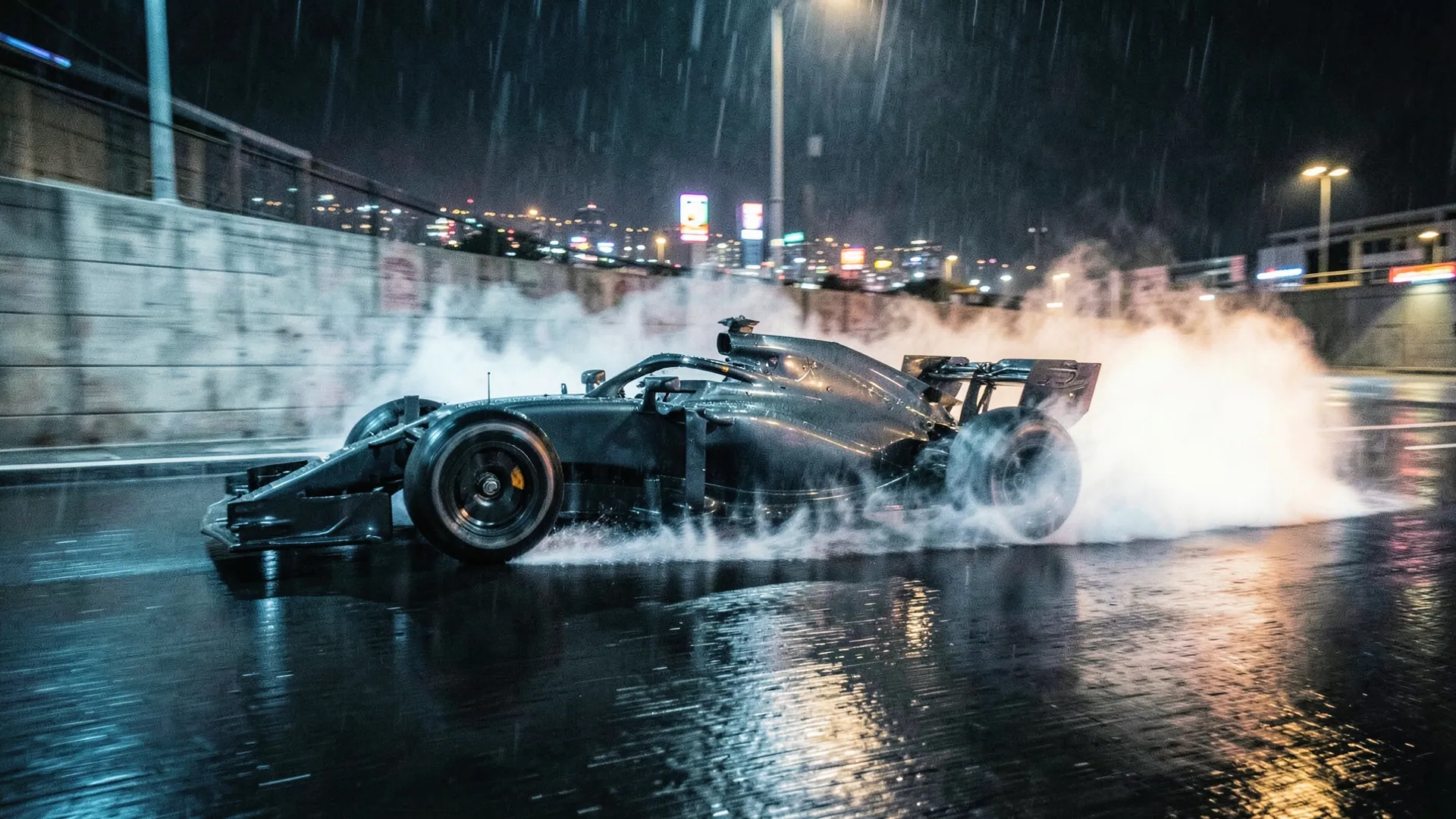
Lando Norris has warned that a wet Las Vegas Grand Prix would be “scary” on Formula 1’s current rain tyres, and has urged Pirelli to bring a much-improved range for 2027. His comments come six days before Round 21 on the Strip, the first of three races left in a season whose drivers’ title already belongs to Andrea Kimi Antonelli. Elsewhere, Liam Lawson’s future at Racing Bulls has finally been confirmed, and Norris has made his first signing as a team owner.
Why Norris fears rain on the Strip
Norris is not usually given to alarm, which is why his warning deserves attention. His argument is about physics rather than nerves. Wet and intermediate tyres work only when they reach their operating window, and they get there through load and sliding. Downforce pushes the tyre into the track, the rubber works and heat builds. Las Vegas is built around long straights and slow corners, and teams run their lowest-drag configurations there. The cars carry little aerodynamic load, so the tyres receive little energy.
Then there is the setting. The race runs late on a November night in the desert, when air and track temperatures are lower than almost anywhere else on the calendar. Even dry-weather tyres have struggled to stay warm there in previous editions, with graining and slow warm-up shaping strategy. A rain tyre that already needs coaxing would face a cold track, cool air and long straights that strip away heat on every lap.
Spray, walls and floodlights
Grip is only half of it. Full wets are designed to clear large volumes of water, which also means throwing up large volumes of spray. On a street circuit lined with walls and lit by floodlights, spray at the speeds reached on the Strip would leave drivers following almost blind. Recent wet races have often been held behind the safety car until conditions allowed a switch to intermediates. Norris’s real point is that the full wet barely does the job it exists for.
His call is aimed at 2027 rather than this weekend, and that is the right target. Pirelli cannot redesign a compound in six days. A defending champion stating the problem in public does raise its priority, though. The 2026 cars are new, and so are their tyres. A wet-weather range that copes at Silverstone or Interlagos but not on a low-downforce street circuit is a gap that should be closed before it causes an accident.
Lawson’s patience is rewarded
The confirmation that Lawson will stay at Racing Bulls has been widely welcomed, and the numbers explain why. Lawson has 89 points and sits ninth in the championship. He is the highest-placed driver outside the big four teams by a wide margin: the next is Pierre Gasly on 42. In Brazil he qualified third and finished seventh, scoring six points while several quicker cars around him came home empty-handed.
The delay was harder to justify than the decision. Red Bull’s driver programme has long kept its drivers waiting, partly to protect its options and partly because the senior and junior teams’ line-ups depend on each other. Lawson’s career shows what that can cost. In 2025 he was promoted to the senior team and dropped again after just two races. That he rebuilt his standing and then had to wait again for a deal his results had earned says more about the system than about him.
The settled line-up should also help Arvid Lindblad. The rookie has 38 points and is 11th in the standings, and he benefits from a team-mate who sets a clear benchmark and is no longer driving for his own seat.
Goethe becomes Norris’s first signing
Norris’s new junior team, LN4 Fusion, has signed Oliver Goethe as its first Formula 2 driver for 2027. Goethe, 22, moves from MP Motorsport for his third season in the category. Like Lawson, he came through the Red Bull junior programme, and his path out of it shows the other side of that system. Red Bull produces winners, but it also releases many capable drivers, who then have to find another route up.
Choosing an experienced driver over a teenage prospect makes sense for a new outfit. A third-year F2 driver knows the tyres, the circuits and the format, which gives a fledgling team a reference point while it builds its engineering base. The risk is the usual one for drivers in their third season: anything short of a title challenge tends to close the door to Formula 1. Goethe and Norris’s team will be judged together in 2027.
Antonelli’s title and the questions at Mercedes
Antonelli has 390 points, nine wins and a 111-point lead with three rounds left. He is the 2026 world champion and, at 20, the youngest in the sport’s history. The aftermath has turned towards the other Mercedes driver.
Marco Antonelli has defended his son’s title and offered a pointed view of George Russell’s failure to mount a challenge. A father’s view is never neutral, and it is better read as loyalty than analysis. The scoreboard is blunt enough without it, however. Russell has three wins to Antonelli’s nine and is 128 points behind in the same car. Between them they have won 12 of the 20 races, which shows the car could support a two-way fight. Only one of them turned that into a title campaign.
That does not make Russell’s season a poor one. He is third in the standings, and in Brazil he finished fourth, one place ahead of Antonelli. He has, however, been clearly beaten by a team-mate in only his second full season. That changes how Mercedes will plan 2027. The team now has a world champion in one seat and an established race winner in the other. Toto Wolff’s task is to stop that becoming a hierarchy before next season starts.
Wolff has also revealed that Christian Horner messaged him after the title was won. It is a small detail, but the rivalry between the two shaped a decade of this sport, and it adds some warmth to a season in which Horner has watched from outside the paddock.
Verstappen’s case as the 2027 favourite
Max Verstappen’s late-season form has prompted an early debate over whether he should start next year as favourite. His Brazilian Grand Prix was the strongest argument for it: he started 21st and finished second, beaten only by Norris, who won from pole. Isack Hadjar’s third place gave Red Bull a double podium on a day when Mercedes took fourth and fifth.
Why Red Bull could start 2027 ahead
- Red Bull began this regulation cycle with its first in-house power unit and has clearly improved through the year.
- The rules stay stable into 2027, and stable rules tend to bring the field together. Teams improving fastest at the end of one season often carry that momentum into the next.
- Verstappen remains the most complete driver in the field, and recent results show the car is good enough to let him prove it.
Why Mercedes remains the benchmark
- Mercedes has won 12 of 20 races and leads the constructors’ standings by 142 points from Ferrari. One recovery drive does not wipe out a season of setting the pace.
- Red Bull’s 415 points put it third, 17 ahead of McLaren. It is fighting for third, not first.
- Mercedes will also develop over the winter, and it starts from further ahead.
The fairer view is that Verstappen has made himself the main threat to Mercedes rather than the favourite. The remaining races offer a cleaner measure. He leads a tight fight for second place on 279 points, with Russell 17 behind, Lewis Hamilton 18, Charles Leclerc 30 and Norris 33. That puts five drivers within 33 points, with 75 available from the grands prix alone. That fight is the best story left in the season.
Hamilton’s Ferrari, inside and outside the car
Reports from Italy have again suggested that Hamilton and the staff he brought to Maranello are less popular than they might like. This has become a recurring theme in his second season with the team, and it deserves some caution. Italian coverage of Ferrari has long magnified internal friction, and unnamed sources describing “unpopularity” rarely separate personal tension from normal disagreement over how a team should be run.
What can be measured looks better than the reports suggest. Hamilton is fourth in the standings on 261 points, 12 ahead of Leclerc, and each has one win. Brazil was a difficult weekend: he started 20th and finished ninth, a lap down. Yet across the season he has slightly outscored a team-mate who has been at Ferrari for many years. When a senior driver brings his own engineers to a team, some friction is the predictable cost of trying to change how it works. The real question is whether those changes make Ferrari quicker in 2027, and that will be answered on track.
Away from the circuit, Hamilton’s Mission 44 foundation has called on Formula 1 to spend £50 million promoting under-represented talent, arguing that fans want to see greater representation in the championship. The figure is deliberately large, yet still modest beside the sport’s commercial income, and it shifts the debate from intentions to money. Formula 1 has supported diversity initiatives before, but a specific sum gives everyone something concrete to measure progress against. The sport’s response will show how seriously it takes the issue.
Other threads heading into Las Vegas
- Las Vegas liveries: Aston Martin and Williams have both unveiled special designs for the race, with Williams adding chrome. Both teams would welcome points more than attention, with Williams on 12 and Aston Martin on seven.
- Three years since the 2023 debut: The first Las Vegas practice session was abandoned after a loose drain cover damaged Carlos Sainz’s Ferrari, and the rescheduled session ran into the early hours without spectators. RacingNews365 reports that fans eventually received a payout of around $3 million.
- The fight for third: Red Bull leads McLaren by 17 points. With Norris winning in Brazil and Verstappen in strong form, it may come down to the final round.
- Audi against Haas: Nico Hülkenberg’s point in Brazil took Audi to 28 points, three behind Haas in the fight for seventh. A single top-10 finish could decide it.
- Cadillac’s wait: The newcomer is still without a point after 20 rounds. Sergio Pérez finished 18th in Brazil, and a disrupted Las Vegas race may be the team’s best chance before the season ends.
- Formula E’s GEN4 era: Pre-season testing for 2027 began with a series of red flags. Early problems are normal for a new car; how quickly they are fixed will say more than the stoppages themselves.
Las Vegas will most likely stay dry, leaving Norris’s tyre concerns as a matter for the winter. The race still has plenty at stake. The fight for second place will reward whoever copes best with a cold, low-grip track, and that is exactly the kind of challenge Verstappen has been relishing this autumn.