
Storm Warning Over Interlagos Turns Brazilian Grand Prix Strategy Into a Gamble
With forecasts ranging from a dry afternoon to an official storm warning, the Brazilian Grand Prix hands strategists a high-stakes guess and gives Charles Leclerc a chance to prove his wet-weather progress.
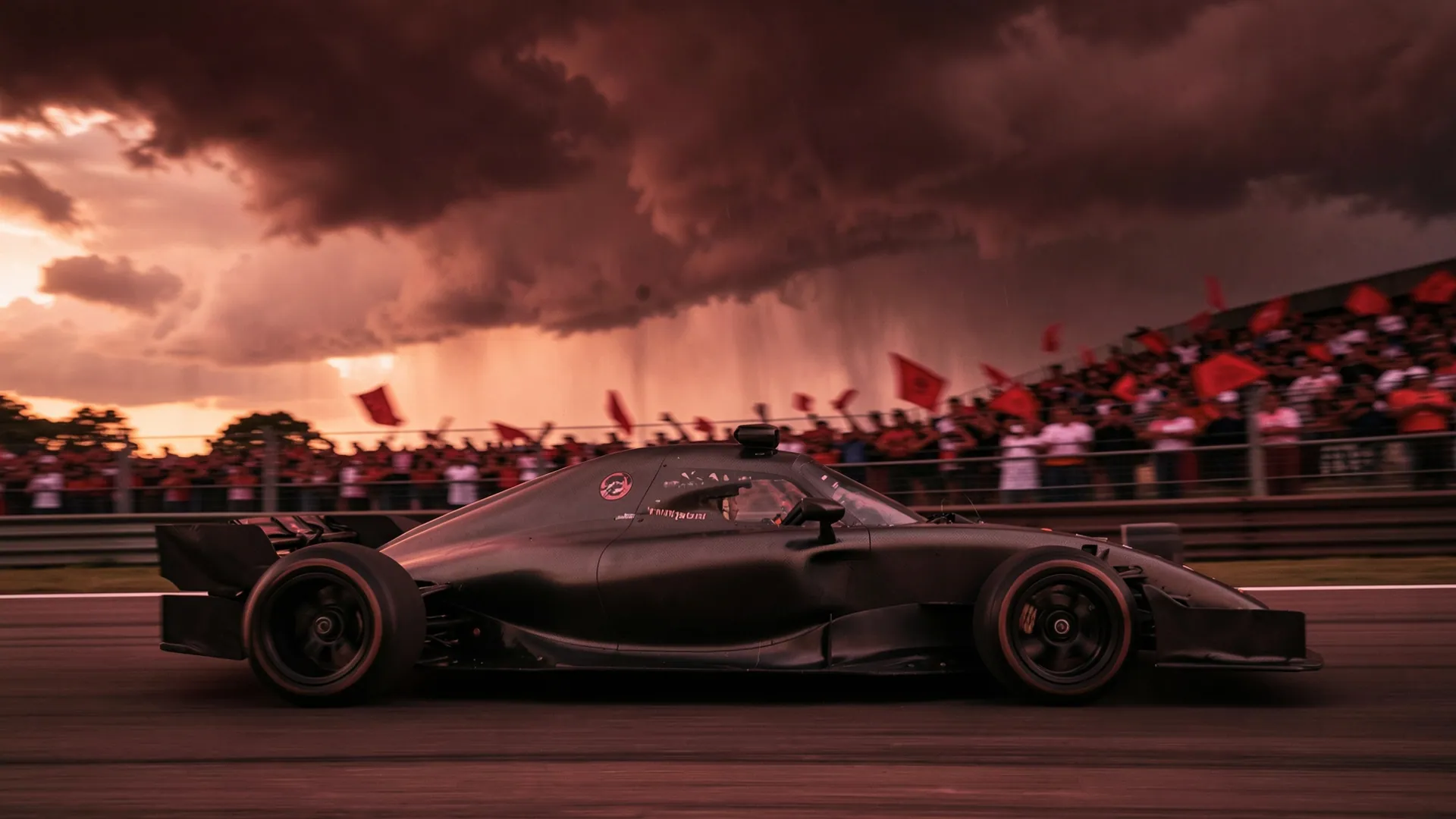
An official storm warning has been issued for the São Paulo region on the day of the Brazilian Grand Prix, even as other forecasts suggest Interlagos could stay dry for the whole race. GPfans reports that the warning points to severe conditions later on Sunday. RacingNews365 has highlighted the opposite scenario, in which a race many expected to be wet turns into a conventional dry afternoon. For the drivers lining up for round 20 of 23, that leaves a genuinely open question about which race they are preparing for.
Two forecasts and one set of decisions
Forecasts disagree all the time. What makes today awkward is that the two scenarios call for different cars, different tyre plans and different attitudes to risk, and most of those choices are already locked in.
Under parc fermé rules, a car’s set-up is largely frozen from the start of qualifying. Teams can make only minor adjustments before the race, such as to front-wing angle. Ride height, suspension stiffness and the overall downforce level were chosen before qualifying, on the basis of forecasts that were no clearer then than they are now. A team that trimmed its car for straight-line speed down to Turn 1 and up the hill to the line will be exposed if the storm arrives. Its slower cornering will cost time in the wet, and its cooler tyres will lack grip. A team that added downforce as insurance will lose time on the straights if the clouds pass by.
Then there is the tyre call itself. In mixed conditions the race tends to turn on the crossover points: the lap on which intermediates become faster than slicks, and the lap on which full wets become necessary. Get the first one right by a lap and you can gain several places. Get it wrong by two and you can lose a points finish. The 2026 power units, with their much larger electrical contribution, add another variable. Delivering that electric torque cleanly on a wet surface is a driver skill and a software problem at the same time, and few teams will have much real-world data on it in heavy rain.
Why Interlagos punishes the wrong guess
Interlagos has a long record of turning weather into chaos, and recent history explains why teams are taking today’s warning seriously even if the race starts dry.
The 2024 race is the obvious reference. Rain forced qualifying to be moved to Sunday morning, and the race itself was decided by timing as much as by speed. Lando Norris and George Russell pitted under a Virtual Safety Car shortly before Franco Colapinto’s crash brought out the red flag. That let Max Verstappen, Esteban Ocon and Pierre Gasly change tyres for free during the stoppage, without losing track position. Verstappen won from 17th on the grid, and Ocon and Gasly finished second and third for Alpine. It was a points haul that transformed Alpine’s season.
Wet conditions in São Paulo have shaped races and seasons before. Lewis Hamilton won a rain-soaked race here in 2016, the same afternoon on which Verstappen produced his celebrated recovery drive to third. Jenson Button won the mixed-conditions finale in 2012, when Sebastian Vettel survived a first-lap spin to claim the title. The circuit’s layout feeds this pattern. The track runs anti-clockwise, with a steep downhill braking zone into the Senna S and a long, climbing run to the line, so a small grip deficit is magnified at both ends of the lap. Storms in the region also tend to build quickly and pass through, which means conditions can swing from slicks to full wets and back within the length of a race.
The red-flag rule matters as much as any forecast. A free tyre change during a stoppage can reward a driver who has delayed a pit stop, and punish one who has made the theoretically correct call a lap too early. Strategists can model the rain, but they cannot model when someone will find a barrier.
Leclerc’s rain record faces its sternest test
If the storm does arrive, the driver with the most to prove may be Charles Leclerc. Wet weather has long been regarded as the weak spot in an otherwise formidable skill set. His slide into the barrier on drying slicks at Hockenheim in 2019, in only his first season with Ferrari, became a lasting reference point. RacingNews365 has noted his progress in the conditions that have troubled him most during his Ferrari career, describing a weakness that has gradually been addressed.
The championship gives that progress a practical value. Leclerc arrives fifth on 245 points after finishing fourth in Mexico. That leaves him 16 points behind Verstappen in second, and the gap between second and fifth is small enough that one chaotic afternoon could reorder the group entirely. A strong wet-weather result would also answer a question that has followed him for years.
His team-mate is a reminder of the standard. Hamilton started from pole in Mexico and finished second behind Verstappen. He sits third on 259 points, just two behind the Red Bull driver, and he has won in the wet at this circuit before. Verstappen’s Interlagos record in the rain needs no elaboration. He won here in 2024 and arrives on the back of victory from fifth on the grid in Mexico City.
What the standings say about who should gamble
The appetite for risk should vary sharply across the grid, and the standings explain why.
At the top, there is little to gain from gambling. Andrea Kimi Antonelli leads the drivers’ championship on 380 points with nine victories. His 119-point margin over Verstappen is larger than four Grand Prix wins are worth. Mercedes, on 630 points, lead Ferrari by 126 in the constructors’ standings. A wet race is the scenario most likely to produce an unexpected zero for the leaders, but even that would barely dent either advantage. The sensible approach for Antonelli and Russell is conservative: no heroics on the crossover lap, and no lunges in the spray.
Behind them, the stakes rise quickly:
| Battle | Gap |
|---|---|
| Drivers’ second place (Verstappen, Hamilton, Russell, Leclerc) | 16 points, covering four drivers |
| Constructors’ third place (Red Bull v McLaren) | 17 points |
| Constructors’ seventh place (Haas v Audi) | 4 points |
| Constructors’ ninth place (Williams v Aston Martin) | 5 points |
The fight between Red Bull and McLaren is the most significant of these. Red Bull are on 382 points and McLaren on 365. Isack Hadjar’s two points for ninth in Mexico, set against Oscar Piastri’s 13th place from 12th on the grid, are the kind of margins that will decide it. Norris took fifth in Mexico, and McLaren need both cars scoring consistently to overturn the deficit.
Further back, a wet race is a rare opportunity for the teams that usually start the weekend expecting nothing. Constructors’ positions carry real prize-money value. Haas and Audi are separated by four points, and Williams and Aston Martin by five. Cadillac are still waiting for their first point. Mexico showed that big gains are possible from the back: Liam Lawson recovered from 22nd on the grid to seventh, and Gabriel Bortoleto and Ryo Hirakawa scored for Audi and Haas. Alpine’s double podium here two years ago is the template every midfield strategist will have in mind. For those teams, an early switch to intermediates, a long first stint gambling on a red flag or a bold call on full wets is a reasonable use of a race in which they have little to lose.
Caution at the front, bravery behind
The forecast split favours caution at the front and bravery further back, and the best teams will treat it that way. Mercedes should plan for the dry, keep both cars out of trouble and let others take the risks. Ferrari and Red Bull cannot afford to be so passive. Second place in the drivers’ standings is in play for both teams, and the constructors’ battle for third is close enough that a single misjudged stop could decide it.
If the storm does arrive, the result will depend on which pit walls can make the correct call under pressure, and on whether Leclerc’s improvement in the wet holds up when it matters. If the race stays dry, the teams that hedged hardest with their set-up will spend the afternoon paying for their insurance. That is the gamble at Interlagos today. Judging by this circuit’s history, the teams willing to accept some risk are more likely to be rewarded than those who simply hope the forecast is wrong.