
Nike Returns to F1 From 2027 as Weather Upends Las Vegas Practice Plans
Nike will return to Formula 1 in 2027, headlining a busy Las Vegas build-up in which disrupted practice, Ferrari's internal dynamics and a renewed V8 debate frame the season's final three rounds.
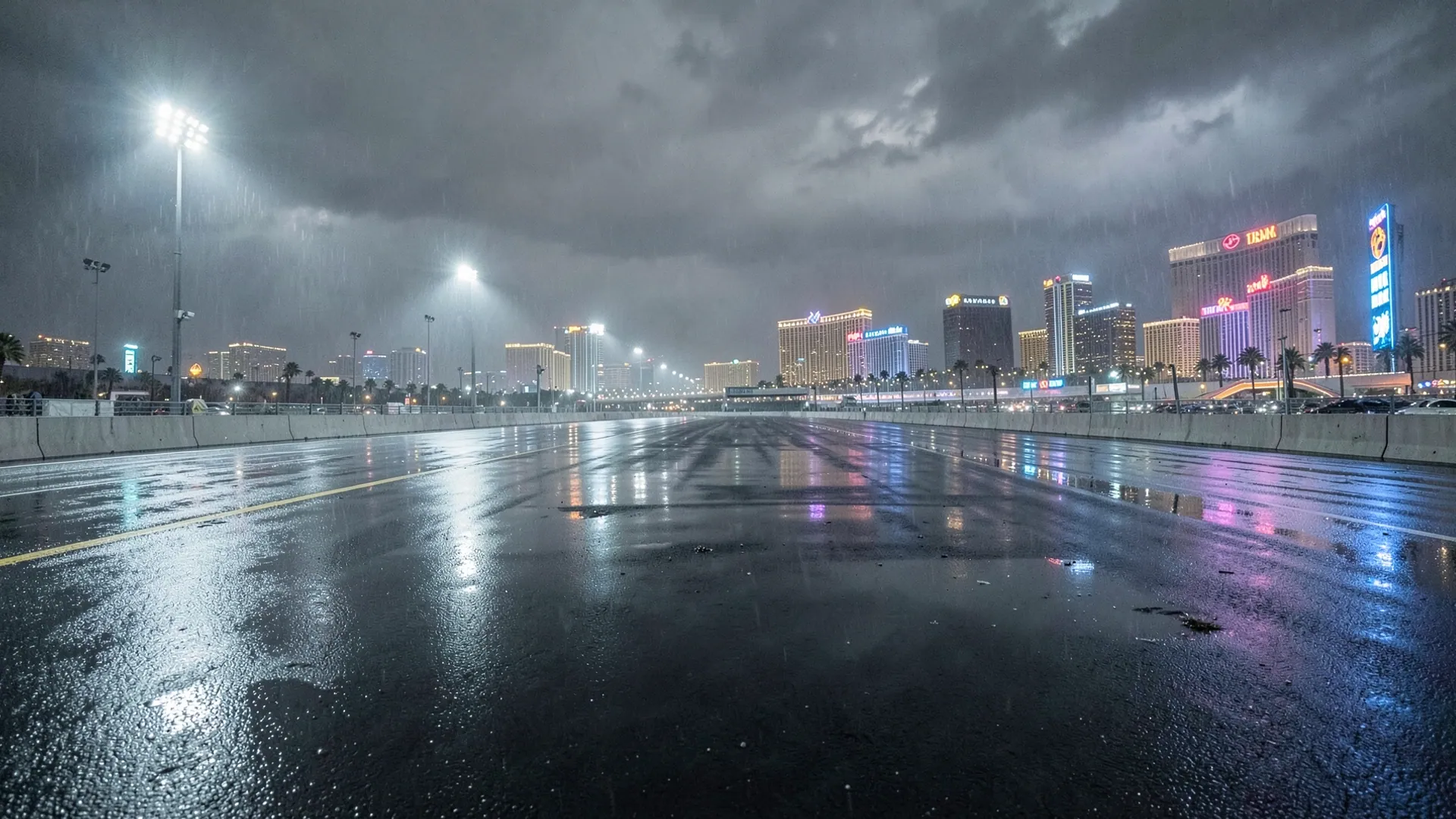
Formula 1 confirmed at the Las Vegas Grand Prix that Nike will replace Puma as a partner from 2027, bringing the sportswear brand back to the sport after 24 years. On track, the weather disrupted both opening practice sessions on the Strip and left teams short of representative dry running before qualifying. Andrea Kimi Antonelli’s title is already beyond his rivals’ reach, so the live contest over the last three rounds is the scramble for second place, where only 33 points separate five drivers.
Why Nike chose Las Vegas to come back
The announcement was made in Las Vegas, and the setting was deliberate. Liberty Media has spent most of its tenure building Formula 1 into an American product. The calendar now includes three US races in Miami, Austin and Las Vegas, and a US-backed team, Cadillac, joined the grid this season. Signing Nike, the most recognisable sportswear name in American retail, is the commercial counterpart to that sporting expansion.
The logic is about reach rather than racing. Nike sells to people who may never have watched a Grand Prix. If F1 merchandise appears in Nike stores, Nike marketing and Nike’s own channels, it reaches audiences the sport’s traditional partners rarely touch. For a series that has spent five years turning casual viewers into paying fans, that is a more valuable return than a logo on a pit wall.
Puma loses its place in the reshuffle, and that should not be dismissed. The brand has been a familiar presence in the paddock for many years. This decision is about where F1 wants to grow next. It says nothing about the quality of that relationship.
The test is execution. Nike’s name will open doors, but what matters is whether the partnership produces products and campaigns that feel authentic to the sport. A licensing deal alone will not do that. The 2027 launch will show whether this is a genuine partnership or simply a badge.
Weather turns Las Vegas practice into guesswork
Las Vegas is already one of the hardest venues on the calendar to prepare for. The race runs at night, track temperatures are low, and the long straights demand a low-downforce set-up that makes tyre warm-up difficult. Weather disruption to both FP1 and FP2 has made the problem worse. Teams usually spend the opening day working through tyre preparation runs and long-run degradation. This time most of them have arrived at the business end of the weekend with an incomplete picture.
Lando Norris has said McLaren has “important work” to complete after the weather affected the first two sessions. Lewis Hamilton has made a similar point about Ferrari, saying the team needs to make full use of whatever limited dry running remains. Both have good reason to worry.
Who benefits from a short weekend
When track time is scarce, teams fall back on simulation and on what they learned at similar venues. Three things are likely to matter:
- Simulator correlation. Teams whose virtual models match their real cars can arrive with a set-up close to the right window. Others will be adjusting on the fly.
- Tyre warm-up. On a cold, low-grip street surface, the driver who can bring the tyres into their operating window in one lap has an advantage in qualifying that a full practice programme would normally reduce.
- Track evolution. A street circuit gains grip as rubber goes down. With less rubber laid on the opening day, the surface will change more than usual through the remaining sessions, so early laps will reveal less.
Norris arrives as the most recent winner after converting pole into victory in Brazil. Max Verstappen arrives as the driver in form after climbing from 21st on the grid to second at Interlagos. Hamilton has less margin. He started 20th in São Paulo and finished ninth, a lap down, and a disrupted weekend in Las Vegas is the kind he can least afford.
The 33-point scramble behind Antonelli
Antonelli has nine wins and 390 points, and his 111-point lead over Verstappen is larger than the total still available. Mercedes, with 12 wins between its drivers, holds a 142-point lead over Ferrari in the constructors’ standings, which leaves that title as close to a formality as it can be without being settled.
The fight for runner-up is far more open.
| Position | Driver | Team | Points | Gap to P2 |
|---|---|---|---|---|
| 2 | Max Verstappen | Red Bull | 279 | – |
| 3 | George Russell | Mercedes | 262 | 17 |
| 4 | Lewis Hamilton | Ferrari | 261 | 18 |
| 5 | Charles Leclerc | Ferrari | 249 | 30 |
| 6 | Lando Norris | McLaren | 246 | 33 |
A single race win is worth 25 points, so every driver on that list can still finish second. Verstappen has the cushion and the momentum. His drive through the field in Brazil was the most persuasive of his recent results, and Red Bull’s double podium, with Isack Hadjar in third, suggests the car is in a better place than it was earlier in the year.
Russell is the most interesting case. He drives the season’s dominant car, yet he sits 128 points behind his team-mate. In Brazil, Antonelli started second and finished fifth while Russell came through from seventh to fourth. Russell does not need to beat Verstappen everywhere. He needs to keep finishing ahead of him and let Mercedes’ pace do the rest.
Norris, meanwhile, is the outsider with form. His three wins match Verstappen’s and Russell’s tallies, but inconsistency elsewhere has left him sixth. A strong finish to the year would tell McLaren a lot about where it stands heading into 2027.
Ferrari’s Interlagos meeting and the Hamilton question
Ferrari held a meeting in Brazil between Leclerc, Hamilton and team principal Fred Vasseur, and Leclerc has since spoken about it publicly. Nico Rosberg has also commented on the state of Hamilton’s relationship with the team. Neither account changes the basic picture: Ferrari’s two drivers are separated by 12 points and both have a realistic chance of finishing as runner-up.
That is a difficult position for any team to manage. Ferrari has won only twice this season, once with each driver. It sits 95 points clear of Red Bull in the constructors’ standings, so second place there is fairly secure, but the drivers’ standings offer each man a personal objective that does not always match the team’s. Scuderia history is full of seasons in which that tension was handled badly and became a distraction.
The healthier sign is that the conversation happened in the open, and that Leclerc is willing to talk about it rather than avoid the subject. Teams that air disagreements in a room with the team principal tend to fare better than those that let them play out on the radio. The proof comes on track. If Las Vegas produces a clean, cooperative weekend from both cars, the meeting will have done its job. If it produces another round of strategic friction, the questions will follow Ferrari to Qatar.
Hamilton’s own season deserves a fair reading. He is fourth, ahead of his team-mate, with a win to his name. Brazil was a poor weekend, not a verdict on his year.
McLaren’s 2027 brief: same engine, different result
McLaren has set out its objective for 2027, with its Mercedes power-unit arrangement confirmed. The context is uncomfortable for the team. Mercedes leads the constructors’ championship on 652 points. McLaren, using the same power unit, is fourth on 398 points, 17 behind Red Bull.
That 254-point gap is the most revealing number in the standings. Engine customers receive the same specification as the works team under the regulations, so the deficit cannot simply be put down to the power unit. It comes from chassis performance, aerodynamic efficiency and how well the engine is packaged and integrated. That last area is where a works team traditionally gains, because it designs car and power unit together from the start, and the new rules have only widened that advantage.
McLaren’s season has been uneven between its drivers. Norris has three wins and 246 points. Oscar Piastri, whose 2025 campaign made him a genuine title contender, is seventh on 152 points without a win. In Brazil he recovered from 10th on the grid to sixth, a respectable drive, but McLaren needs both cars scoring heavily if it wants to fight at the front.
The good news for Woking is that the problem is one it can solve itself. Its power unit is clearly capable of winning titles. Its task for 2027 is to build a car that makes the most of it, and few teams have a better recent record of turning a weak car into a front-runner.
The V8 debate refuses to go away
The argument over Formula 1’s next power unit continues, even with the current regulations less than a year old. Williams team principal James Vowles has given his full backing to a possible return to V8 engines, even though progress on the idea has reportedly stalled. GPfans has taken a contrary view, arguing that the classic, unrestrained V8 of the past is unrealistic and pointing to street venues such as Miami and Las Vegas as part of the reason.
Both positions can be true at once. The sport has moved far from the era when a V8 could simply be bolted into a car and allowed to scream. City-centre races depend on promoters, local authorities and sponsors who want a story about efficiency and sustainable fuel. A future V8 would almost certainly look very different from the engines that powered the sport until 2013.
What a V8 return would have to solve
- Manufacturer commitment. Audi, Honda, Ford through Red Bull, Mercedes and Ferrari all signed up to the current formula on the understanding that it would last. Changing direction quickly risks losing the investment that justified their involvement.
- Cost and complexity. A simpler engine could lower costs and help independent teams such as Williams, which partly explains why Vowles is so keen.
- Relevance versus spectacle. Hybrid systems give manufacturers a road-car justification. A louder, simpler engine gives fans a more visceral show. Sustainable fuel is the argument that might reconcile the two.
The likely outcome is a compromise: a simpler, lighter engine running on sustainable fuel, with a reduced electrical component. That would deliver some of the sound and drama fans miss without dismantling the case for manufacturers to stay. The stalled progress suggests no one has yet found the formula that satisfies all parties.
Qatar broadcasts, Cadillac’s wait and the fight for third
- Formula E’s fiery test finale. Formula E’s 2027 pre-season test at the Circuito del Jarama in Madrid ended with a car exploding in a fireball. The incident underlines the safety demands of high-voltage battery systems, and the series’ explanation will be closely followed.
- Sky Deutschland and Qatar. The German broadcaster will not send a TV crew to the Qatar Grand Prix, which follows Las Vegas. It is an unusual step for a major rights holder, and other broadcasters may follow suit, particularly late in a season whose title is already decided.
- RB F1 Team’s grip on fifth. RB has 114 points against Alpine’s 69. Liam Lawson’s seventh and Arvid Lindblad’s 11th in Brazil showed the team still scores more consistently than the midfield around it.
- Cadillac’s search for a first point. The newcomer is the only team still without a point, and Sergio Pérez finished 18th in São Paulo. A low-grip, high-attrition street race is the type of event where a first point becomes possible.
- Red Bull v McLaren for third. Just 17 points separate the two teams in the constructors’ standings. Hadjar’s podium in Brazil gives Red Bull a second consistent scorer, and with three rounds left that could prove the deciding factor.