
207 Deleted Laps: Why Austin's Track Limits Crackdown Could Shape Antonelli's Title Weekend
The FIA struck off 207 lap times in Friday practice at the Circuit of the Americas, making qualifying a test of discipline just as the drivers' title comes within Andrea Kimi Antonelli's mathematical reach.
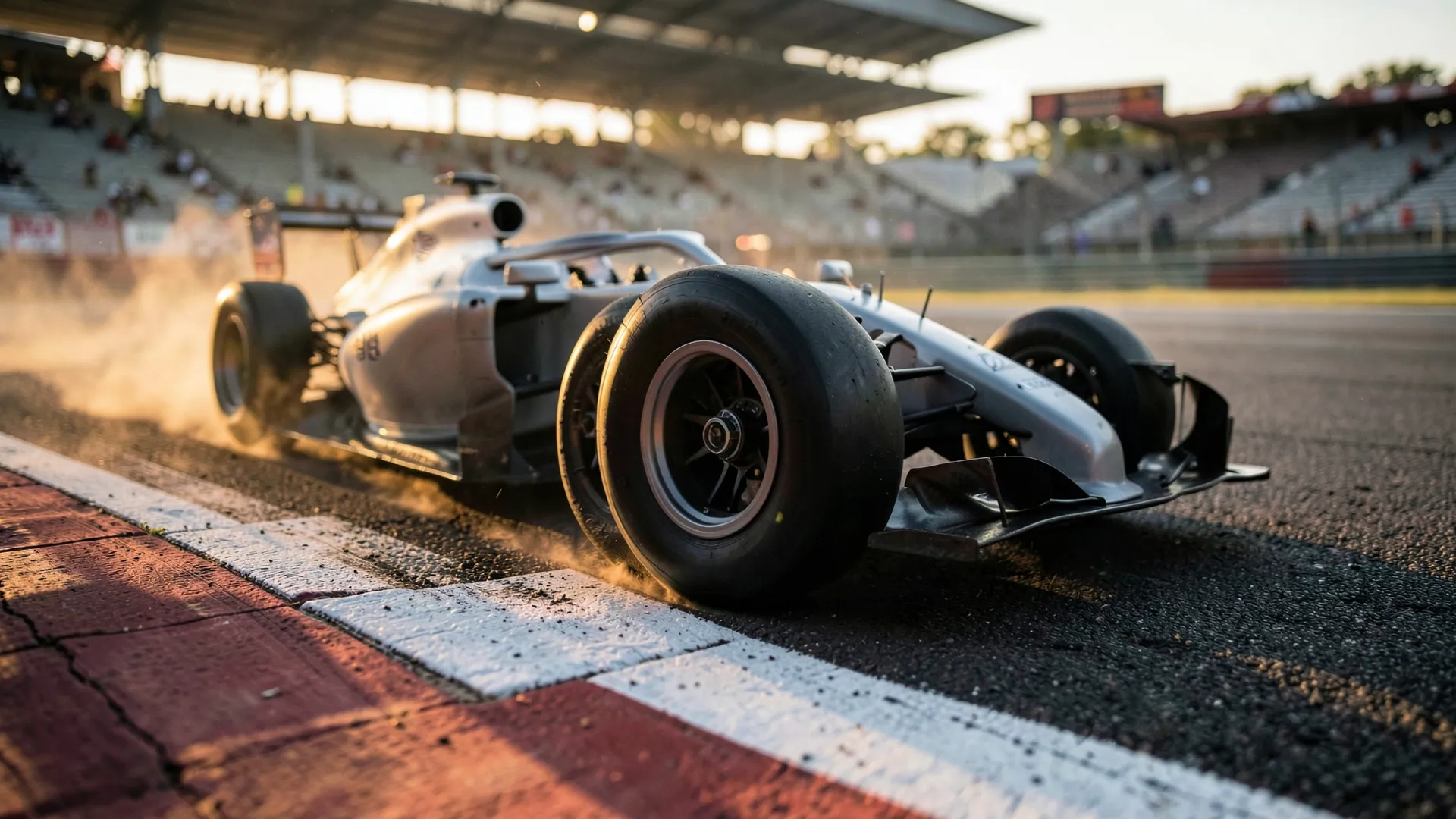
The FIA deleted 207 lap times for track limits violations during Friday practice at the United States Grand Prix, an extraordinary tally even at a circuit that has long tempted drivers wide. Andrea Kimi Antonelli arrives in Austin 102 points clear in the drivers’ championship, and he has argued that the layout of the Circuit of the Americas is partly responsible for the numbers. With qualifying today and the title mathematically within reach for the first time, the difference between a banker lap and a deleted one carries unusual weight.
What 207 deletions actually tell us
The rule itself is simple. The white lines define the edge of the circuit, and a driver who takes all four wheels beyond them has left the track. In practice and qualifying, the penalty is automatic: the lap time is struck from the record. In the race, offences are counted, with a black-and-white warning flag after the third and time penalties if the pattern continues.
Spread across a 22-car field, 207 deletions works out at more than nine per driver in a single day. That is a striking figure, but it needs context. Friday practice is exploratory by design. Drivers deliberately probe the edges of each corner to find where the time lives and where the line is drawn, and a deleted practice lap costs nothing beyond the data from that run. Some of those 207 offences were the system working exactly as intended, with drivers finding the boundary by crossing it.
Deletions also generate information. Every struck-off lap tells an engineer which corner exits are worth attacking and which are costing laps. By this morning, every team will have a map of where its drivers strayed, and the qualifying briefing will be built around it. The question is whether drivers can absorb that lesson when the stopwatch actually matters, because qualifying offers far less room to experiment than a practice session.
Antonelli’s case against the asphalt
Antonelli’s point, as reported by RacingNews365, is that the Austin layout itself contributes to the volume of violations. He is right, and the reasons are mechanical rather than mysterious.
The Circuit of the Americas (COTA) is a track of wide, sweeping corners, many of which open onto long straights. The fastest way through those exits often involves letting the car run out to the edge under power, because a tighter line means scrubbing speed and compromising the run that follows. Where a corner feeds a straight as long as the one after the Turn 11 hairpin, exit speed carries all the way to the next braking zone. That makes the temptation to use every centimetre stronger than at a circuit of slower, self-contained corners.
The decisive factor is what lies beyond the line. Where run-off is paved rather than gravel or grass, running wide carries no physical cost. The car does not slow down, the tyres are not damaged and there is no risk of beaching. The only deterrent is a camera and a deleted lap. Drivers are paid to find lap time, and if the track surface tells them that a wider line is faster and safe, they will take it until the timing screen tells them otherwise.
That is why the 207 figure reflects the circuit at least as much as the drivers. A self-policing edge, such as a narrow strip of gravel or grass, settles the matter at source. A white line backed only by electronic surveillance turns every exit into a judgement call made at 250km/h. Antonelli is not asking for leniency. He is pointing out that the FIA is policing a problem the circuit creates.
Where one deleted lap meets the arithmetic
With six rounds remaining, including this one, Antonelli has 340 points to George Russell’s 238. Lewis Hamilton is 111 behind, Max Verstappen 119 and Charles Leclerc 125. Once Austin is complete, five Grands Prix will remain, worth 125 points to a driver who wins every one of them.
For Antonelli to leave Texas as champion, his lead over every rival must exceed 125 points by Sunday evening. Only a win keeps that door open. Even then, Russell would have to score no more than a single point, and Hamilton would need to finish no higher than fifth. A second place for Antonelli would leave Russell in the fight regardless of where he finished.
It is a narrow path, but it is precisely the kind of scenario that qualifying shapes. Singapore offered a clear demonstration of how much grid position matters this season. Verstappen converted pole into victory, Leclerc finished where he started in second, and Antonelli climbed from fourth to third. Russell, meanwhile, started 19th and recovered to ninth for two points. On a circuit where overtaking is far more feasible than in Singapore, a recovery drive is less costly, but it still eats into the margin that Russell can least afford to lose.
The pressure falls unevenly. Antonelli can afford a tidy, slightly conservative lap that keeps all four wheels inside the line, because a front-row start protects his position even if it does not win him the title this weekend. Russell cannot. He needs to beat his team-mate on track, and that means attacking every exit at the limit. The driver chasing the championship has the strongest incentive to flirt with the white line, and is therefore the most exposed to a lap deletion that drops him down the grid.
A deleted lap in qualifying is rarely a matter of a single tenth. It can mean losing a banker run in Q1 and relying on a final attempt in traffic, or reaching Q3 with only one valid effort to count. Friday’s numbers suggest that several drivers will be eliminated or compromised today not because they lacked pace, but because they found it in the wrong place.
Austria 2023 and the case for strictness now
The FIA’s hard line in Austin makes more sense in light of recent history. At the 2023 Austrian Grand Prix, track limits went largely unchecked during the race, and the stewards spent hours afterwards working through roughly 1,200 reported infringements. Penalties were applied to a dozen drivers and the classification was revised long after the chequered flag. It was a fair outcome in principle and a poor spectacle in practice, because fans left the circuit not knowing the true result.
The lesson the FIA took from the Red Bull Ring was that policing has to happen in real time. A deleted lap on Friday or Saturday is a clean, immediate consequence. A five-second penalty applied after the podium ceremony undermines public confidence in the result. If the choice is between 207 deletions in practice and a rewritten classification on Sunday night, the former is plainly preferable.
COTA also has its own history of decisive off-track rulings. In 2024, Lando Norris passed Verstappen around the outside of Turn 12 having left the circuit, received a five-second penalty and lost a podium finish. That decision was contentious, but it set a standard: gaining an advantage beyond the white line here will be punished, whatever the stakes. Drivers arrived this weekend knowing that standard has not softened.
Strictness does not resolve the underlying problem, however. Consistent enforcement of a line that the circuit design encourages drivers to cross is better than inconsistent enforcement, but it is still a second-best solution. Austria improved its situation by adding gravel at problem corners. Austin’s organisers and the FIA should treat Friday’s figure as a clear case for following that example before the 2027 race, rather than accepting weekends in which camera monitoring does the work the circuit should be doing.
The lap that may decide more than pole
For this weekend, the rules are fixed and every driver knows where the lines are. The advantage will go to the driver who turns Friday’s deletion map into discipline, sacrificing a few hundredths at each exit in return for a lap that counts.
That suits Antonelli. He does not need to clinch the title in Austin, and his eight wins this season have been built as much on consistency as on raw speed. Russell has no such luxury. If he is the Mercedes driver who loses a lap to the white line today, the arithmetic for the final five rounds will become very difficult. The championship will probably not be settled on Sunday, but the shape of the remaining title fight could well be set in qualifying.