
Mercedes Arms Both Drivers for Austin as Its 2026 Supremacy Fades
Mercedes won the first six grands prix of 2026 but only five of the 11 since, and fitting its latest upgrade to both cars at Austin shows how seriously it takes the fight.
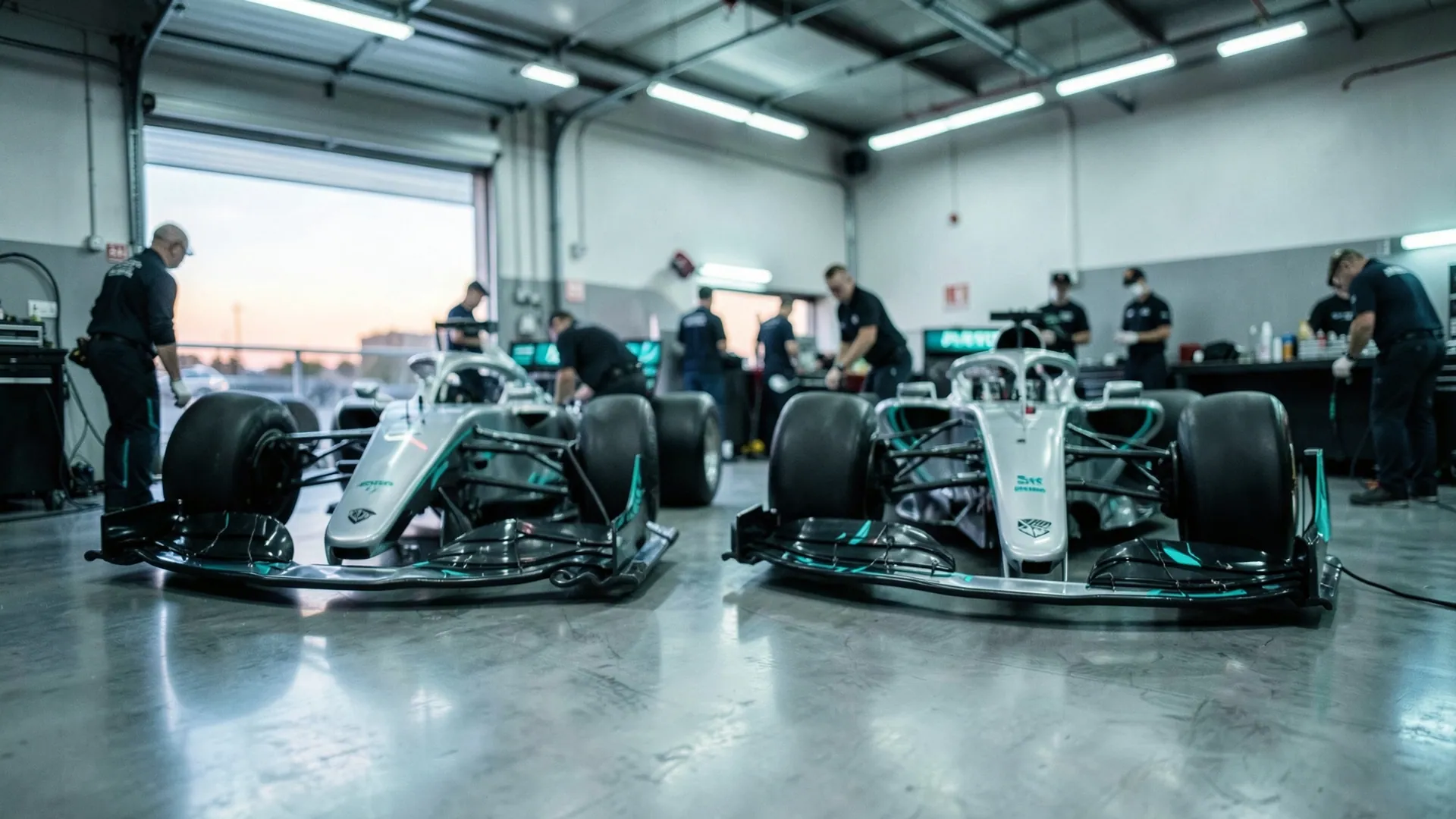
Mercedes will run its latest upgrade package on both Andrea Kimi Antonelli’s and George Russell’s cars at this weekend’s United States Grand Prix, ending the split specification it ran in Singapore. At Marina Bay only Antonelli had the new parts, and he finished third while Russell recovered from 19th on the grid to ninth. The decision to commit fully for Austin comes as the team concedes, in its own public assessments, that its rivals have closed in on the car that opened the season unbeaten.
Six from six, then five from 11
The headline numbers still look imperious. Mercedes leads the constructors’ championship on 578 points, 134 clear of Ferrari, and has won 11 of the 17 grands prix held so far. Antonelli has eight of those victories and a 102-point lead over Russell, who has the other three.
Split the season in two, though, and a different picture appears. Mercedes won each of the opening six rounds. Since then it has won five of 11, with the rest shared evenly among three rivals.
| Phase | Mercedes | Ferrari | McLaren | Red Bull |
|---|---|---|---|---|
| Rounds 1–6 | 6 | 0 | 0 | 0 |
| Rounds 7–17 | 5 | 2 | 2 | 2 |
That second line matters more than the first. A team winning fewer than half the races is no longer dominant, whatever the standings say. It is the strongest of four competitive teams, and the table suggests that has been the shape of the season for some time.
Singapore made it vivid. Max Verstappen converted pole into victory ahead of Charles Leclerc, and Mercedes left Marina Bay with 17 points. Ferrari and Red Bull each scored 26, and McLaren 22. Measured by points, Mercedes was the fourth-best team in the field that weekend. One street race does not define a season, and Russell’s grid position distorted the count. But Antonelli’s third place came from fourth on the grid, so even with the newer parts he was not quick enough to fight Verstappen or Leclerc for the win.
Mercedes has said publicly that it remains confident of winning again and is aware the challenge from the other top teams has grown. Both halves of that statement are true, and the upgrade decision is how the team intends to act on them.
What the Singapore split was for
Running different specifications on two cars is a standard way to validate new parts. When one car runs the update and the other runs the old package, engineers get a back-to-back comparison on the same track, in the same conditions and on the same weekend. That is the cleanest test available outside the wind tunnel and simulator. It shows whether gains predicted at the factory turn up on the stopwatch and in the sensor data, and whether the new parts change the car’s balance in ways the drivers can use.
The cost is that one driver races a car the team believes is slower. Mercedes chose to give the new package to its championship leader and accept that compromise for Russell, whose weekend was already complicated by starting near the back.
Moving both cars to the new specification in Austin tells us two things. First, the team is satisfied enough with what it learned in Singapore to stop hedging. Teams rarely double up on a package they still have doubts about, particularly when spare parts are expensive to produce under the cost cap. Second, Mercedes no longer believes it can afford to leave lap time on one car. At the start of the year a slower Russell would still have been fast enough. With Red Bull, Ferrari and McLaren all now capable of winning, it would cost points.
Circuit of the Americas is also a useful place to commit. Its high-speed opening sector, heavy braking zones and bumpy surface test aerodynamic load, mechanical grip and ride quality at once. A package that works there should travel well to the remaining tracks on the calendar.
Why Russell’s car matters as much as Antonelli’s
Look at the drivers’ table and upgrading Antonelli seems almost unnecessary. His lead over Russell is 102 points with six grands prix left, and he is 111 clear of Lewis Hamilton. On grand prix points alone, Antonelli could finish third in every remaining race behind a rival who wins all six and still be champion. The title is not mathematically settled, but it would take a collapse to lose it.
Russell’s position is where the real tension sits. He is second on 238 points, but Hamilton is only nine behind on 229, Verstappen is 17 behind on 221 and Leclerc is 23 adrift on 215. With Verstappen in this form, Russell could easily slip from second to fifth by the end of the season. A Mercedes one-two in the championship would be a clear statement about the season. Russell finishing behind both Ferraris and a Red Bull would weaken it, and Mercedes knows how that would be read.
There is also the constructors’ title. A 134-point lead over Ferrari is comfortable, not decisive. If Ferrari repeated its Singapore margin over Mercedes in each of the last six rounds, it would gain 54 points. That is not enough to overturn the deficit, but a couple of bad weekends, a retirement or a run of poor reliability could tighten things quickly. Two fully competitive cars are the best insurance Mercedes can buy.
The longer-term reason may be the most important. This is the first year of new technical rules, and the 2027 cars will build on the same framework. Every lap Russell completes on the new package produces data that shapes next year’s car. As the leading constructor, Mercedes also has the most restricted aerodynamic testing allowance, because the sliding scale gives the least wind tunnel and CFD time to the team at the top. It cannot recover lost development time at the factory, so learning from real running on both cars is worth more to Mercedes than to anyone.
How early dominance usually ends
None of this is unusual. Teams that interpret a new rule set best often open with a run of results that cannot last, because their rivals have the same deadline to catch up and a clear target to aim at. In 2009 Brawn and Jenson Button won six of the first seven races before Red Bull’s development rate turned the second half into a defence. Button held on to the title because the early points were already banked. In 2024 Red Bull opened as the clear favourite before McLaren’s mid-season upgrades swung the balance, and McLaren went on to win the constructors’ championship.
Mercedes in 2026 is closer to the Brawn example than the Red Bull one. Its early advantage was big enough to build a cushion that its rivals’ faster development is unlikely to close before Abu Dhabi. That is why the Austin decision is more interesting than it first appears. A team simply defending a points lead could ease off, save parts and shift resources to 2027. Mercedes is doing the opposite and spending to stay fast now.
That says something about how the team reads the competitive order. If Mercedes believed its rivals were peaking, it could manage the run-in. Committing both cars suggests it thinks Red Bull, Ferrari and McLaren will keep improving, and that the convergence seen since round seven is a lasting trend rather than a passing phase.
Austin as the test of Mercedes’ development race
The title picture will not decide whether this was the right call, because Antonelli is close to the championship either way. The real test is whether Mercedes can win again on merit, against a Verstappen who has just won from pole and a Ferrari pair who finished second and sixth in Singapore.
The judgement here is simple. If neither Mercedes can fight for victory at Austin with the new package fitted, the team will have to accept that the season’s competitive balance has shifted for good, and that 2027 will start as an open contest rather than a defence of its advantage. If Antonelli and Russell finish at the front, the Singapore split will look like a well-timed step that showed Mercedes can still out-develop its rivals.