
Red Bull Give Verstappen a New Race Engineer as Russell Talks Up Their Threat
Max Verstappen gets a new race engineer in Tom Hart as George Russell names Red Bull the team to beat, while Honda promises answers over Fernando Alonso's mysterious engine problem.
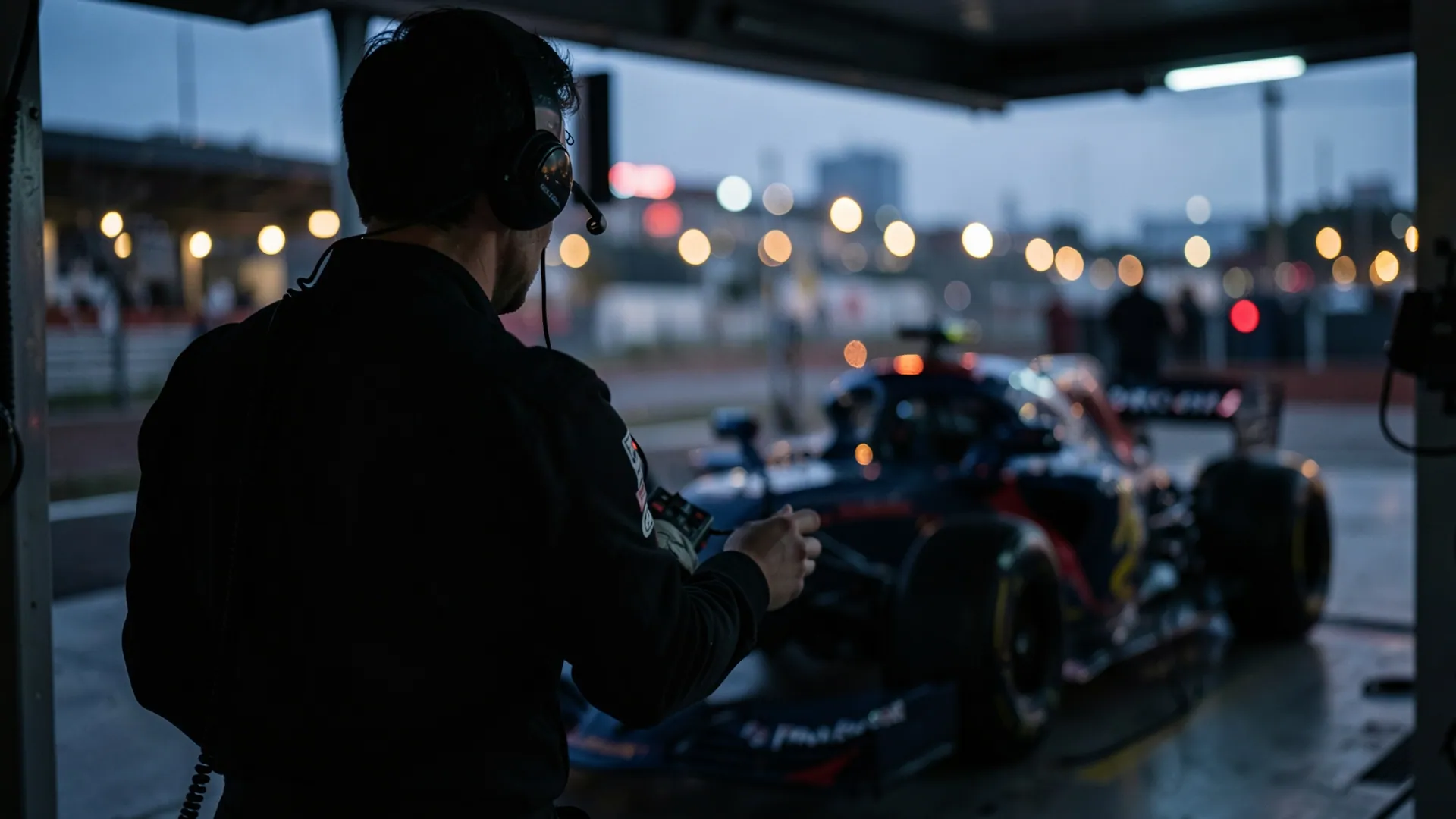
Red Bull have given Max Verstappen a new race engineer, Tom Hart, in the biggest change on that side of the garage in a decade. It comes three days after Verstappen converted pole into victory at the Singapore Grand Prix, and on the same day that George Russell named Red Bull the team to beat and Honda pledged to find the cause of Fernando Alonso’s engine trouble. With six rounds left and Austin next on 25 October, the closing phase of 2026 is taking shape around a team that started the year a long way from where it wanted to be.
A new voice in Verstappen’s ear
Since his promotion to Red Bull in 2016, Verstappen has had Gianpiero Lambiase on the radio. Their exchanges have been blunt, occasionally combustible and always efficient. Over four world championships between 2021 and 2024, that relationship became part of how Verstappen goes racing. Fans tend to remember the sharp lines that make the broadcast. The real work happens elsewhere, in thousands of small calibrations: knowing when to feed a driver information and when to stay silent, how he describes balance, and what “the rear is gone” means at one circuit compared with another.
That is what Hart inherits. A race engineer translates a driver’s feel into set-up changes and translates the team’s strategic picture back into something the driver can act on at 300km/h. The data can be learned quickly. The trust takes time, and Verstappen does not hand it out lightly.
There is a reasonable argument that he is the driver best equipped to absorb such a change. Verstappen is famously self-sufficient in the car, often making strategic judgements before the pit wall does, and he is less dependent than most on a particular voice to settle him. The bigger question is what the move says about Red Bull’s direction. This is a team that has lost Adrian Newey, Jonathan Wheatley and, in July 2025, Christian Horner, with Laurent Mekies taking charge. Reshaping the group around its lead driver fits a broader pattern of a team rebuilding its structure while also building its own power unit for the first time.
Why the timing matters less than it looks
Verstappen is fourth in the standings, 119 points behind Andrea Kimi Antonelli, with 150 points left to win. His title chances are remote at best, so there is little for a new partnership to compromise. If the relationship is going to need bedding in, this is the cheapest moment to do it. The real judgement on this decision will come in 2027.
Russell’s Red Bull theory meets the standings
According to PlanetF1, Russell has declared Red Bull “the team to beat”, and Antonelli has offered his own view in response. On the surface it is a curious thing for a Mercedes driver to say. Mercedes have won 11 of the 17 grands prix, lead the constructors’ championship on 578 points, 134 clear of Ferrari, and have the top two drivers in the standings.
Read as a comment on form rather than on the season, it makes more sense. Verstappen told RaceFans that the car felt “scary” to drive early in the year, and the recovery since has been striking. Singapore underlined it. Verstappen led from pole to flag, and Isack Hadjar climbed from 22nd on the grid to score a point in 10th. Antonelli could manage only third from fourth, while Russell salvaged ninth after starting 19th.
There is also a competitive logic to Russell’s framing. He is second in the championship on 238 points, and his realistic target now is to secure runner-up. Antonelli’s 102-point lead is worth more than four grand prix wins, which leaves Russell needing a run of misfortune for his team-mate on top of victories of his own. Talking up Red Bull serves two purposes. It reframes Mercedes as hunters rather than hunted, and it acknowledges where the threat to his second place is likely to come from.
The numbers behind Red Bull’s revival come with a caveat:
- Verstappen has 221 points; Hadjar has 97. The gap between the two cars still limits the team.
- Red Bull are fourth in the constructors’ standings on 332 points, seven behind McLaren.
- Verstappen has two wins, the same as Lando Norris, and both trail Antonelli’s eight by a distance.
Red Bull may well be the fastest package over a single weekend right now. Being the team to beat across six rounds requires two cars scoring, and that is not yet the case.
Hamilton’s slide and the scramble for second
Lewis Hamilton started third in Singapore and finished sixth, while Charles Leclerc took second. PlanetF1 has since published untelevised team radio from Hamilton’s race, including the line “Shall we wait?”. A single question out of context proves very little. It does, however, invite the kind of scrutiny Ferrari’s strategy calls have attracted repeatedly over the years. Losing three places from the second row on a street circuit, where track position is everything, is costly.
The cost matters more than usual because the fight for second in the drivers’ championship is the most crowded contest left in the sport:
| Position | Driver | Team | Points | Gap to second |
|---|---|---|---|---|
| 2 | George Russell | Mercedes | 238 | – |
| 3 | Lewis Hamilton | Ferrari | 229 | 9 |
| 4 | Max Verstappen | Red Bull | 221 | 17 |
| 5 | Charles Leclerc | Ferrari | 215 | 23 |
| 6 | Lando Norris | McLaren | 201 | 37 |
With five drivers covered by 37 points and six grands prix to run, one strong weekend can move a driver two places. Hamilton’s eight points in Singapore against Verstappen’s 25 cut his advantage over the Red Bull driver to eight. Had he held third, he would be within two points of Russell.
Ferrari are comfortable in second place in the constructors’ table, 105 points clear of McLaren. The intra-team picture is more delicate. Leclerc’s 18 points in Singapore brought him to within 14 of Hamilton, and with no title at stake, both drivers will want to finish the year as Ferrari’s lead driver. How the pit wall manages that over the final six rounds will reveal a good deal about its priorities for 2027.
Honda’s Alonso puzzle and Verstappen’s engine lecture
RacingNews365 reports that Honda has promised to get to the bottom of what it describes as a mysterious problem with Alonso’s engine. That a manufacturer is making the pledge publicly says something about the pressure on this project. Aston Martin entered 2026 with a works Honda partnership, Newey on the technical side and heavy investment in facilities. They are 10th of 11 in the constructors’ championship on seven points, ahead of only newcomers Cadillac.
Singapore was another bleak evening. Alonso started 20th and finished 16th, a lap down, while Lance Stroll retired from 21st on the grid. A problem described as mysterious implies something more elusive than a straightforward component failure, and under these regulations, with electrical power providing close to half the output, the possible culprits multiply. Energy recovery, deployment strategy and the software governing both can all cost lap time without anything visibly breaking.
There is a pointed contrast with Red Bull. Honda powered Verstappen to his titles; Red Bull now build their own power unit with Ford and have a car that wins races. Honda’s challenge is to show that its 2026 engine, rather than the chassis or the integration between the two, is not the primary limitation.
Verstappen and the former drivers
That complexity sits behind Verstappen’s latest argument. He has hit back at former drivers who criticised his stance on the 2026 regulations, saying: “They don’t know how the engine works.” It is a characteristically direct response, and it has some merit. These power units are far harder to understand from the outside than their predecessors, and much of what decides a lap now happens in the energy management rather than in the driver’s right foot.
Former drivers are entitled to judge the racing as spectators do, however, and the sport benefits from people willing to question whether the formula is producing the competition it promised. The more productive debate would focus on the specifics: where the energy rules shape the racing, and whether that is what F1 wanted.
Horner speaks openly about the cost of the job
In an interview with Motorsport.com, Horner has revealed that he suffered panic attacks during his Formula 1 career. It is a striking admission from a man who spent two decades as Red Bull’s team principal, from 2005 until his departure in July 2025, and who was often seen as the most composed political operator in the paddock.
Team principals rarely discuss their own health. The job combines an unrelenting calendar, responsibility for hundreds or thousands of staff, constant negotiation with rivals and governing bodies, and results that are judged in public every other weekend. Drivers have increasingly spoken about the psychological demands of the sport in recent years. Hearing the same from the pit wall broadens that conversation in a useful way, and teams would do well to treat it as a prompt to look at how they support senior staff as well as drivers.
Separately, RacingNews365 reports that Horner has given an update on a possible F1 comeback, including a hint about his next move. Any return would be one of the stories of the winter, given his record and his connections. The interview about his health deserves to be read on its own terms first.
GT racing, IndyCar, Rwanda and the race for third
- Verstappen goes GT racing. Verstappen races at Portimão in the GT World Challenge this weekend, sharing the grid with Valentino Rossi, who told Crash.net that the Red Bull driver will be a “big problem”. Crash.net reports that the event can be watched for free.
- Tsunoda heads to IndyCar. Yuki Tsunoda, absent from the 2026 grid, is expected to test IndyCar machinery in the United States this month, according to GPfans. An American move would suit a driver whose racecraft has never been in question.
- Rwanda’s circuit takes shape. Designers of the planned RISE Motordrome have described record-breaking elevation changes, high-speed corners and lakeside sections. President Paul Kagame has urged critics to “take a breath” before judging the event. F1 has not raced in Africa since Kyalami in 1993, and the scrutiny of this project will not ease simply because the track looks dramatic.
- The money behind the teams. RacingNews365’s Jake Nichol has examined the annual financial filings of the eight UK-based teams and of F1 itself. These filings are one of the few windows into how teams are operating under the cost cap.
- Cadillac’s wait goes on. Sergio Pérez finished 17th and Valtteri Bottas 19th in Singapore, leaving the new team as the only one without a point after 17 rounds.
- Third place is the constructors’ fight to watch in Austin. McLaren lead Red Bull by seven points. On current form, Red Bull look likelier to finish the season ahead, provided Hadjar’s Singapore recovery is not a one-off.