
McLaren Bets on Austin Upgrade to Hold Off Red Bull in Fight for Third
McLaren brings an MCL40 upgrade to the United States Grand Prix and openly admits it could misfire, with only seven points protecting third place from Red Bull and six rounds remaining.
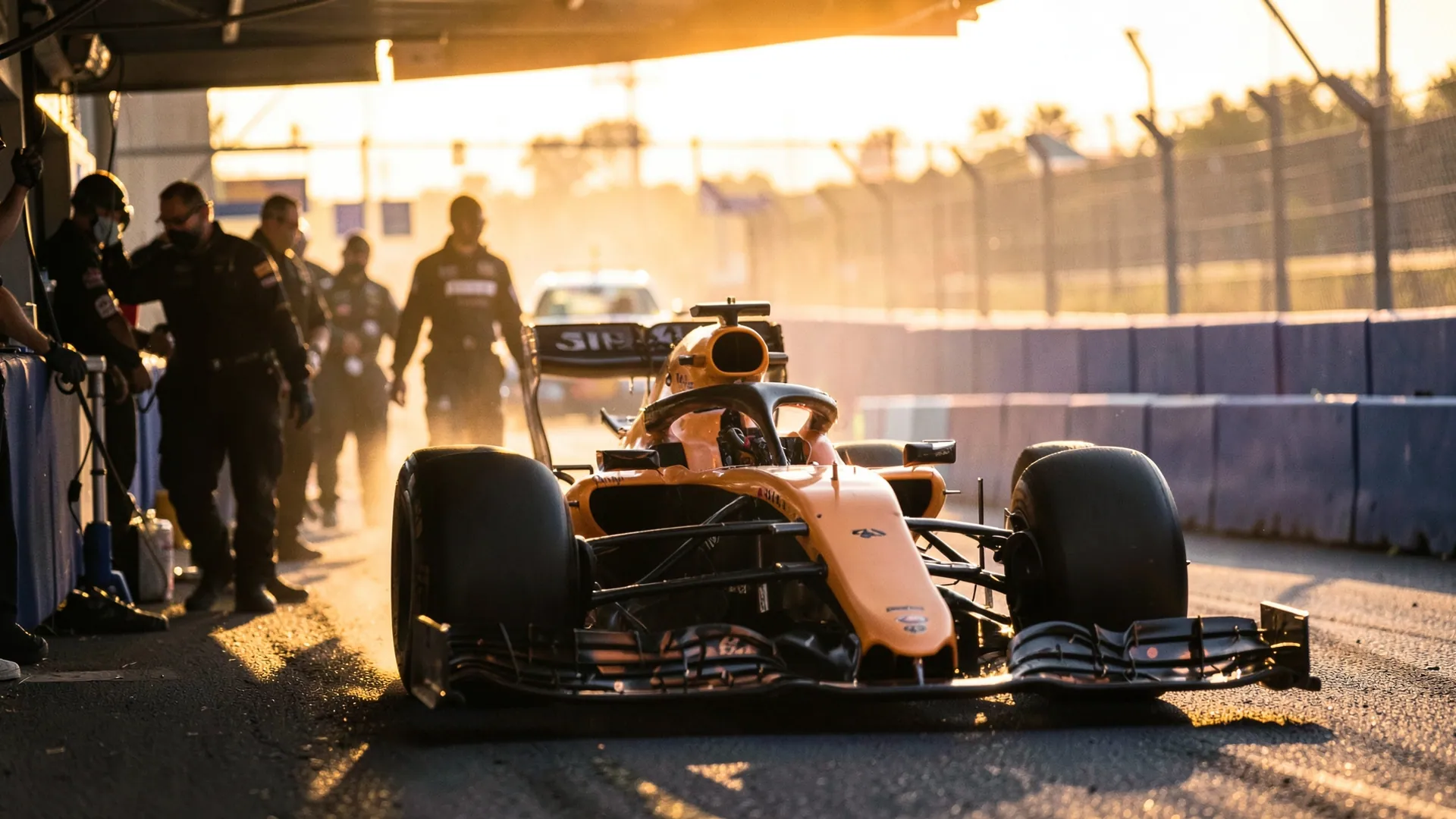
McLaren will introduce an upgrade package for the MCL40 at this weekend’s United States Grand Prix in Austin, aimed at the weaknesses that have dragged the team into a fight for third in the constructors’ championship. With six rounds left, the reigning champions sit on 339 points, only seven clear of Red Bull. According to PlanetF1, the team’s own assessment of the update is unusually candid: it may go right, and it may go wrong.
That admission is the most revealing part of the story. Teams rarely talk down new parts before they have turned a wheel. That McLaren has chosen to do so shows how finely balanced it judges this decision to be.
From “no fix” to a new package
Not long ago, Oscar Piastri was saying there was no fix coming for the car’s shortcomings. Taken at face value, that sounded like a team prepared to ride out the year with what it had and push its resources towards 2027. The Austin package suggests either that the thinking at Woking has shifted, or that Piastri was referring to a fundamental cure rather than incremental help.
Either way, the conclusion is the same. McLaren has decided that standing still is a bigger risk than adding new parts to a car it does not yet fully understand. That is a defensible call, but it is not a comfortable one.
Piastri’s own season shows why the team cannot simply shrug. He has 138 points and no wins, which leaves him seventh in the standings and 63 behind Lando Norris. Through much of 2025 he led the championship. When a driver of his calibre struggles this much to extract performance, the usual explanation is a car with a narrow operating window. That is precisely the kind of problem an upgrade can either widen or make worse.
Singapore’s seven-point warning
The constructors’ table explains the urgency, and the Singapore Grand Prix on 11 October explains the trend.
| Team | Driver | Started | Finished | Points |
|---|---|---|---|---|
| McLaren | Lando Norris | 5 | 4 | 12 |
| McLaren | Oscar Piastri | 6 | 5 | 10 |
| Red Bull | Max Verstappen | 1 | 1 | 25 |
| Red Bull | Isack Hadjar | 22 | 10 | 1 |
McLaren left Marina Bay with 22 points and Red Bull with 26, so the gap shrank from 11 to seven. What should trouble McLaren is the manner of it. Both of its cars ran cleanly, converting fifth and sixth on the grid into fourth and fifth at the flag. Red Bull’s second car started 22nd and recovered only to 10th. McLaren had close to a best-case result for its current pace and still lost ground, because Verstappen won from pole.
That points to two different models of scoring. Red Bull leans heavily on Verstappen, who has 221 points and two wins and sits 20 points ahead of Norris in the drivers’ standings. Hadjar’s 97 points put him eighth, a useful but not decisive contribution. McLaren has two scorers but no reliable winner. Norris has taken both of its victories, and neither driver has run at the front often enough to match a Verstappen win with any regularity.
Above them, Ferrari’s 444 points put second place 105 points away. That is not a realistic target over six rounds, so McLaren’s season now comes down to holding off Red Bull. Nor is there any threat from behind: RB F1 Team is fifth on 100 points.
Why a late upgrade is a genuine gamble
McLaren’s caution is well founded, and the reasons are technical as much as psychological.
Correlation is still shallow. This is the first season of a new set of regulations. Every team’s understanding of how wind-tunnel and CFD results translate to the track is thinner than it would be three years into a rules cycle. A part can produce exactly the downforce figure the tunnel promised and still make the car worse, because it changes how the aerodynamic platform responds to ride height, roll or yaw. The headline number goes up while the usable performance goes down.
Circuit of the Americas is a demanding test bench. The track is notoriously bumpy and asks for very different things in quick succession: the high-speed direction changes through the opening sector, a long back straight, and a slow, traction-limited final section. A car that becomes more sensitive to ride height will be exposed quickly. If the upgrade sharpens the MCL40’s peak but narrows its window further, Austin is the kind of venue where that shows.
Evaluation time is tight. McLaren has Friday practice to establish whether the new parts are an improvement, understand their set-up implications and decide whether to commit. If the answer is unclear, reverting to the old specification costs track time and leaves the engineers chasing a baseline they have not refined for this circuit. A team only seven points clear can ill afford a weekend spent experimenting.
Recent history offers precedent in both directions. McLaren’s own 2023 season turned on mid-year upgrades introduced in Austria and at Silverstone, which took a car that had been struggling near the back of the midfield and made it a regular podium contender. Aston Martin’s experience that same year is the cautionary tale: its in-season development took the car backwards, and the team spent the latter part of the season switching between old and new specifications to find a version that worked.
There is also a cost cap trade-off. Every hour of design and manufacturing spent on the MCL40 is an hour not spent on next year’s car. In the first year of a rules cycle, though, that expense carries more value than usual. Whatever McLaren learns about why its car behaves as it does should transfer into 2027, even if the parts themselves disappoint this weekend. Seen that way, the upgrade is partly an experiment, and a failed one would still produce useful data.
What third place is really worth
Constructors’ positions determine the distribution of commercial revenue, and the gap between third and fourth amounts to millions. For any team operating under a budget cap, that money matters.
The reputational stakes are higher still. McLaren won the constructors’ title in 2024 and 2025, and in 2026 it runs the same Mercedes power unit that has carried the works team to 11 wins from 17 rounds and a lead of 134 points over Ferrari. If McLaren finishes behind Red Bull with that engine in the back, the verdict on its chassis work will be hard to dispute. Red Bull, by contrast, is in the first season of its own power unit programme. Being overhauled by a team carrying that extra burden would sting.
The candour about the upgrade, then, reads as an honest description of the situation rather than a hedge. McLaren could have sat on a seven-point lead and hoped that Hadjar’s inconsistency would protect it. Singapore showed why that is a weak plan: even when Red Bull’s second car has a poor weekend, a Verstappen win nearly cancels out two solid McLaren finishes.
Saturday in Austin will set the tone
McLaren is right to bring the package. Whether either car wins at the Circuit of the Americas matters less than whether Norris and Piastri can consistently finish ahead of Hadjar and close to Verstappen. If they can, McLaren’s two-car scoring will be too much for a Red Bull team that depends so heavily on one driver.
The first sign will come in qualifying. If both MCL40s line up in the top five on Saturday, the upgrade will have done its job. If McLaren is reverting parts after Friday, a seven-point cushion looks fragile against a driver who has just won from pole. The task is plain: McLaren needs to leave Austin with its lead intact and still be ahead after the two rounds that follow, or third place is likely to belong to Red Bull by the season finale.