
Waché Traces Verstappen's RB22 Tyre Wear to Aero, Grip and Suspension Link
Red Bull's technical director has tied the RB22's degradation to a chain of aerodynamic, mechanical and suspension factors, a diagnosis that matters as Max Verstappen takes his Singapore form to Austin.
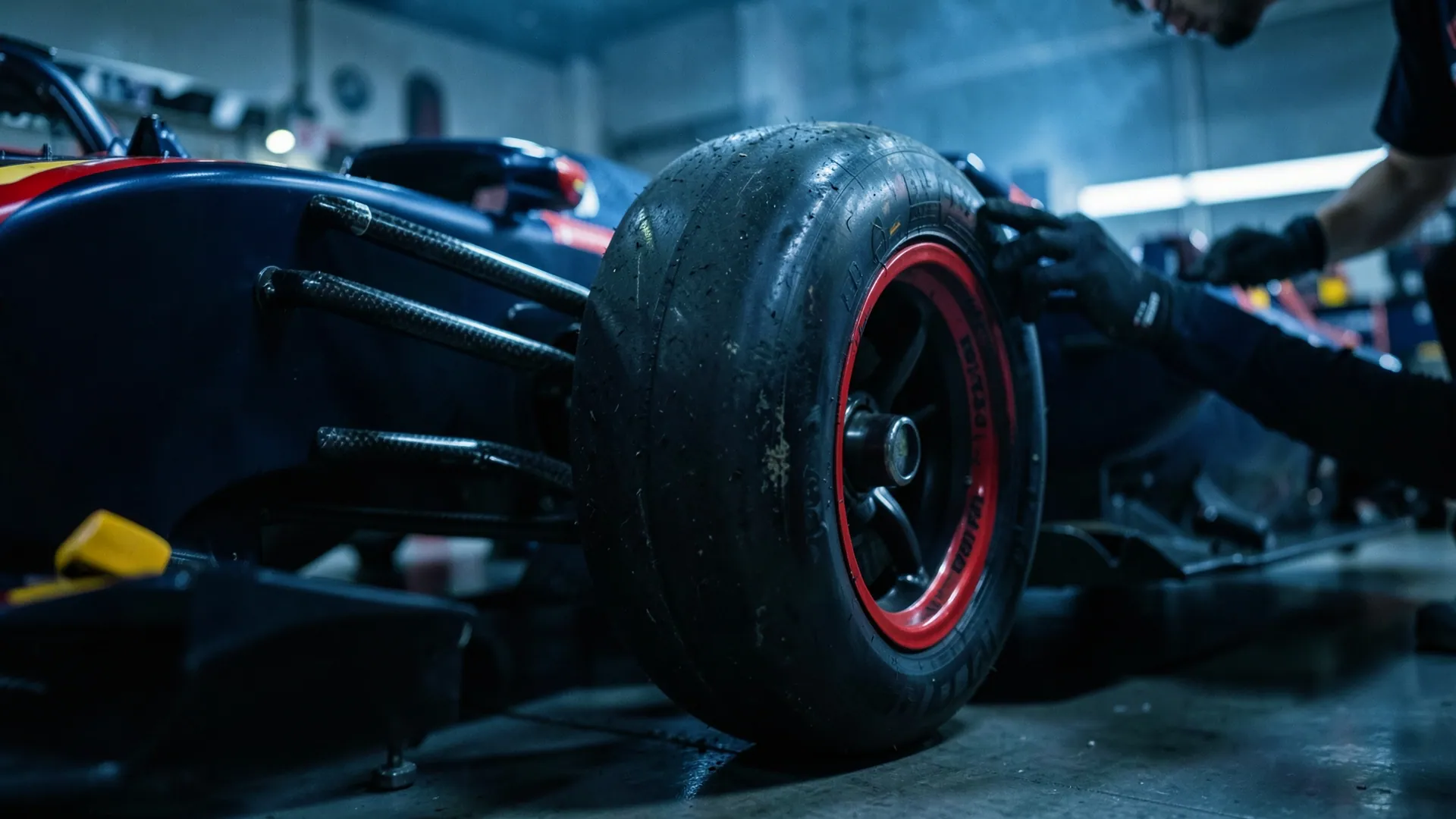
Red Bull technical director Pierre Waché has explained that the tyre degradation affecting Max Verstappen’s RB22 comes from a linked chain of aero wear, mechanical grip and suspension behaviour, according to PlanetF1. The explanation arrives 10 days after Verstappen converted pole into victory at the Singapore Grand Prix, and four days before Round 18 at the Circuit of the Americas. The timing gives the diagnosis an immediate test. Marina Bay showed that the RB22 can win; Austin will show whether it can do so on a circuit that leans hard on the very weakness Waché has described.
Why a chain is harder to fix than a fault
The most revealing part of Waché’s account is that he did not blame a single component. He described three related causes. When a technical director frames a problem this way, he is usually conceding that no bolt-on upgrade will make it disappear.
The mechanism is familiar to any race engineer. A car that generates much of its downforce from the floor is sensitive to ride height and pitch, so engineers want a stable aerodynamic platform. The simplest way to protect that platform is stiffer suspension, which limits how far the car moves under braking, in corners and over bumps. Stiffness has a cost, though. A stiffly sprung car soaks up fewer of the road’s irregularities, keeps the tyre in less consistent contact with the tarmac and produces less mechanical grip. Once mechanical grip drops, the tyre slides more. Sliding generates heat, heat accelerates wear, and the degradation then compounds over a stint.
Run the trade-off the other way and the problem moves rather than disappears. Softer suspension helps the tyre but lets the platform wander, so downforce becomes inconsistent through a corner. The driver then feels the car move around beneath him, and the tyre slides anyway, this time because the aerodynamic load has gone missing.
That is why Waché’s framing matters. The aero, mechanical and suspension elements cannot be tuned in isolation. Every gain in one area has to be paid for in another, and the art lies in finding a window where the payment is smallest. The 2026 regulations have made that window narrower. Reduced downforce and narrower Pirelli tyres push teams to rely more on mechanical grip, and they shrink the margin available to cover an imperfect balance. A car whose platform demands a firm set-up is penalised twice under these rules.
Red Bull has been here before. The RB20’s struggles over kerbs and bumps in 2024 were a version of the same dilemma: a car with a sharp aerodynamic peak that became awkward the moment the surface stopped being smooth. The RB22 is a different machine under different rules, but the engineering tension Waché described has a recent precedent at Milton Keynes.
What Singapore proved, and what it did not
Verstappen’s Singapore win was clean. He started on pole, finished ahead of Charles Leclerc and Andrea Kimi Antonelli, and collected the second victory of his season. Isack Hadjar’s drive from 22nd on the grid to 10th added a point and suggested the car’s race pace was healthy in traffic as well as in clean air.
The circuit’s characteristics should temper any wider conclusion. Marina Bay is slow, stop-start and dominated by traction zones. It rarely punishes tyres with long periods of sustained lateral load, the kind of punishment that faster circuits deliver. At a track like that, a car with a degradation weakness can hide it, especially from the front, where the leader controls the pace and manages the rubber rather than fighting for track position.
Nor did Singapore reset the season. Verstappen has two wins from 17 rounds. Mercedes has 11 between Antonelli’s eight and George Russell’s three. Antonelli finished third in Singapore and still leads the championship by 102 points from his team-mate. One strong weekend on a circuit that suited the car’s strengths does not make the RB22 the season’s benchmark.
Austin is the sterner examiner
The Circuit of the Americas asks almost every question that Waché’s explanation raises. The high-speed esses in the first sector load the tyres laterally, one direction after another, with no time for them to recover. The surface has a long reputation for bumps, which exposes any car that needs a stiff set-up to keep its floor working. The long back straight and the tight final sector then demand traction and braking stability, so the car has to perform across very different conditions in a single lap.
The bumps have shaped results here before. In 2023 Lewis Hamilton and Leclerc were both disqualified after the race for excessive skid-block wear. Their cars had been run too low over a surface that rewarded aggressive ride heights and then punished them. That episode captures the Austin dilemma neatly. Run low and stiff for aerodynamic performance and you risk the plank and the tyres. Run high and soft for safety and you give away lap time.
For Red Bull, the question is whether the understanding Waché has outlined has already produced set-up gains that travel, or whether Singapore simply flattered the car. The team has historically gone well in Austin, and Verstappen knows the circuit’s rhythm intimately. History will not help much, however, if the RB22 has to choose between protecting its platform and protecting its tyres through the esses. Watch the long runs in practice. A car that holds its lap times across a stint at COTA has addressed the chain. One that falls away after a handful of laps has not.
The ‘team to beat’ tag and the fight Red Bull is actually in
Verstappen’s Singapore form has prompted some in the paddock to call Red Bull the team to beat. Ferrari has pushed back against that label, PlanetF1 reports, and on the evidence of the standings it has a point. Ferrari sits second in the constructors’ championship on 444 points, more than 100 clear of Red Bull. Leclerc finished second in Singapore, and both Ferrari drivers are within touching distance of Verstappen in the drivers’ table.
The real stakes for Red Bull over the final six rounds sit some way below the title. Antonelli’s lead of 119 points over Verstappen puts the championship beyond realistic reach unless the Mercedes driver suffers a dramatic collapse. The scrap for second, though, is among the tightest of the year:
| Position | Driver | Points | Gap to 2nd |
|---|---|---|---|
| 2 | George Russell (Mercedes) | 238 | – |
| 3 | Lewis Hamilton (Ferrari) | 229 | 9 |
| 4 | Max Verstappen (Red Bull) | 221 | 17 |
| 5 | Charles Leclerc (Ferrari) | 215 | 23 |
Four drivers are covered by 23 points, with six Grands Prix left. A single win could reshuffle that order. A single weekend of heavy degradation could do the same in reverse.
The constructors’ picture is just as pointed. Red Bull is fourth on 332 points, seven behind McLaren in third. That gap matters for prize money and for pride, and it shows why the degradation problem is a team issue as much as a Verstappen one. Hadjar has 97 points to Verstappen’s 221. McLaren’s pairing of Lando Norris and Oscar Piastri has given it a more even spread, with both cars finishing ahead of Hamilton in Singapore. If the RB22’s tyre behaviour makes it harder to drive at the limit, the less experienced driver usually feels that most. That puts Red Bull’s chances of overhauling McLaren in Hadjar’s hands as much as Verstappen’s.
What Texas will tell Red Bull
Austin is the place to judge Waché’s diagnosis. If the RB22 can live with its tyres through the esses and over the bumps, Singapore will look like the start of a strong finish. In that case Verstappen becomes the favourite to climb past Hamilton and Russell into second, and Red Bull the likelier team to catch McLaren. If the degradation returns, Ferrari’s objection to the “team to beat” label will look justified within a week. A problem that a technical director describes as a chain of related causes is rarely solved in a single fortnight. Expect a stronger Red Bull in Texas, but not yet a complete one.