
Russell Admits Raising His Risk in Las Vegas as Third Place Slips Away
George Russell says he deliberately took more risk in Las Vegas to chase highlights, but the approach cost him third place in the standings with two rounds left.
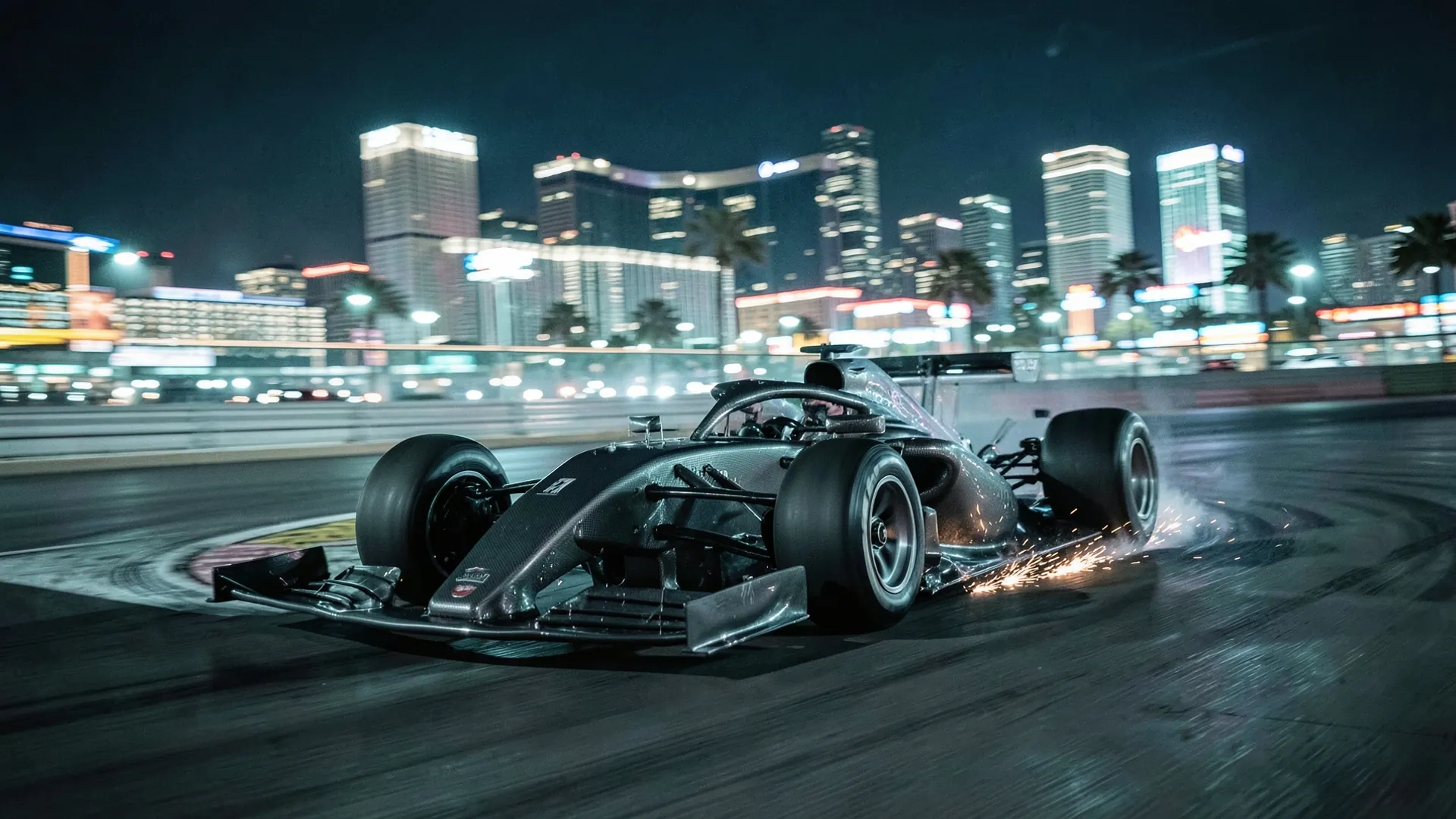
George Russell has admitted that he turned up his “risk dial” at last weekend’s Las Vegas Grand Prix because he wants “highlights” before the 2026 season ends. The Mercedes driver started from the front row alongside Max Verstappen and was classified ninth after a crash. Speaking to PlanetF1, he linked that crash to a deliberate decision to take more risk. In the same week he has renewed hostilities with Verstappen and accused sections of the media of spinning the truth, which suggests a driver whose priorities have changed with the title gone.
From the front row to two points
The bare numbers from Las Vegas are unkind. Russell started second, with Verstappen on pole and Lando Norris third. Verstappen won, Norris finished second and Oscar Piastri, who started 17th, completed the podium. Russell took the flag in ninth for two points, behind both Alpines, Lewis Hamilton and Carlos Sainz, who had started 20th in the Williams.
Andrea Kimi Antonelli, starting sixth in the other Mercedes, finished fourth. In the same car, on the same night, the team-mate who started four places further back scored 10 more points.
Admitting that you raised your risk tolerance is unusual in itself. Drivers normally frame an error as a misjudgement, a gust of wind or a cold tyre, and Las Vegas has offered plenty of all three since F1 returned to the Strip. Russell instead chose to explain a mistake as the product of intent. That honesty deserves some credit. It also invites a harder question about what exactly he was trying to achieve.
A title already settled, a podium place still live
The case for Russell taking risks is easy to make. Antonelli leads the drivers’ championship on 402 points, 98 clear of Verstappen. With only Qatar and the season finale remaining, that margin cannot be overhauled, so the title is settled. Mercedes are equally secure in the constructors’ standings on 666 points, 149 ahead of Ferrari. Russell is 138 points behind his team-mate. In championship terms there is no team objective left for him to protect.
Antonelli’s nine wins to Russell’s three tell their own story. Russell arrived in 2026 as the senior Mercedes driver in the first year of the new regulations, the obvious candidate to lead the team’s challenge. Instead a driver in only his second season has won the title in the same car. Wanting a few memorable moments to close a year like that is an understandable human impulse.
But the impulse ignores the table. Russell is not drifting in no man’s land. The fight for third is one of the closest on the grid:
| Position | Driver | Team | Points |
|---|---|---|---|
| 3 | Lewis Hamilton | Ferrari | 267 |
| 4 | George Russell | Mercedes | 264 |
| 5 | Lando Norris | McLaren | 264 |
| 6 | Charles Leclerc | Ferrari | 250 |
Before Las Vegas, Russell held third on 262 points, one ahead of Hamilton on 261 and 16 clear of Norris on 246. One race later he is fourth, three points behind Hamilton and level with Norris, while Charles Leclerc is only 14 points further back. The extra risk cost him more than a strong result. It cost him a championship position he had held.
Third in the standings is not a title, and nobody frames a “best of the rest” certificate. Yet for a driver whose year has been defined by being outscored by a younger team-mate, finishing ahead of Hamilton, Norris and Leclerc would be a meaningful marker. Two Grands Prix remain, and that marker is now harder to secure because of a choice Russell has described as deliberate.
Verstappen, Lusail and a grudge that never cooled
The risk-dial comments landed alongside another flare-up with Verstappen, which has dominated the conversation around Russell this week. GPfans reports that he has also turned on some members of the press, saying “they spin the truth”. In a separate interview reported by Crash.net, Russell described both Verstappen and Hamilton as “ruthless” while drawing a pointed distinction between the two.
The history here is long. At Qatar in 2024, Verstappen received a grid penalty after Russell complained about being impeded in qualifying. Verstappen said he had lost all respect for Russell, and Russell responded by calling him a bully. At the 2025 Spanish Grand Prix, Verstappen drove into Russell after being told to give a place back and was handed a 10-second penalty that dropped him to 10th. Each episode has hardened the grudge rather than resolved it.
The timing is awkward. The next round is at Lusail on Sunday, the circuit where the feud began. Verstappen arrives as the Las Vegas winner, the clear second-best driver of the season and 37 points clear of Hamilton in second place, with little left to chase in the standings. Russell arrives having publicly said he is willing to accept more risk. Two drivers who feel they have little to protect, a personal grievance and a track where overtaking demands commitment through fast corners make an uncomfortable combination for the stewards.
Comparing Verstappen with Hamilton is also an old Russell habit. He spent three seasons alongside Hamilton at Mercedes and has always positioned himself as someone who understands what elite ruthlessness looks like up close. The comparison keeps Russell’s name in the same sentence as two multiple world champions, which may be part of the point.
The trouble with fighting the press
The media jab is the least surprising and the least productive element of the week. Every driver feels misrepresented at some point, and the volume of coverage around the Verstappen relationship means some of it will have been less careful than it should have been. Russell is entitled to say so.
The difficulty is that he has made himself the story three times in one week: with the risk admission, the Verstappen exchanges and the swipe at journalists. Russell has built a reputation as one of the sport’s most articulate voices, a director of the Grand Prix Drivers’ Association who usually chooses his words with care. Open conflict on several fronts at once cuts against that image. It reads less like a considered campaign and more like a driver releasing a season’s worth of frustration in a matter of days.
There is precedent for drivers loosening up once a championship is beyond them. Some produce their best racing, free of the arithmetic that encourages caution. Others overreach. The deciding factor is usually whether the extra aggression is pointed at a clear objective. In Las Vegas, Russell’s was pointed at “highlights”, which is not an objective a car or a strategy can be built around.
Resetting the dial for Lusail
Russell is right that the final rounds offer freedom, but the freedom is narrower than his comments imply. With Mercedes’ titles secured, the team can afford to let both drivers race without restraint. Russell cannot afford to treat the last two rounds as an exhibition, because three points separate him from third and Norris is level with him in a McLaren that took a double podium in Las Vegas.
The sensible reading of Las Vegas is that the dial went too far and the result showed it. If Russell takes that lesson to Lusail, he has the pace to reclaim third, and a clean, aggressive drive there would generate more lasting highlights than any brave move that ends in the barrier. If he arrives still determined to prove a point to Verstappen and to his critics, the circuit where the feud began could also be where his season’s last meaningful target slips away.
Our judgement is that Russell will finish the year fourth unless he resets the dial this weekend. Neither Hamilton nor Norris has spoken of taking extra risks for the cameras, and in a fight settled by single-digit margins, the driver who makes the fewest mistakes usually takes the place.