
Hamilton's Strategy Overrides Put Ferrari's Pit-Wall Trust Under Scrutiny
Lewis Hamilton has twice overruled Ferrari's strategy calls in recent races, and with the team defending second in the constructors' standings, his partnership with race engineer Carlo Santi has become a competitive question.
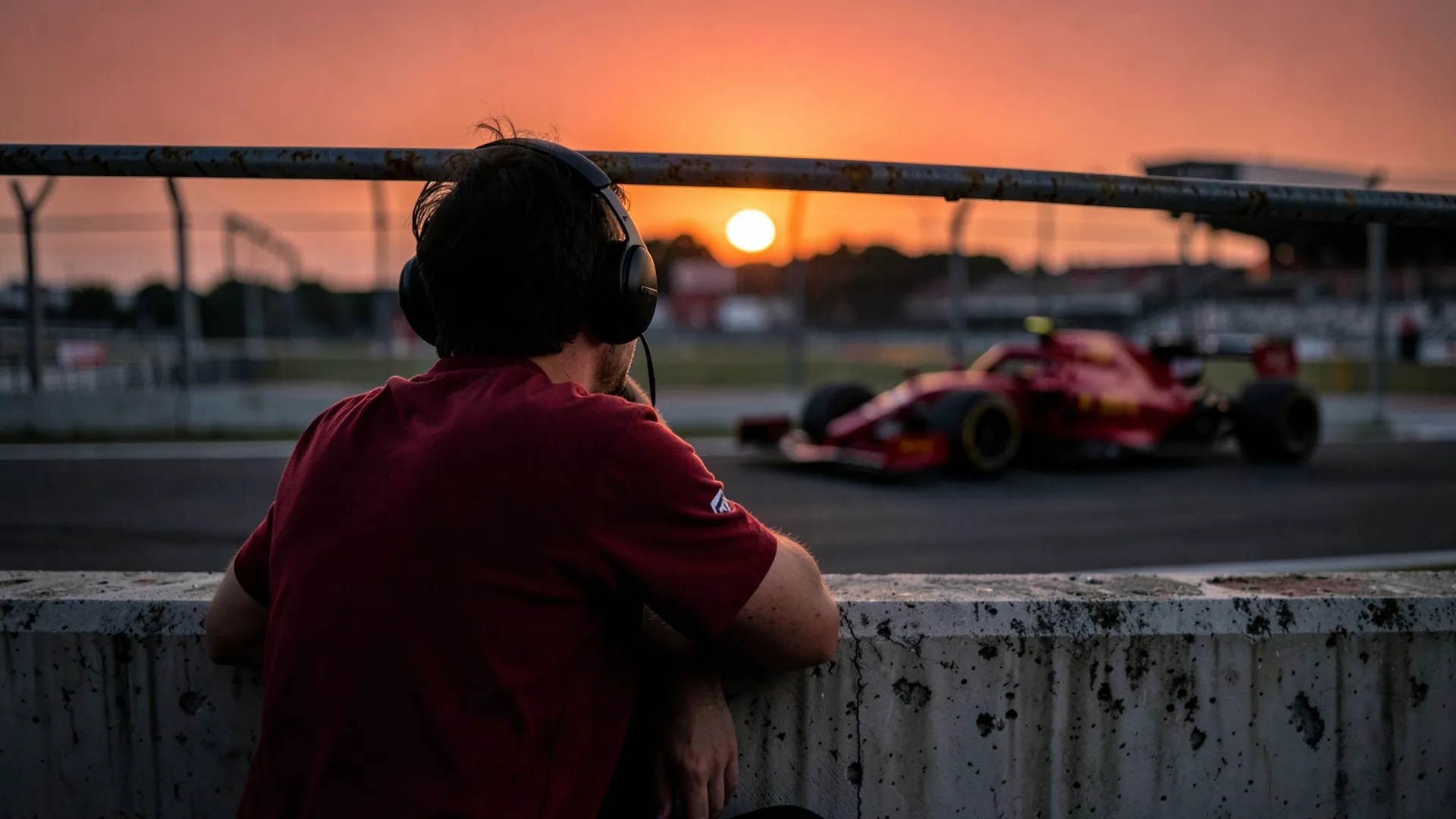
Lewis Hamilton has addressed his working relationship with Ferrari race engineer Carlo Santi after twice taking strategy into his own hands in recent races, according to RacingNews365. The seven-time champion’s willingness to overrule the pit wall has put Ferrari’s in-race communication under fresh scrutiny. It comes as the team defends second place in the constructors’ championship with three rounds remaining.
On the face of it, this is a minor story. Drivers argue with their engineers every weekend, and most of those exchanges are forgotten by Monday. But a driver choosing to act against an instruction is a different matter. Doing it twice is a pattern, and patterns at Ferrari tend to become narratives whether the team wants them to or not.
Two calls Hamilton made for himself
The facts are simple. On two occasions, Hamilton decided his own reading of the race was better than the one coming over the radio, and he acted on it. He has since spoken about how he and Santi communicate. Neither side is publicly describing a breakdown, and it would be wrong to present one.
Still, the significance lies in the act itself. In a modern Formula 1 team, strategy calls are made by a group of people, not by one engineer. Strategists on the pit wall and analysts at the factory run models of tyre degradation, gaps, traffic and rival behaviour. The race engineer filters that output into something a driver can act on at 300km/h. When the driver overrides it, he is disagreeing with more than Santi. He is disagreeing with the whole process behind him.
That is sometimes the right thing to do. A driver feels things no sensor captures cleanly: the moment a tyre starts to go off, the grip level on a drying line, how hard a car behind is really pushing. The best drivers have always used that information. The question is whether the override reflects better information or a lack of confidence in the people making the call. Hamilton’s comments suggest he sees the relationship as a work in progress rather than a problem. Whether Ferrari can afford a work in progress at this stage of the season is a separate question.
Why a driver stops waiting for the radio
To understand why Hamilton might trust his own judgement over the team’s, it helps to remember where he came from. At Mercedes he spent more than a decade with Peter Bonnington, a partnership so settled that much of their communication was shorthand. Bonnington knew when Hamilton wanted detail and when he wanted silence. Hamilton knew that when Bonnington gave a firm instruction, the reasoning behind it was sound. That kind of trust is built over hundreds of races. It cannot simply be moved to a new team.
His first season at Ferrari showed how hard the rebuild would be. His 2025 radio exchanges with Riccardo Adami became a running theme, most memorably in Miami, where his sarcastic suggestion that the team “have a tea break” while it hesitated over swapping him with Charles Leclerc spread well beyond the paddock. The pairing with Santi was meant to give him a fresh start. Two strategy overrides this autumn suggest the trust has not yet fully formed.
Hamilton also has a history of overruling his team when he believed he knew better. At Abu Dhabi in 2016, he ignored repeated instructions from Mercedes, relayed at one point by technical chief Paddy Lowe, to speed up as he backed Nico Rosberg into the pack in a last attempt to win the title. That was an extreme case with a championship at stake, and he never apologised for it. Hamilton has always kept the right to make the final call. What has changed is the setting. At Mercedes he had earned the standing to do it. At Ferrari he is still earning it.
There is also a reason specific to 2026. Under the new regulations, energy deployment and management are a much bigger part of a driver’s race than before, so engineers are talking to drivers more often and about more things. Every extra instruction is another chance for the driver to doubt one. A driver who has learned to tune out part of the radio may also begin to tune out the strategy calls.
Second place is safer than Brazil made it look
This is where the story moves from the personal to the competitive. Ferrari are second in the constructors’ championship on 510 points, 95 clear of Red Bull on 415, with McLaren a further 17 back on 398. Mercedes, on 652 points with 12 wins, are all but out of reach. So is Andrea Kimi Antonelli, whose 111-point lead over Max Verstappen with three rounds left means the drivers’ title is decided.
That leaves second place as Ferrari’s main objective for 2026, and Brazil was a warning. At Interlagos, Red Bull scored 33 points through Verstappen’s drive from 21st on the grid to second and Isack Hadjar’s third place. Ferrari scored six. Leclerc recovered from 14th to eighth, while Hamilton started 20th and finished ninth, a lap down. That was a 27-point swing in a single afternoon.
Repeat that swing at each of the final three rounds and Red Bull would close the gap to 14 points. Ferrari would still hold on, but only just, and only if nothing else went wrong. One retirement or one badly timed stop would change the result. In a fight that can tighten this quickly, a strategy executed together is worth more than one that is occasionally brilliant. A team whose drivers and pit wall are not fully aligned gives away points in exactly the moments that decide the outcome.
The drivers’ standings make the point even more directly. Hamilton is fourth on 261 points, one behind George Russell and 18 behind Verstappen in second. Leclerc is 12 points further back on 249, with Lando Norris three behind him after his win in Brazil. Hamilton has a real chance of finishing as runner-up in his second Ferrari season. That would be a respectable result in a year dominated by Mercedes, and it is one that a single well-judged pit stop could secure or lose.
| Constructors’ standings | Points | Gap to Ferrari |
|---|---|---|
| Ferrari | 510 | — |
| Red Bull | 415 | 95 behind |
| McLaren | 398 | 112 behind |
The case for Santi, and the case for Hamilton
Treating this as a simple question of who was right misses the point. If Hamilton’s overrides worked, Ferrari should ask why its models disagreed with his reading of the race. If they did not, he should ask whether his doubts are about the information or about the people giving it. Neither answer is comfortable. Both are better faced now than in February.
The fair view is that both sides carry some responsibility. Ferrari’s strategy work has been questioned for years, under several team principals, and a driver with Hamilton’s record is entitled to some scepticism. But a team cannot function if its most experienced driver treats every instruction as optional. Santi needs to know that when he makes a firm call, it will be followed, or at least challenged on the radio before it is ignored. Otherwise the pit wall cannot plan around both cars, and that is how one driver’s improvisation ends up costing his team-mate a better strategy.
The fact that Hamilton has spoken about the relationship openly is encouraging. Drivers who have truly lost faith in their engineers tend to go quiet, or let the radio speak for them. Talking about it suggests he sees this as something that can be fixed.
Las Vegas is the wrong place for guesswork
Round 21 in Las Vegas on 22 November will test this quickly. The street circuit’s cold night-time conditions have made tyre warm-up and graining central to the race in recent years. Teams have often struggled to predict how a stint will develop, and drivers have often felt the tyre’s behaviour before any model has shown it. That is the kind of race in which a driver is most tempted to trust his instincts, and in which a split between car and pit wall is most likely to show.
Ferrari do not need Hamilton to stop thinking for himself. They need a process in which his reading of the tyres reaches the strategists before the decision is made, rather than replacing their decision afterwards. If Hamilton and Santi can show that over the last three races, Ferrari should keep second place and Hamilton may well finish runner-up. If another override comes in Las Vegas, the conversation will no longer be about communication. It will be about whether Ferrari’s pit wall and its star driver are working to the same plan going into 2027.