
McLaren's New Front Wing Offers an Early Look at Its 2027 Car
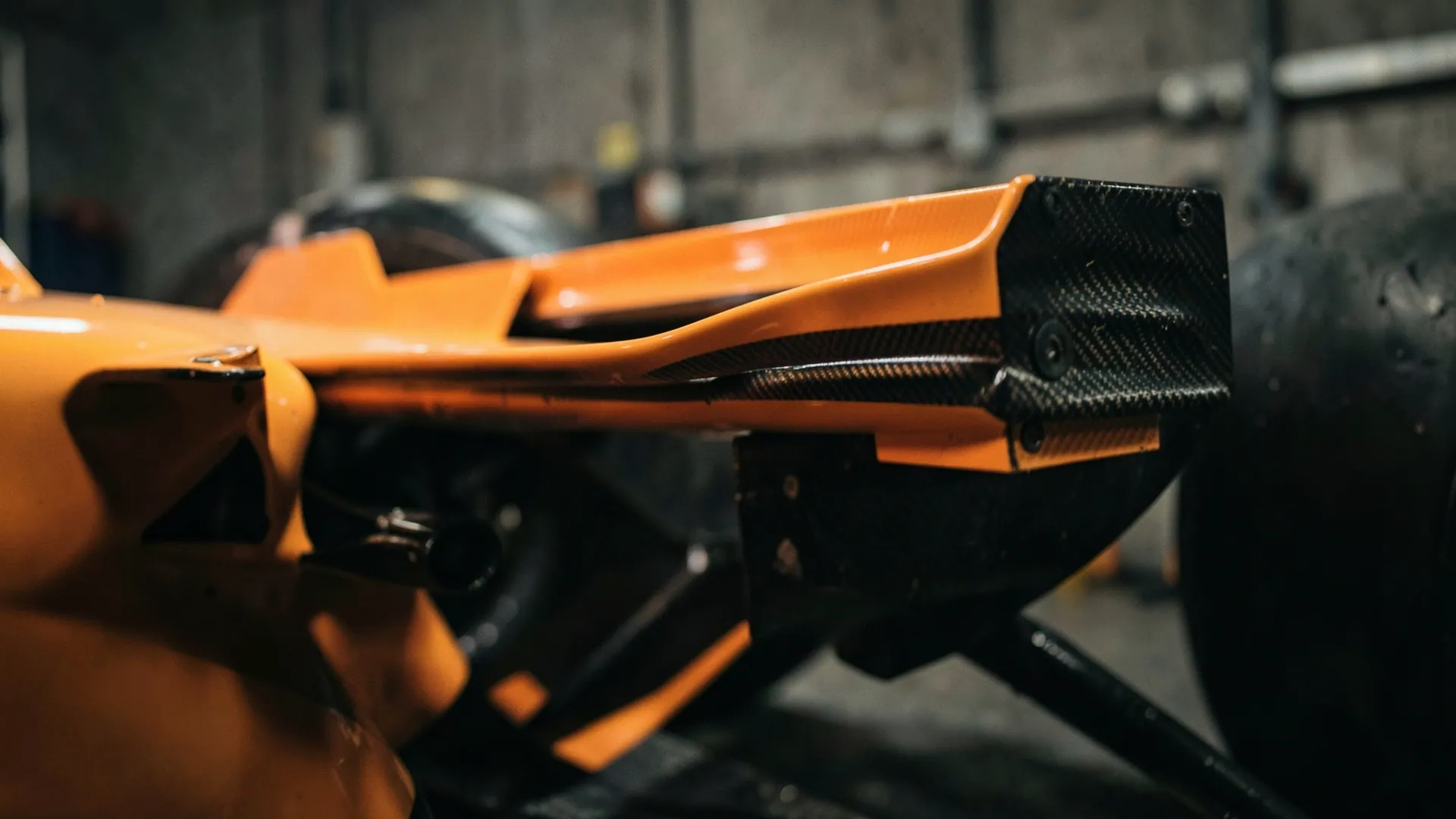
McLaren has confirmed that its latest front wing architecture will carry over into its 2027 car, PlanetF1 reports. The confirmation comes days after Lando Norris converted pole into victory at the Brazilian Grand Prix, McLaren’s best weekend in some time. With three rounds of 2026 remaining, the team has already shown a piece of next year’s car, and that tells us more about its thinking than any single result.
Why McLaren is talking about 2027 in November
Teams rarely say this sort of thing out loud. Late-season upgrades are normally presented as a push for the current campaign, with any benefit to the following year left unspoken. McLaren chose to say it directly: this layout is part of the 2027 car.
The cost cap and the restrictions on aerodynamic testing explain much of the reasoning. Every hour in the wind tunnel and every CFD run is rationed, so a part that has to be thrown away in the winter is development spent twice. If the architecture is right, the work that refines it now becomes groundwork for next year rather than a sunk cost. The track also gives the team something the tunnel cannot: real-world correlation, gathered across the final races, on a component it already knows it will keep.
The architecture is the underlying concept, meaning the overall layout and how the wing manages the flow behind it, rather than any individual flap or endplate trim. The detail will keep changing over the winter. What McLaren has signalled is that the philosophy will not.
The front wing’s job under the 2026 rules
Under the current regulations, the front wing has a harder job than at any point in the ground-effect era that ended last year. The cars are narrower, the floors produce less of the total downforce, and active aerodynamics means the wing must work in two distinct states. It has to deliver load and a stable platform through the corners, shed drag on the straights, then return to its cornering setting cleanly and predictably as the driver brakes.
That transition is where drivers find or lose confidence. A front end that bites inconsistently on turn-in, or that behaves differently from one braking zone to the next, costs lap time in a way that rarely shows up as a single obvious weakness. The front wing is also the first surface to meet the air. It shapes the wake from the front tyres and conditions the flow that reaches the floor, the sidepods and the rear of the car, so a change in its architecture alters how the whole car behaves.
That is why a front wing can stand in for a design direction. A team that settles its front wing layout has, in effect, settled how it wants air delivered to everything behind it. The 2027 car will be built around that choice.
Interlagos and the limits of one result
The Brazilian Grand Prix was McLaren’s strongest weekend in a while. Norris qualified on pole and won, and Oscar Piastri recovered from 10th on the grid to sixth. McLaren left São Paulo with 33 points, the same haul as Red Bull and more than either Mercedes or Ferrari.
That result needs careful reading. Max Verstappen came from 21st on the grid to finish second, which suggests McLaren’s advantage over the pace-setters was real but not overwhelming. Andrea Kimi Antonelli, who started second, finished only fifth, and his weekend may say as much about Mercedes as Norris’s does about McLaren.
The case for a resurgence also has to account for the championship table. Norris has three wins, level with Verstappen and George Russell, yet he sits sixth on 246 points. That is 33 behind Verstappen in second, 16 behind Russell, 15 behind Lewis Hamilton and three behind Charles Leclerc. For the 2025 world champion, that is a modest return, and it shows how much ground McLaren lost earlier in the year to a Mercedes car that has carried Antonelli to nine wins. His 111-point lead, with 75 grand prix points left to play for, has already settled the title.
Piastri’s numbers make the same point more sharply. He has 152 points and no wins, 94 behind his team-mate. Whatever McLaren has found recently, it has not yet produced a car that both drivers can exploit equally. That should keep the team cautious about how much one component explains.
The link between the new wing and Norris’s form is therefore plausible rather than proven. McLaren’s decision to commit to it suggests the team’s own data supports the connection. Internal data has misled teams before, though, and the next three races are the first chance to test the idea on varied circuits.
Precedent: McLaren’s 2023 template, and Mercedes’ warning
McLaren has done this before. In 2023, after a poor start to the season, the team introduced a major upgrade package in Austria and followed it with another in Singapore. Those parts were not a short-term fix. They became the basis of the 2024 car, which won the constructors’ championship, and that lineage carried into the 2025 car that delivered both titles. The lesson McLaren drew was that a mid-season concept change, if correctly identified, is worth more to the following year than to the current one.
Red Bull offered a similar example across 2022 and 2023, refining one strong concept rather than reinventing it, and the result was one of the most dominant seasons the sport has seen.
The counter-example is just as instructive. Mercedes entered 2022 with its slim-sidepod concept and stuck with it well beyond the point at which its own results argued for a rethink, abandoning it only during 2023. Early commitment works only if the direction is correct. McLaren is betting that its late-season data from 2026 reflects a real step, not a set of circuits that happened to suit the car.
There is one important difference from 2023. Then, McLaren was chasing a field led by a single runaway car with a concept the rest of the grid understood. Now, the 2026 rules are in their first year, and the margins between teams are still shifting. With Mercedes on 12 wins and 652 constructors’ points, the benchmark is clear, but the routes to it are not. Committing early to an architecture in a new rules cycle is a bigger bet than refining one in a mature cycle.
Las Vegas, third place and the trade-off
The immediate fight is for third in the constructors’ championship. McLaren is fourth on 398 points, 17 behind Red Bull, with Ferrari second and 112 points ahead of McLaren. Brazil showed McLaren can outscore Red Bull on a given weekend, but Verstappen’s recovery drive and Isack Hadjar’s third place suggest the gap will not close easily.
Finishing position matters for prize money, and the aerodynamic testing allocation works on a sliding scale that gives lower-placed teams slightly more time. Falling short of third would hand McLaren a fractionally larger allocation for 2027, a modest consolation for a team that has just committed to a new direction. No team plans to finish lower for that reason, but it does soften the cost of missing out.
Las Vegas on 22 November will be a revealing first test. The long straights put the emphasis on low-drag running, and cold track temperatures make front tyre warm-up difficult. A wing that behaves predictably as it switches between modes should help on both counts. If the new architecture is as significant as McLaren believes, it should show in the consistency of Norris’s and Piastri’s braking and turn-in as much as in raw pace.
My view is that McLaren is right to commit, and right to say so publicly. The team’s 2023 recovery shows it can identify a correct direction mid-season and follow it through. The real test is not whether Norris wins again before the season ends. It is whether Piastri’s results move closer to his team-mate’s over the final three rounds. If they do, the wing is a foundation McLaren can build its 2027 car around. If they do not, it may suit one driver more than the car, and that is a much weaker basis for a new season.