
Red Bull's Clutch Flaw Will Shadow Its Starts Until 2027, Mekies Admits
Laurent Mekies concedes the RB22's launch weakness needs a redesign that cannot arrive before next season, leaving Verstappen and Hadjar exposed while Red Bull sits level with McLaren in the fight for third.
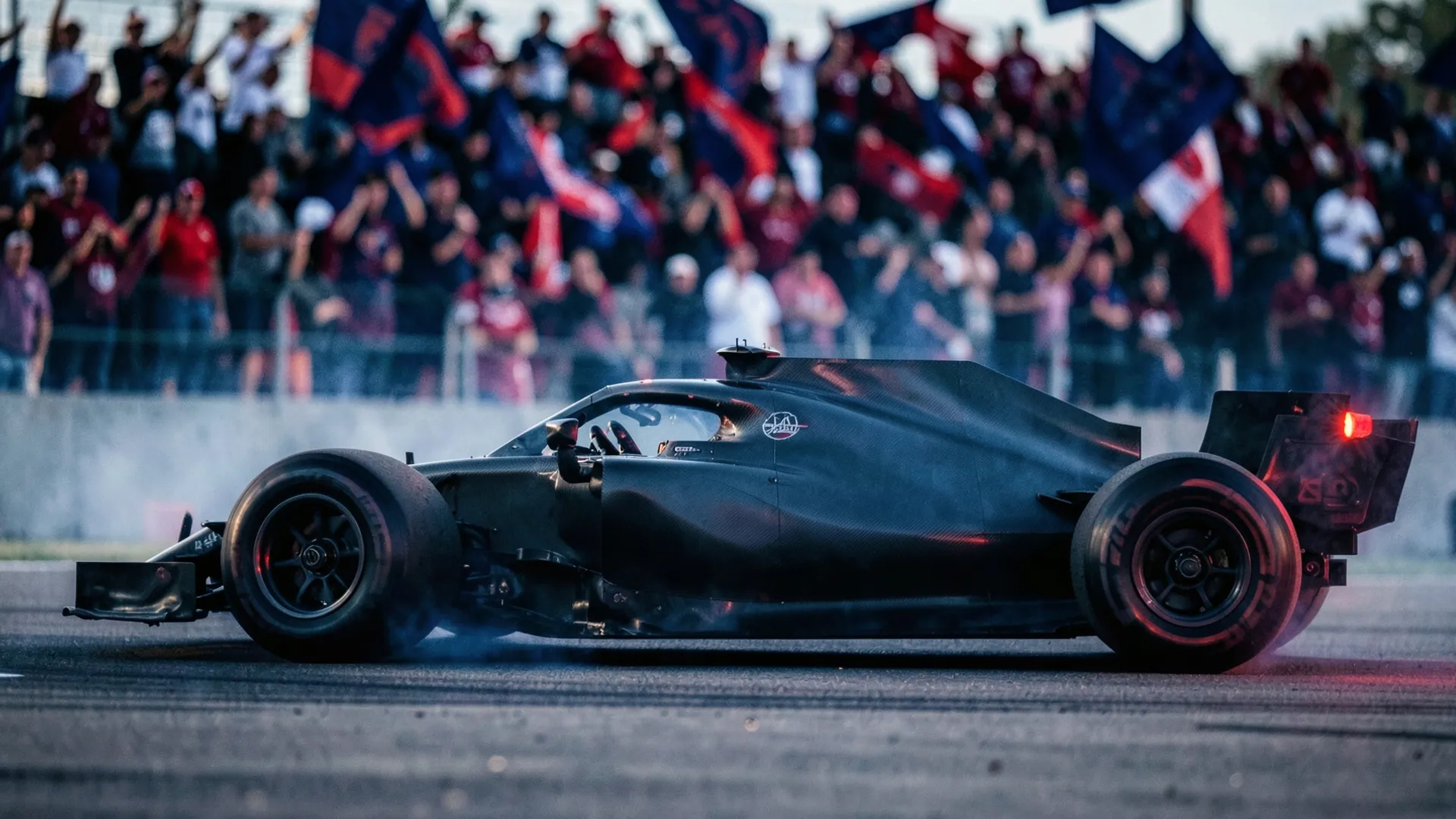
Red Bull team principal Laurent Mekies has admitted that the RB22’s weakness off the start line, which stems from the design of its clutch, cannot be properly fixed until the 2027 car. He made the concession after Sunday’s United States Grand Prix in Austin, where Isack Hadjar lined up third, made a poor getaway and finished sixth before calling for the clutch to be redesigned. With five rounds to run, Red Bull and McLaren are tied on 355 points in the race for third in the constructors’ championship. A known, unfixable weakness at the start of every race is a heavy burden to carry into that fight.
Austin’s grid flattered Red Bull
On Saturday at the Circuit of the Americas, Red Bull looked like the second-fastest team. Max Verstappen qualified on the front row alongside Andrea Kimi Antonelli, and Hadjar took third. McLaren’s Lando Norris and Oscar Piastri started eighth and seventh.
By Sunday evening, that advantage had largely evaporated. Antonelli converted pole into his ninth win of the season. Verstappen took the flag third, behind Charles Leclerc, who climbed from fourth to second. Hadjar fell to sixth, with Lewis Hamilton and Norris both ahead of him. Norris gained three places from his grid slot, and Piastri held station in seventh.
Red Bull scored 23 points to McLaren’s 16. That wiped out a seven-point deficit and drew the two teams level, which on the surface made it a good afternoon. But a team that took two of the top three grid slots should have expected more than a seven-point swing over a rival whose cars started on the fourth row. In a battle this close, the gap between where Red Bull starts and where it finishes is the story of its season.
Hadjar was blunt afterwards. He complained that “stupid little things” were undermining his races and pointed directly at the clutch. The comment carries weight because it comes from a driver in his first season at the senior team, who has generally been measured in public. When a young driver in that position calls for a redesign, he is speaking for the people working on his car as well.
Why a launch problem cannot be patched
Mekies has not pretended otherwise. His position, as reported by PlanetF1 and RacingNews365, is that Red Bull has improved its starts over the course of 2026, but that the changes needed to make the car the benchmark off the line are fundamental. They will have to wait for next year’s car.
The reason lies in what a race start actually asks of a car. Since 2016, drivers have used a single clutch paddle and must find the bite point themselves, with far less electronic help than before. Software can shape how torque is delivered, but it cannot change the physical behaviour of the clutch: how consistently it engages, how it reacts to the heat built up on the formation lap and while the car sits on the grid, and how cleanly it releases power to the rear tyres in the first few metres. If the hardware is inconsistent, the driver is effectively guessing how the car will launch, and a small misjudgement costs a place or two before the first braking zone.
The 2026 regulations have made this harder for everyone. Without the MGU-H, there is no longer an electric motor to spin the turbocharger and hold boost while the car waits on the grid, so getting the engine into a strong launch state has become a more delicate job. Red Bull is also running its first power unit built with Ford, which means the clutch, transmission and engine have all been developed together under new rules. When the three are so closely interdependent, a shortcoming in one tends to be built into all of them.
That is why a redesign is a 2027 project. The clutch is not a bolt-on part like a front-wing endplate. Changing it properly means reopening the transmission and its interface with the power unit, and teams treat those components with great caution mid-season because a reliability failure costs far more than a slow start. Under the cost cap, the engineering hours and manufacturing budget for such a change would also come directly out of the 2027 programme. Red Bull has decided, reasonably, that a solution worth having must be designed into next year’s car from the outset.
There is precedent for living with this. Mercedes spent much of 2016 struggling with launches after the clutch rules were tightened, and Hamilton’s poor getaways at Monza and Suzuka that year cost him heavily in a title fight he lost by five points. Mercedes improved through procedure and refinement, but the problem only properly disappeared once later cars were designed around it. Red Bull now faces the same compromise: manage the weakness for the rest of the season and design it out over the winter.
A third place that will be won off the line
The constructors’ table explains why this matters so much now.
| Pos | Team | Points | Wins |
|---|---|---|---|
| 2 | Ferrari | 474 | 2 |
| 3 | Red Bull | 355 | 2 |
| 4 | McLaren | 355 | 2 |
| 5 | RB F1 Team | 102 | 0 |
Ferrari is out of reach in second, 119 points clear. Nobody behind is a threat. Third place is a straight contest between two teams with identical points and identical win totals, with five Grands Prix left to settle it.
The stakes are real. Third pays significantly more prize money than fourth. There is a small consolation for the loser, because the aerodynamic testing rules give teams lower in the standings slightly more wind-tunnel and CFD time. That difference, however, is modest compared with the financial gap and the effect on a team’s standing. For Red Bull, finishing behind McLaren again would confirm how far its position has slipped.
The two line-ups are also built differently. McLaren’s points are spread more evenly, with Norris on 211 and Piastri on 144. Red Bull relies more heavily on Verstappen, whose 236 points are more than double Hadjar’s 105. That makes Hadjar’s Sundays the deciding factor. A driver who qualifies third and finishes sixth gives away exactly the points Red Bull cannot spare, and a clutch that stops him keeping his grid position turns his best qualifying laps into wasted effort.
The drivers’ standings raise the stakes further. Verstappen is fourth on 236 points, six behind George Russell, five behind Hamilton and three ahead of Leclerc. Four drivers are separated by nine points in the fight for second place behind Antonelli. If Verstappen loses one place on the first lap at each of the remaining races, that alone could decide where he finishes in that group.
What Red Bull can still control before Mexico City
Red Bull’s main tool in the meantime is preparation. Practice starts at the end of each session, bite-point checks on the reconnaissance laps, management of clutch temperature on the formation lap and the timing of the final grid procedure can all reduce the problem, even if they cannot remove it. Mekies’ remark that starts have already improved this year suggests the team has extracted most of what is available from software and procedure. What remains will have to come from the drivers’ judgement and from qualifying well enough to absorb a slow getaway.
Mexico City is a difficult place to test that. The run from the grid to Turn 1 at the Autódromo Hermanos Rodríguez is one of the longest on the calendar, leaving plenty of room for a poor launch to become a lost position, and for the slipstream to cost another before the braking zone. The thin air at altitude also makes engine and cooling behaviour harder to predict, which does not help a car that is already sensitive at the start.
Red Bull’s qualifying pace in Austin suggested it has the faster car of the two teams over a single lap. That should still decide third in its favour, but only if Verstappen and Hadjar start inside the top four consistently enough to absorb a place lost at every start. If McLaren qualifies within touching distance in Mexico, the RB22’s launch will cost more than the car’s speed can recover, and Red Bull could end the season fourth with a solution already scheduled for a car that will not race until next year.