
Red Bull's Austin Split Shows How Narrow the RB22's Window Has Become
Max Verstappen coped with a difficult RB22 in Friday practice at COTA while Isack Hadjar called it undriveable, and that gap may decide whether Red Bull can overhaul McLaren for third.
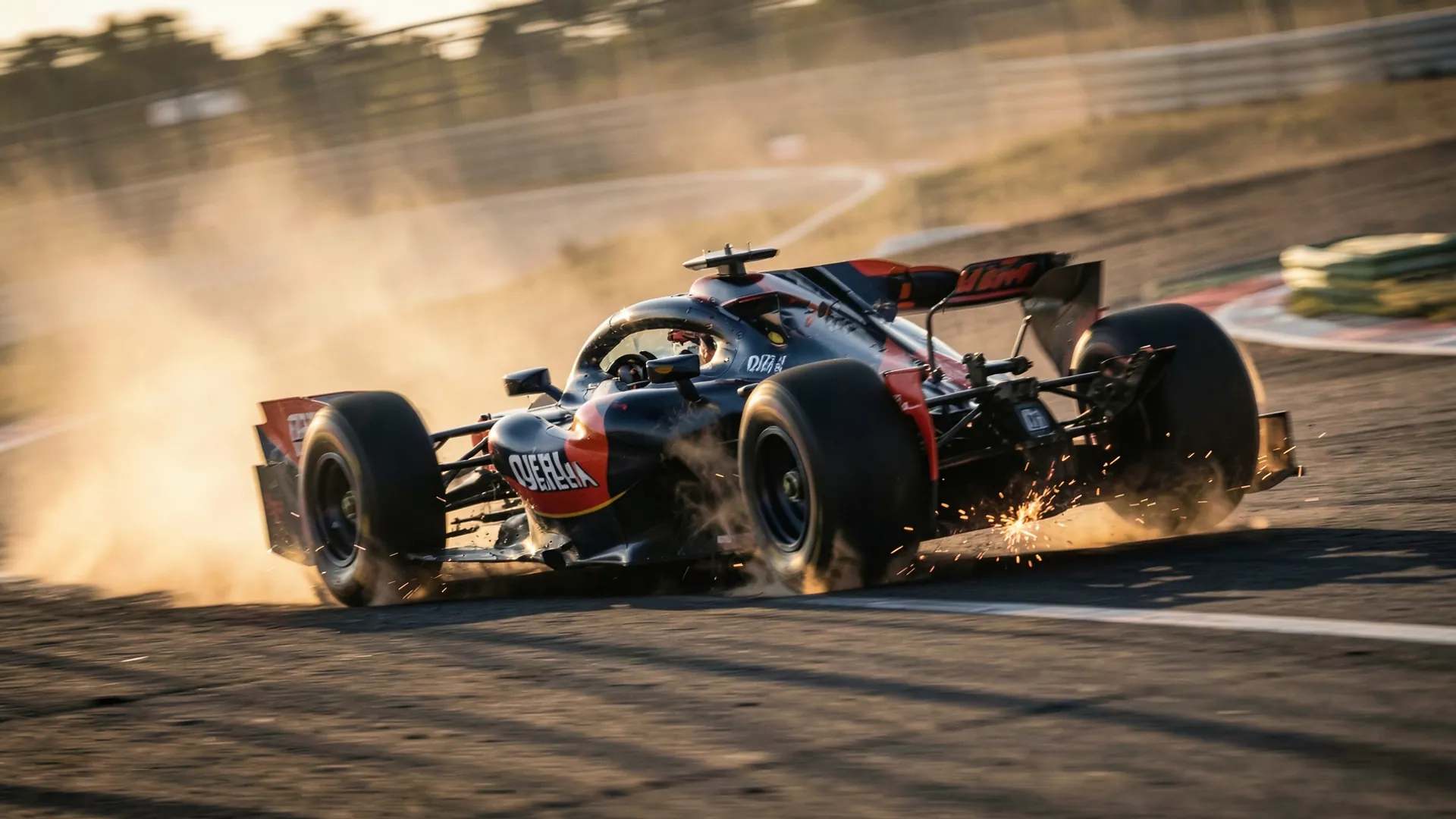
Red Bull has admitted its RB22 was “more difficult than we expected” on Friday, the opening day of the United States Grand Prix weekend at the Circuit of the Americas. Its two drivers gave very different accounts of why. Max Verstappen was largely satisfied with the car’s early form, while Isack Hadjar, speaking to Motorsport.com, called it “just undriveable” and described his struggles as “massive”. With six rounds left and McLaren seven points ahead in the fight for third in the constructors’ championship, the distance between those two verdicts matters more than any single practice session.
One car, two very different Fridays
Practice is usually a poor guide to a weekend. Teams run different fuel loads, test a different set-up direction on each car and often split their programmes to learn more. A driver who is unhappy on Friday can be competitive by Sunday once the engineers have digested the data.
But “undriveable” is not a word drivers use lightly, and Red Bull did not try to explain it away. The team’s public line was that the car had been harder to handle than its preparation suggested. Teams rarely say that unless the simulation and the circuit have disagreed in a way they cannot yet account for.
Verstappen’s response was more measured. He was broadly content with what the car showed him, although his comments still focused on balance. That fits a familiar pattern: the same machine can feel workable to one Red Bull driver and hostile to the other.
The contrast is sharper because Singapore went so well. Verstappen converted pole into victory at Marina Bay, his second win of the season, ahead of Charles Leclerc and Andrea Kimi Antonelli. Hadjar also had a useful evening, recovering from 22nd on the grid to finish 10th and take the final point. That drive showed he can race the RB22 hard when it is in a state he trusts. Austin has so far shown what happens when it is not.
Why the bumps and esses at COTA find the weak spot
COTA asks for several things at once. The sweeping esses in the first sector demand a car that changes direction crisply at high speed. The long back straight rewards efficiency. The heavy braking zones and the slow stadium section at the end of the lap need stability on entry and traction on exit. The circuit has also long been known for its bumps, which punish any car that depends on a tightly controlled platform.
Each of those demands is manageable on its own. The difficulty comes when a car produces its best performance in a narrow band of ride height and balance. On a smooth street circuit such as Singapore, a team can run that car close to its ideal setting. On a bumpy surface it faces a trade-off. It can raise the car and soften it, giving up downforce. Or it can keep it low and stiff and ask the driver to live with a car that moves around underneath them.
The 2026 regulations add another variable. The cars’ active aerodynamics change configuration between straights and corners. Any shift in balance as the car settles back into its cornering mode is felt most at the end of a fast straight, under braking, over uneven tarmac. Red Bull has not said this is the source of its trouble, but it is the kind of interaction that can catch a team out at a track like this.
The likeliest explanation for Friday is that Verstappen can drive around instability that Hadjar cannot yet tolerate. That is not a criticism of Hadjar. It describes a problem Red Bull has had for most of the past decade.
The second-seat story Red Bull keeps retelling
Since Verstappen became the team’s reference driver, a succession of team-mates has struggled with cars built around his preferences. Pierre Gasly and Alexander Albon could not settle in 2019 and 2020. Sergio Pérez won races but fell away badly as the cars developed in Verstappen’s direction. In 2025, Liam Lawson was replaced after two rounds, and Yuki Tsunoda found the car just as hard to master.
The usual description is a car with a sharp, responsive front end and a rear that moves. Verstappen turns that instability into lap time because he trusts it. Most drivers lift, and the lap time disappears with their confidence.
Hadjar’s arrival for the new regulation cycle was a chance to break that pattern. The rules changed, the car is new, and Red Bull now builds its own power unit in partnership with Ford. In theory, a clean sheet should have allowed the team to design a car with a broader operating window. Austin suggests that, at least on certain circuits, it has not fully done so.
There is a fair counter-argument. Hadjar sits eighth in the drivers’ championship on 97 points, clear of every driver outside the top four teams. Lawson, best of the rest, has 75. For a driver in his first season at the senior team, that is respectable. The issue is the benchmark: Red Bull’s direct rival has a far stronger second car.
Seven points, and where they are lost
The constructors’ table after Singapore reads McLaren 339, Red Bull 332. Mercedes leads on 578 and Ferrari is second on 444, so third is the realistic target for both teams. It is also worth tens of millions in prize money.
Look at how each team’s points are spread, and the shape of the fight is clear:
- Lead drivers: Verstappen has 221 points, 20 more than Lando Norris on 201. The pair have two wins apiece, and Verstappen sits fourth in the drivers’ standings, ahead of both McLaren drivers.
- Second drivers: Oscar Piastri has 138 points without a win. Hadjar has 97, which leaves him 41 behind.
Red Bull is in this fight almost entirely because of Verstappen. McLaren is in front because Piastri, even in a winless season, keeps scoring solid points. Singapore showed both effects. Verstappen’s win and Hadjar’s point gave Red Bull 26, while Norris and Piastri took 22 between them for fourth and fifth. That cut the gap by four points. Verstappen did almost all the work, and he cannot do that six weekends in a row.
The arithmetic for the run-in is simple. If Verstappen keeps beating Norris by the margins he has managed this season, Red Bull gains a few points a race at the front. If Hadjar finishes outside the points while Piastri runs fifth or sixth, McLaren takes back eight or 10 at the other end. A seven-point deficit can widen quickly when one car is carrying the team.
Hadjar’s problem is Red Bull’s problem
Red Bull’s instinct, shaped by years of success with Verstappen, has been to develop and set up the car around its lead driver. When the car performs, he wins. When it is difficult, he still scores well, and the gap to the other side of the garage is accepted as normal.
For the next six rounds that instinct is the wrong one. In a constructors’ fight decided by single-digit margins, a set-up change that makes the RB22 more predictable for Hadjar is worth more than a few tenths of extra peak pace for Verstappen. Verstappen has shown at COTA and elsewhere that he can manage a car that is not quite to his liking. Hadjar has not yet shown he can manage one that frightens him. The engineering effort this weekend should go into Hadjar’s car rather than Verstappen’s.
There is a longer-term reason, too. Red Bull will design its 2027 car using what it learns now. If the lesson from 2026 is again that only one driver can extract its performance, the team will end up searching for a new team-mate rather than fixing the car.
Friday’s “undriveable” verdict is a warning, not a result. If Hadjar can recover from it and finish in the top eight on Sunday, the RB22’s window will look wider than Friday suggested. If he cannot, McLaren will probably leave Austin with a larger lead than it brought. Red Bull’s hope of third would then rest on Verstappen alone, and he has been in that position too often before.