
Russell's Mexico No-Show Leaves His Mercedes Future Hanging on 2027
George Russell skipped his mandated media duties after finishing sixth in Mexico City as Andrea Kimi Antonelli clinched the title, and Martin Brundle's warning makes 2027 the most important season of Russell's career.
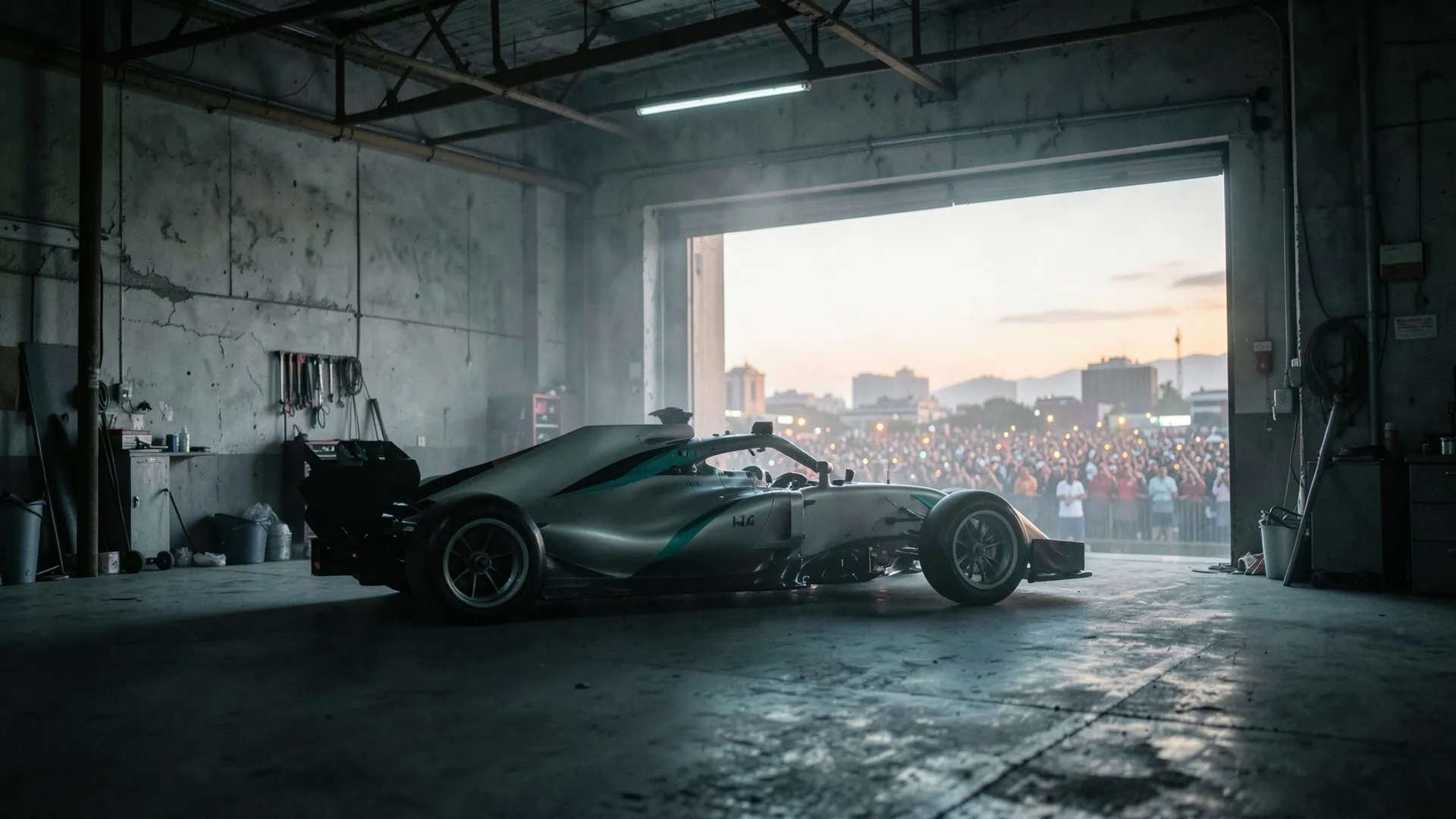
George Russell did not attend his FIA-mandated media duties after Sunday’s Mexico City Grand Prix, where he started from the front row and finished sixth as his Mercedes team-mate Andrea Kimi Antonelli sealed the drivers’ championship. Martin Brundle has since said he does not blame Russell for staying away. The former driver has also warned that Russell needs to find an “overdrive” for 2027 or risk his time at Mercedes coming to an end.
The two positions sit together more comfortably than they first appear. One is about a bad afternoon. The other is about where that afternoon fits in a season that has turned the Mercedes driver hierarchy upside down.
Sixth from the front row on title day
The bare facts from Mexico City were brutal for Russell. He lined up second, two places ahead of Antonelli, and had the clearer route of the pair to the podium. Max Verstappen won from fifth on the grid, Lewis Hamilton converted pole into second, and Antonelli came through from fourth to finish third. That was more than enough to make him champion. Russell crossed the line sixth, behind both Ferraris and Lando Norris’s McLaren.
Antonelli now has 380 points and nine wins from 19 rounds. Verstappen, the nearest challenger, has 261. With a 119-point lead and only four Grands Prix remaining, the title is beyond anyone else’s reach. Antonelli has done it in only his second season in Formula 1.
Russell, by contrast, sits fourth on 250 points with three wins. In most seasons that would read as a strong campaign. Inside Mercedes, it reads as a 130-point deficit to the driver who arrived in 2025 as the junior partner. A year ago Russell was clearly the team’s lead driver and its reference point. Mercedes have scored 630 points and won 12 races in 2026, and Antonelli has supplied 380 of those points and nine of those victories.
That is the context for the empty chair in the press pen. Russell had to watch a team-mate who started behind him celebrate a title, on a day when his own race had gone backwards. Few drivers would have wanted to explain that to a room full of microphones within the hour.
Why the empty chair still matters
Brundle’s sympathy is understandable, and plenty of drivers have been through the same thing. Yet the post-race media obligations are not a courtesy. They are part of the sporting framework, and an unauthorised absence is a matter the stewards are entitled to examine. The FIA has shown in recent seasons that it treats conduct in front of the media as a regulatory issue. Verstappen was handed a community-service sanction for his language in a Singapore press conference in 2024, and he had turned up.
The absence also sits awkwardly with the image Russell has spent years presenting to the world. He has been a director of the Grand Prix Drivers’ Association, one of the grid’s most articulate voices on safety and governance, and someone who usually handles the media better than almost anyone. That is precisely why the absence registered so loudly. When a driver known for his composure in front of a microphone avoids one entirely, people read it as a sign of how much the day hurt.
There is a fair case to be made for him. Russell did not lash out or criticise the team, and he did not undermine Antonelli’s moment. Staying silent may well have been the least damaging option available to him that evening. But Formula 1 is a sport in which perception feeds into contract talks, and in which a team principal judges how a driver copes with adversity as well as how fast he is. One missed session will not decide Russell’s future. Repeated signs that he is struggling with Antonelli’s rise would carry real weight.
Brundle’s ‘overdrive’ and the Bottas precedent
Brundle’s choice of word is telling. He is not suggesting Russell has become slow. He is suggesting that the margin between a very good team-mate and the driver a top team builds around is narrow, and that Russell is currently on the wrong side of it.
Mercedes know this situation better than any team on the grid. Between 2017 and 2021 Valtteri Bottas won 10 races and finished as championship runner-up twice, in 2019 and 2020. He was quick and dependable, and he cost the team very little in political terms. It still was not enough. Mercedes replaced him for 2022 with Russell, the young driver they believed had a higher ceiling.
The uncomfortable point for Russell is that the reasoning which got him the seat now works against him. Toto Wolff has always been willing to look elsewhere, and he made little secret in 2024 of his interest in Verstappen. A team with the new world champion already under contract, and a constructors’ lead that now looks all but decisive, can afford to be demanding about the second car.
History suggests the dynamic Russell faces is hard to reverse once it settles. Mark Webber never fully recovered his standing at Red Bull once Sebastian Vettel became the focal point of the team. Rubens Barrichello spent six years at Ferrari as Michael Schumacher’s team-mate and was regarded throughout as the number two. Nico Rosberg is the rare counter-example. He beat Hamilton to the 2016 title by raising his game in a way few expected, and the effort was so draining that he retired days later.
Russell has already shown he can respond to an internal challenge. He outscored Hamilton across their first season together in 2022 and regularly beat him in qualifying in 2024. The question Brundle is raising is whether he can do the same against a team-mate who is younger, still improving and now has a championship behind him.
The runner-up fight is Russell’s best reply
The most persuasive answer Russell can give is on track, and the timing works in his favour. Antonelli’s title is settled, but the race for second in the championship is wide open:
| Pos | Driver | Team | Points | Gap to 2nd |
|---|---|---|---|---|
| 2 | Max Verstappen | Red Bull | 261 | – |
| 3 | Lewis Hamilton | Ferrari | 259 | 2 |
| 4 | George Russell | Mercedes | 250 | 11 |
| 5 | Charles Leclerc | Ferrari | 245 | 16 |
Four drivers are covered by 16 points with four rounds left. Russell has the car that has won 12 of 19 races this year, and with the drivers’ title decided, there is no longer any reason for Mercedes to prioritise Antonelli’s strategy. Finishing as runner-up ahead of Verstappen and Hamilton would not erase the gap to his team-mate. It would, however, give Russell a strong argument going into the winter: he was the best of the rest, ahead of two drivers with 11 world titles between them.
Mercedes have an interest of their own in that outcome. Their constructors’ lead over Ferrari stands at 126 points, and the team will want it confirmed as early as possible. A focused Russell scoring big results helps them do that. A Russell still dwelling on Mexico does not.
São Paulo is the obvious place for him to start. Interlagos is where Russell won his first Grand Prix in 2022, the victory that convinced many people Mercedes had picked the right successor to Bottas. Round 20 at the Autódromo José Carlos Pace is on Sunday, and Russell will be expected to meet the media on the Thursday before it.
He should take that opportunity. If he addresses Mexico openly, admits it was a difficult day and talks about his own goals for the final four races, the no-show will soon be forgotten. Second place in the championship would then answer Brundle’s warning better than anything he could say. Mercedes are unlikely to rush a decision about him this winter, but how he handles these last four races will shape how they think about 2027.