
Austin Stewards' Split Verdicts on Bearman and Lindblad Expose First-Lap Inconsistency
Oliver Bearman's 10-second penalty for hitting Pierre Gasly, set against no action for Arvid Lindblad's squeeze on Carlos Sainz, leaves F1 without a clear standard for opening-lap racing.
Oliver Bearman received a 10-second time penalty for his collision with Pierre Gasly in Sunday’s United States Grand Prix, while Arvid Lindblad faced no action for squeezing Carlos Sainz towards the pit wall at the start. Both incidents happened on the opening lap at the Circuit of the Americas. The penalised driver and the driver who felt wronged have each said they cannot make sense of the outcome. Taken together, the two calls expose a problem Formula 1 has never quite solved: nobody can say with confidence what the rules of engagement are when 22 cars arrive at the first corners together.
Two opening-lap calls, two different answers
Bearman told Motorsport.com that he had made a strong start, gaining two places on the opening lap, before the contact with Gasly. He said he was “pretty shocked” by the penalty and called it “crazy”. His defence came down to one phrase: he “couldn’t disappear”. As he described it, the space around him was closing, and in his view the collision came from having nowhere to go rather than from an optimistic lunge.
Sainz’s complaint runs the other way. Speaking to RacingNews365, the Williams driver said he was baffled that the stewards took no action after Lindblad pushed him towards the concrete on the run from the grid, describing it as a “pretty nasty moment”. Lindblad, in his rookie season with RB, went on to finish 12th from 14th on the grid, a lap down. Sainz started 16th and finished 18th, also lapped.
Neither verdict shaped the front of the race. Andrea Kimi Antonelli converted pole into his ninth win of the season, ahead of Charles Leclerc and Max Verstappen, and Gasly still collected the final point in 10th. The front-runners will barely remember these two incidents. The drivers involved will remember them for a long time, because together they suggest the stewards weighed contact more heavily than danger.
Why the pit wall should be the line
The order of priorities looks wrong. A midfield collision in a braking zone is a racing problem: someone loses time, perhaps a front wing, perhaps a result. A car being pressed towards a wall at the start is a safety problem. The cars are on full fuel loads and cold tyres, and the field behind is packed nose to tail. The driver being squeezed cannot brake out of the situation without collecting someone else, and cannot steer away from a barrier that does not move. If wheels touch in that moment, the consequences are no longer measured in lost positions.
The sport has drawn this line before. At the 2010 Hungarian Grand Prix, Michael Schumacher edged Rubens Barrichello so close to the pit wall that the Williams nearly brushed it at full speed. The stewards gave Schumacher a 10-place grid penalty for the next race, and the case became the reference point for a simple principle. A defending driver is entitled to one move but must leave room, and when the alternative is a wall, that obligation is not up for negotiation. Schumacher’s move came mid-race and at a higher speed than a getaway from the grid, but the logic still transfers. What matters is less how fast the cars were going than whether the driver being squeezed had anywhere to go.
There is a fair case for the stewards. They may have concluded that Sainz was never sufficiently alongside to be owed space, or that Lindblad made a single move before the Williams committed to the gap. Starts are chaotic, and a driver concentrating on the car ahead does not always see what is happening in his mirrors. That is why so much is forgiven on lap one. If that was the panel’s reasoning, though, it should be set out plainly and publicly, because the alternative interpretation is that pressing a rival towards the wall carries no sanction, provided nobody actually hits it.
The leniency that only applies to some
Stewards have long been encouraged to take a more forgiving view of first-lap incidents, and the reasoning is sound. When the field is bunched, small misjudgements cascade, and punishing every touch would turn the opening corners into a procession of cautious lifts. Nobody wants that.
But leniency is only defensible when it is applied evenly. A 10-second penalty is the heavier of the two standard time penalties, a sanction that in a tight midfield can cost several positions. By his own account, Bearman was hemmed in. Lindblad, by Sainz’s account, chose to move across towards a wall. If either deserved the benefit of the doubt that lap one usually brings, it is hard to see why it went to the move with the more serious potential consequences.
Part of the difficulty is structural. The guidance the FIA has given stewards and drivers in recent seasons concentrates largely on who is entitled to a corner when two cars arrive side by side: where the front axle is, who is ahead at the apex, who is on the outside. That framework works well for a duel between two cars. It is far less useful when three or four cars arrive at once, half of them reacting to a car they cannot see. Add the fact that panels rotate from weekend to weekend, with a different former driver advising each time, and consistency becomes something the sport hopes for rather than designs in.
Small margins at the back of the table
With five rounds left, Antonelli’s lead over George Russell stands at 123 points, so the drivers’ title is close to settled. For much of the field, the meaningful fights from here are in the constructors’ standings, where each place is worth real prize money.
Haas sit seventh on 30 points, seven clear of Audi. Williams have 12 points, ahead of Aston Martin on seven and Cadillac, who are still to score. In fights this tight, a single point can decide a position worth millions, and a 10-second penalty in the middle of the field can easily be the difference between scoring and not scoring. Every verdict at this end of the grid carries weight. Haas are entitled to ask why their driver was punished for a tangle while a far more alarming moment involving a Williams passed without action.
The championship maths also changes how these decisions are read. A shaky call at the front of a title fight dominates the conversation for weeks. A shaky call between 13th and 15th rarely does, which makes it all the more important that the standard holds when fewer people are watching.
Mexico’s long drag to Turn 1 is the next test
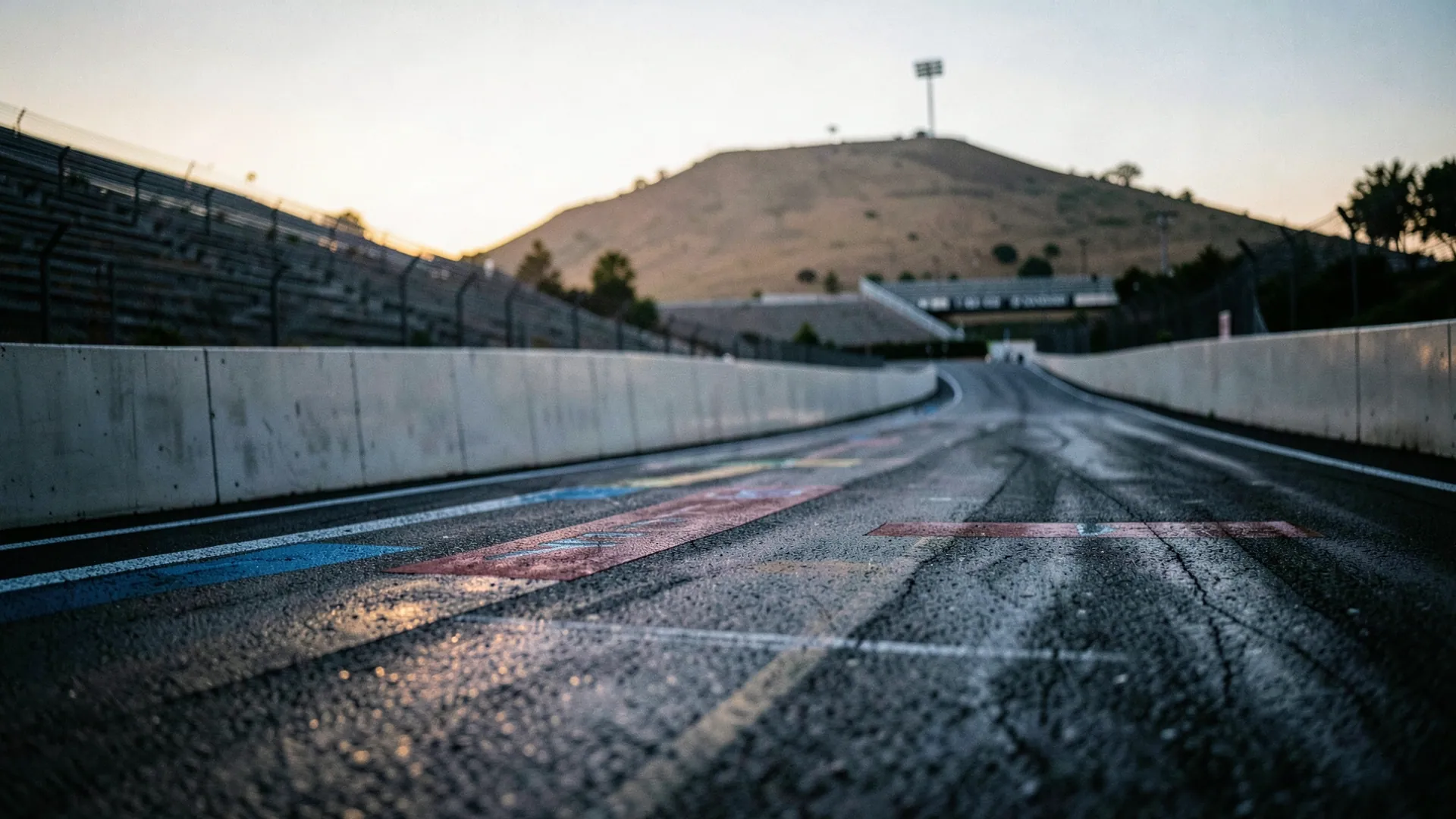
The next race could hardly be a sharper examination of whatever standard Austin set. The Autódromo Hermanos Rodríguez has one of the longest runs from grid to first corner on the calendar, a slipstreaming drag on which cars fan out across the track. Drivers spend those seconds deciding how much room to leave and how much to take. They will arrive in Mexico City for the race on 1 November having learned from Austin that contact is punished and intimidation may not be.
That is the wrong lesson to teach, and the stewards can correct it without rewriting a single regulation. Any start-line move that forces a rival towards a wall should be formally investigated, whether or not the cars touch. When a panel decides not to act, it should publish a short note explaining why. Bearman may or may not have deserved his 10 seconds. What the sport cannot afford is a grid of drivers who conclude that the pit wall is a legitimate defensive tool, and Mexico’s opening seconds will show whether that message has already sunk in.