
Verstappen's New Engineer and Radio Dropouts Expose a Red Bull in Transition
Max Verstappen's first race with a new race engineer ended in third place and complaints of radio dropouts he called "a disaster", as Red Bull drew level with McLaren in the constructors' fight.
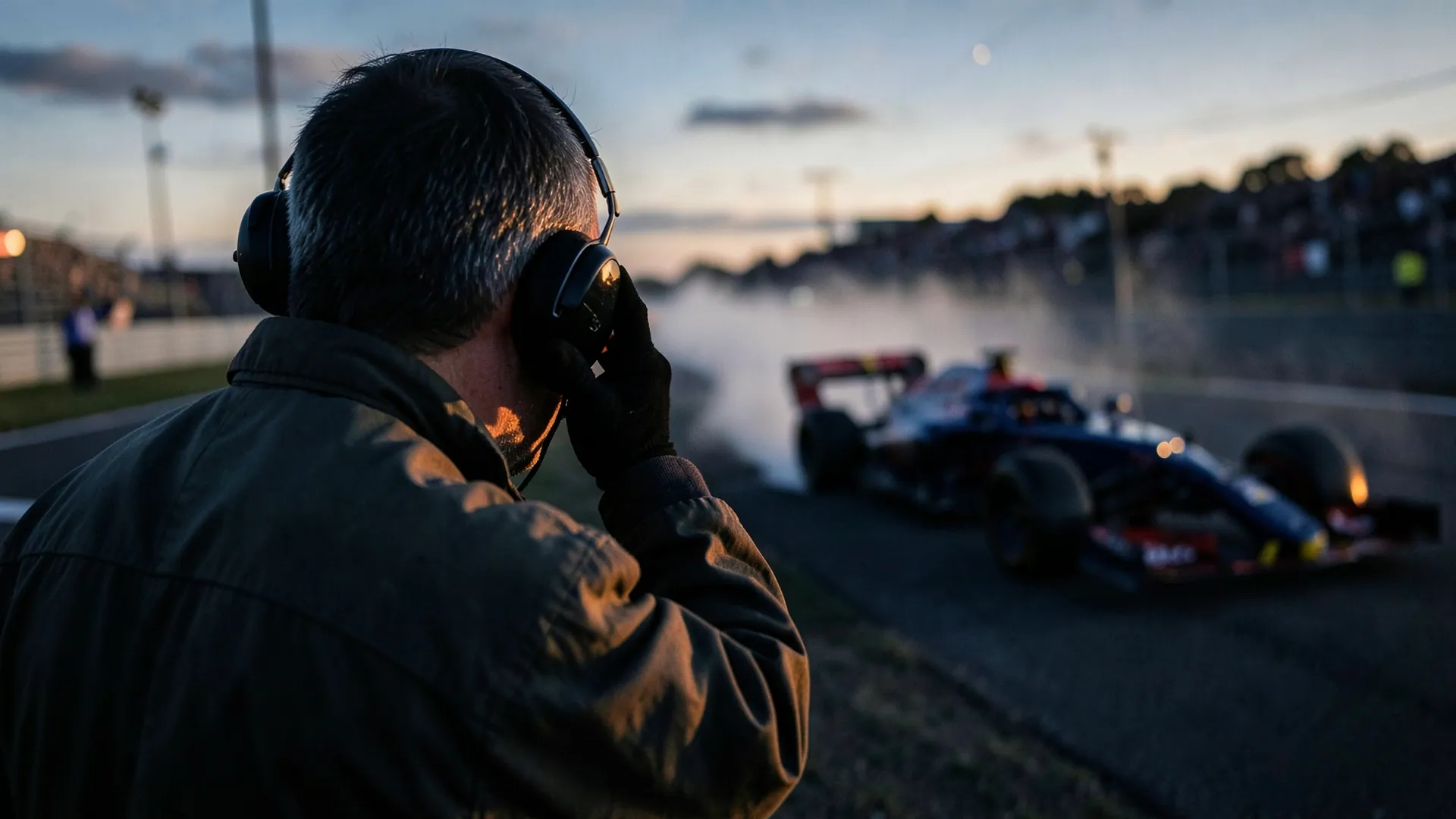
Max Verstappen raced with a new race engineer for the first time at the United States Grand Prix on Sunday, finishing third in Austin behind Andrea Kimi Antonelli and Charles Leclerc. The change comes as GianPiero Lambiase prepares to leave Red Bull. It was not the smoothest of debuts: Verstappen was frustrated by repeated team radio dropouts during the race and, speaking to Sky Sports F1 afterwards, described them as “a disaster”.
On its own, a faulty radio link is a technical irritation. Coming in the very race where the most famous voice in Verstappen’s ear was replaced, it says something larger about where Red Bull is as a team. With five rounds left, Red Bull is fighting McLaren for third in the constructors’ championship and has very little margin for operational error.
A new voice, and a race that slipped away
On paper, Austin was a decent afternoon for Red Bull. Verstappen started second and finished on the podium. Isack Hadjar started third and took sixth. The team scored 23 points to McLaren’s 16, enough to erase a seven-point deficit and pull the two teams level on 355.
Look at the grid, though, and the picture is less flattering. Red Bull had two cars in the top three at the start and neither gained a place. Verstappen was passed by Leclerc, who climbed from fourth to second. Hadjar fell three places, finishing behind Lewis Hamilton, who started fifth, and Lando Norris, who rose from eighth to fifth. Of the top six starters, only Antonelli, who converted pole into his ninth win of the season, finished where he started.
It would be too convenient to blame all of that on a crackling radio. Ferrari clearly had strong race pace, and Norris’s recovery suggested McLaren’s long-run speed was better than its qualifying showed. But a driver who has just lost his long-standing engineer, and then cannot reliably hear his replacement, is starting from a weaker operational position. When Verstappen chooses a word as strong as “disaster”, it is a fair sign the problem was more than an occasional burst of static.
Why a dropped signal costs more in 2026
Radio has always mattered in Formula 1, but this season has made it more important. The 2026 regulations brought a far larger electrical share of the power unit, which means energy management is now a constant, lap-by-lap negotiation. Deployment, harvesting, overtake assistance and the active aerodynamic modes all bring decisions that drivers increasingly make with live guidance from the pit wall. There is more information to pass on and less tolerance for missing it.
Then there are the usual race variables: tyre degradation trends, the gaps to cars ahead and behind, pit windows opening and closing, and the threat of an undercut. A driver can cope without some of that information for a lap or two. He cannot race at his best without it for a whole stint.
The timing made matters worse. A new engineer-driver pairing depends on calibration. The engineer has to learn when to speak and when to stay quiet, how much detail the driver wants, and how to judge his tone. The driver has to learn to trust the information coming back. That process only works with clean, frequent exchanges. Radio dropouts in the first race of a new partnership disrupt that learning at the moment it matters most.
Ten years of shorthand, and what replaces it
The Verstappen-Lambiase partnership is one of the defining relationships of modern Formula 1. Lambiase has been in his ear since Verstappen’s promotion to Red Bull in 2016, through the first win in Barcelona, five victories in Mexico City and four consecutive world titles from 2021 to 2024. Their exchanges became famous for being blunt. Verstappen would push back, sometimes sharply, and Lambiase would answer with dry, unbothered firmness. Some fans heard it as friction. In practice it showed a level of mutual trust that allowed both men to be completely direct with each other mid-race.
That kind of shorthand cannot be handed over. Lambiase’s role had also grown well beyond the radio, with his promotion to head of racing in 2024. Red Bull is therefore losing a race engineer and a senior operational figure at the same time.
There is recent precedent for how difficult this can be. When Hamilton moved to Ferrari in 2025 and ended his long partnership with Peter Bonnington, his early radio exchanges with Riccardo Adami were often awkward and occasionally strained. Neither man lacked ability. Both were simply learning to work with someone new while racing. Verstappen faces a milder version of that problem, because he is staying in a familiar team, but the principle is the same.
It also fits a wider pattern. Over the past two seasons Red Bull has lost Adrian Newey, Jonathan Wheatley and Will Courtenay, replaced Christian Horner with Laurent Mekies as team principal and, this season, begun racing its own power unit. Each of those changes has been managed. Taken together, they mean the team that dominated 2023 has been rebuilt piece by piece, and the Lambiase handover removes one of the last pillars of that era.
Level with McLaren, and Verstappen six points off second
The stakes for the final five rounds are clear. The drivers’ title belongs to Antonelli in all but mathematics: his 365 points give him a lead of 123 over George Russell, and Mercedes, with 12 wins between its two drivers, has a commanding 607 points in the constructors’ standings. Ferrari is 119 points clear in second. For Red Bull, third place is the realistic target, and it is a straight fight.
| Constructors’ standings | Points | Wins |
|---|---|---|
| 3. Red Bull | 355 | 2 |
| 4. McLaren | 355 | 2 |
The two teams are level on points and level on wins. Their driver line-ups help explain why the fight is so close. McLaren has Norris on 211 points and Oscar Piastri on 144, which makes it more balanced than Red Bull, whose total still depends heavily on Verstappen. Hadjar’s 105 points in his first season with the senior team are respectable, but they leave Red Bull relying on its lead driver every weekend. That makes the quality of Verstappen’s race operation even more important.
Verstappen also has an individual battle on his hands. He is fourth on 236 points, six behind Russell and five behind Hamilton, with Leclerc only three points further back. Four drivers are separated by nine points in the fight to be runner-up to Antonelli. Second place in the championship matters to drivers of this calibre, and to Verstappen in particular, as a statement of how much he can extract from a car that is not the class of the field. In a contest that close, a single badly timed stop, caused by a misheard or unheard call, could decide the outcome.
What Mexico City has to show
Round 19 takes Formula 1 to the Autódromo Hermanos Rodríguez on 1 November, and few venues will test the new arrangement as quickly. The high altitude makes cooling and power-unit management unusually demanding, and energy deployment under the 2026 rules will need careful handling down the long main straight. This is a track where the conversation between driver and pit wall carries real performance value. It is also where Verstappen and Lambiase built their most successful record, so comparisons with the past will be easy to make.
Red Bull’s first priority is basic: the radio has to work. If that is resolved, as it should be, the remaining questions are about rhythm and trust. These are harder to fix but tend to improve with every clean weekend. Five races is a short time to build a partnership, but it is long enough for a team to show it can run a reliable race operation.
Our view is that Austin should be treated as a warning rather than a crisis. Verstappen’s complaint was justified, and he was right to make it publicly. Red Bull’s results are not the problem: it outscored McLaren on Sunday and has pulled level. The concern is that with equal points, equal wins and a less evenly matched driver pairing than its rival, Red Bull cannot afford to give anything away through avoidable operational failures. If Verstappen can hear his engineer clearly in Mexico City and the partnership starts to settle, Red Bull is well placed to claim third. If the problems continue, McLaren’s stronger second car is likely to decide the fight in its favour.