
Red Bull Close on McLaren as Verstappen Defends Formula 1's 2026 Rules
Red Bull have cut McLaren's constructors' advantage to seven points, Max Verstappen has rounded on critics of the 2026 regulations, and Honda has admitted it wasted two years on Aston Martin's engine.
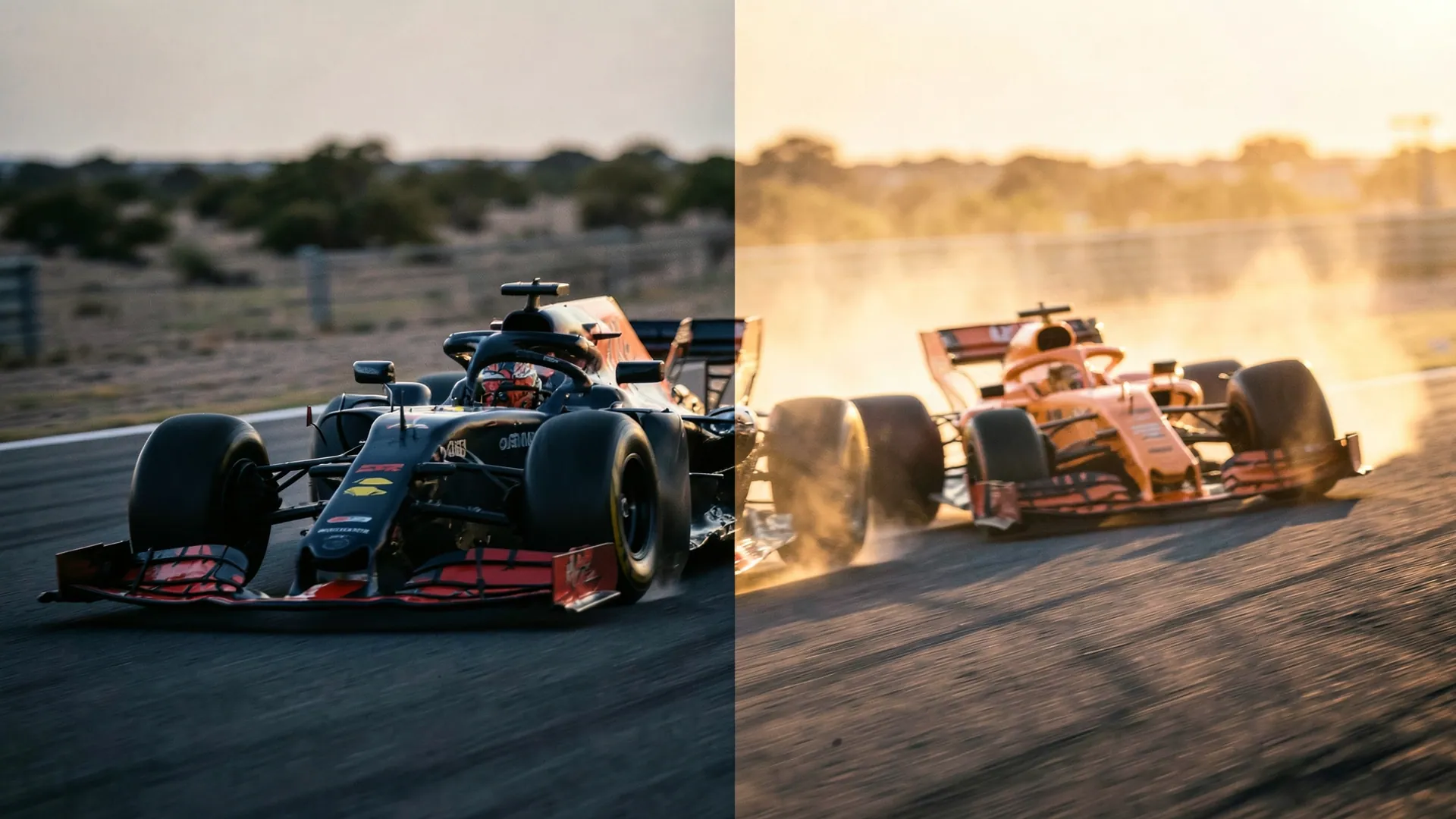
Red Bull have closed to within seven points of McLaren in the fight for third in the constructors’ championship after Max Verstappen won the Singapore Grand Prix from pole a week ago. McLaren team principal Andrea Stella says the reigning constructors’ champions are nonetheless reassured by the “ping-pong” rhythm of the 2026 season. With six rounds left and the United States Grand Prix in Austin next Sunday, it is one of the tightest fights in either championship. Elsewhere, Honda has made a rare public admission about how its Aston Martin project went wrong, and Verstappen has spent his week defending the rules, racing GT cars and standing up for an abused team-mate.
Seven points between McLaren and a resurgent Red Bull
The standings are stark. McLaren have 339 points and Red Bull 332, both a long way adrift of Mercedes (578) and Ferrari (444), but separated by less than a third of a race win. Singapore showed clearly how the momentum has shifted. McLaren brought both cars home in the points, with Lando Norris fourth and Oscar Piastri fifth, for a tidy 22-point haul. Red Bull still outscored them in the Grand Prix, with Verstappen’s 25 points and a single point for Isack Hadjar, who climbed from 22nd on the grid to 10th.
What Stella means by “ping-pong”
Speaking to RacingNews365, Stella framed the season as one in which the competitive order swings from weekend to weekend, so no single result should be over-read. There is logic to that. Ferrari, McLaren and Red Bull have two wins apiece this year, which suggests a pack of front-runners in which circuit characteristics decide a great deal.
The weakness in the argument is that ping-pong only reassures you if your peaks stay as high as your rival’s. Norris, by PlanetF1’s account, delivered a bleak verdict after Singapore, suggesting that fourth place flattered the car rather than reflected its pace. When a team’s lead driver is that downbeat after a solid result, the reassurance from the pit wall reads more like morale management than a technical diagnosis.
McLaren’s two-driver cushion
McLaren’s genuine advantage is depth. Norris (201 points) and Piastri (138) both score consistently, whereas Red Bull lean heavily on Verstappen, who is fourth in the drivers’ standings with 221 points while Hadjar has 97. Over six rounds, two cars finishing fourth and fifth will outscore a winning car whose team-mate fails to score. Piastri’s season, however, has yielded no wins and leaves him 63 points behind his team-mate, and that limits how much the cushion can absorb.
Why Red Bull’s technical chief is not satisfied
Red Bull’s messaging this week has been notably hungry. Technical director Pierre Waché told RacingNews365 that the team will not be “satisfied” until it hits the target it has set itself, while team principal Laurent Mekies spoke to Crash.net about a “brutally honest” relationship with Verstappen built on trust and transparency. Mekies has led the team since Christian Horner’s departure in the summer of 2025, and that frankness appears to be shaping how the car is developed: driver feedback goes straight into the programme rather than being filtered through team politics.
On the current trajectory, Red Bull are favourites to finish third. McLaren’s best defence is the one Stella is already relying on: the next swing of the pendulum going their way, and two cars ready to cash in when it does.
Verstappen and the case for the 2026 rules
Verstappen, in comments reported by Motorsport.com, has hit back at former drivers who have criticised the 2026 regulations. He argues that much of the negativity comes from pundits who do not fully understand how the new cars work.
It is a striking position for a driver who was among the more vocal sceptics when the rules were first simulated. The 2026 package brought a far larger electrical share of power unit output, fully sustainable fuels, active aerodynamics and smaller cars. Before a wheel was turned, the main concern was that drivers would spend laps managing energy deployment rather than racing flat out. Many of the criticisms since have been variations on that theme.
Verstappen has a point. Analysis rooted in the instincts of the previous era can misread what is happening on track, particularly when deployment strategy means a car that looks slow on one straight is saving energy to attack on the next. The sport has not always done enough to explain that to viewers, and former drivers are not obliged to be experts in hybrid energy management.
There is a fair counter-argument, though. Pundits are there to judge the spectacle, not the engineering, and a fan does not need to understand the rules to know whether a race was enjoyable. The burden of explanation sits with the sport, not with the audience.
The more useful test is historical. Major rule changes almost always produce one early dominant team: Brawn in 2009, Mercedes in 2014, Red Bull in 2022. Mercedes have won 11 of 17 rounds this year, which fits the pattern. What matters is whether the field converges. Red Bull’s climb, and a season in which four teams have won races, suggest that it is converging, and that is a better defence of the regulations than any argument about whether critics understand them.
Mercedes chase the clues in a harder-to-drive car
At the front, Mercedes are working through a curious problem. According to Autosport, the team’s latest upgrade made its car harder to drive, and Singapore gave the engineers their first real clues to unlocking the package. Because it was a sprint weekend, with only one practice session, those clues came from limited running.
The results reflected the mixed picture. Andrea Kimi Antonelli finished third from fourth on the grid, while George Russell started 19th and recovered to ninth. That swung the title fight further towards Antonelli, who now leads his team-mate by 102 points.
The arithmetic facing Russell
With six rounds remaining, Russell needs to outscore Antonelli by an average of 17 points a weekend to draw level. That would require more than a reversal of the Singapore Grand Prix result at every race from now until the season finale. Lewis Hamilton (111 behind) and Verstappen (119 behind) are in even weaker positions.
Antonelli has eight wins and 340 points. If he converts this lead, he will become the youngest world champion in the sport’s history at 20, beating the record Sebastian Vettel set in 2010.
The upgrade issue is therefore less about this year’s titles, on which Mercedes already have a firm grip, than about understanding. A team with a 134-point constructors’ lead can afford to experiment, and what it learns about why this car became harder to drive will shape its development for 2027. Russell has more incentive than anyone to see the problem solved quickly.
Honda’s admission and Aston Martin’s lost season
The most candid quote of the week came from Koji Watanabe, the outgoing president and CEO of Honda Racing Corporation. He told GPfans that the company “wasted two years” in developing its F1 engine for Aston Martin.
The scale of the problem is clear from the standings. Aston Martin have seven points after 17 rounds and sit 10th of 11 teams, ahead only of newcomers Cadillac. In Singapore, Fernando Alonso started 20th and finished 16th, lapped, while Lance Stroll retired from 21st on the grid. Audi, in their first season as a works entrant, have 23 points, which shows that a new power unit programme does not have to mean a lost year.
The admission carries weight because of Honda’s history. Its 2015 return with McLaren was badly troubled. It recovered with Toro Rosso and then Red Bull, and announced in 2020 that it would leave the sport, only to power Verstappen to his first title in 2021. The Aston Martin works deal followed in 2023. Watanabe did not specify which two years he meant, but his words support a lesson the sport has learned before: an engine programme loses ground every time its direction changes, and that ground cannot be recovered quickly.
There is something to respect in a departing chief stating the problem so plainly rather than hiding behind talk of “learning”. Whether it helps Aston Martin depends on what his successor does with that honesty. Alonso is 45, and time is the one thing this project cannot give back to him.
Portimao, Lulham and the cost of online abuse
Verstappen’s week away from F1 was eventful. Racing in the GT World Challenge at Portimao, he saw his car hit with a major penalty, prompting a late recovery drive that RacingNews365 described as eye-catching. The weekend took an uglier turn when his Verstappen Racing team-mate Chris Lulham was targeted with abuse online after a costly incident on Saturday.
Verstappen responded publicly: “I also feel I need to speak up.” It was the right call. Lulham, a British driver with nowhere near Verstappen’s profile, was suddenly exposed to the full size of an F1 audience. When a four-time world champion races in GT, he brings a huge following with him, and the drivers around him have none of the support structure that shields F1 stars from that level of scrutiny.
In a separate interview reported by Motorsport.com, Christian Horner described how his wife, Geri Halliwell, helped him cope with the hostility that followed his rise to fame through Drive to Survive. The two stories share a root. The sport’s commercial growth has been built on turning personalities into characters, and the cost of that falls unevenly, often on the people least able to absorb it.
Radio rights, the fight for second and the road to Austin
- The BBC’s radio deal under threat. Radio station talkSPORT is considering a bid for F1’s UK radio rights, which the BBC has held for 32 years. The station’s head, Liam Fisher, told The Telegraph that F1 would suit its output. Losing Radio 5 Live’s coverage would change how many British fans follow the sport.
- The fight for second. Russell (238), Hamilton (229), Verstappen (221) and Charles Leclerc (215) are separated by just 23 points, making that race far more open than the title fight.
- A shared request from rivals. PlanetF1 reports that Hamilton and Verstappen are aligned on a request concerning the Singapore track. Agreement between those two tends to carry weight in the paddock.
- A familiar face in an unfamiliar garage. Anthony Hamilton, Lewis’s father, was spotted visiting Verstappen’s garage at Portimao. It was a small, friendly scene between two families whose rivalry defined the 2021 season.
- Cadillac still waiting. The newcomers remain the only team without a point after 17 rounds. Sergio Pérez finished 17th and Valtteri Bottas 19th in Singapore.
- Austin next. The Circuit of the Americas on 25 October rewards high-speed balance more than Singapore’s street corners. If McLaren cannot reverse the trend there, Red Bull’s grip on third place in the constructors’ championship will only tighten before the season ends.