
FIA Targets Cost Cap Staff Loophole as Pérez Backs Vowles on Policing
A new operational rule targets teams that keep staff working on Formula 1 while they sit officially outside the budget, as Sergio Pérez and James Vowles question whether the cap binds everyone equally.
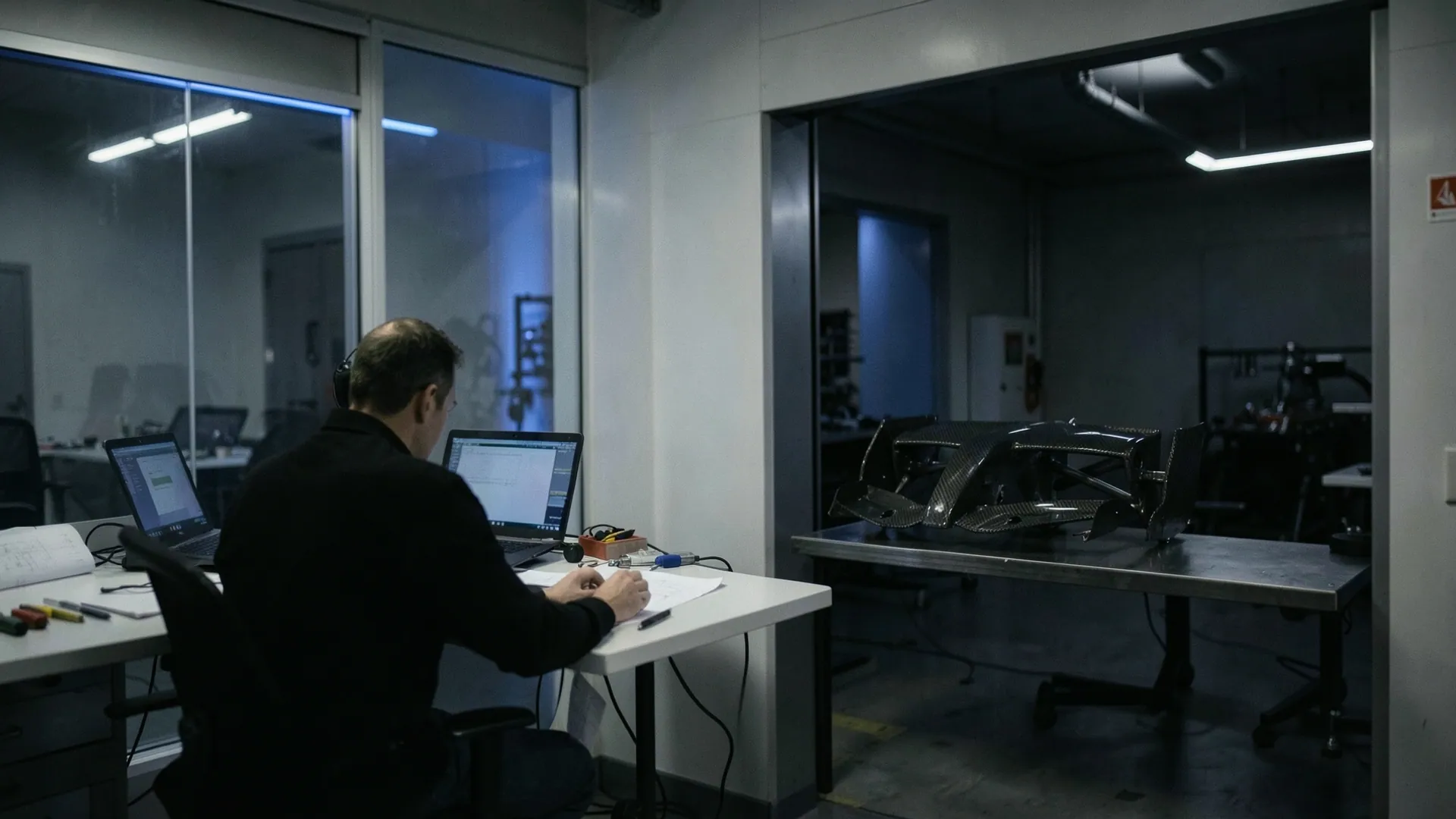
The FIA has added a new article to Formula 1’s operational regulations for next season, aimed at stopping teams from having staff work on the F1 project while officially assigned elsewhere. The move comes as Cadillac’s Sergio Pérez publicly sides with Williams team principal James Vowles, who has questioned whether the cost cap is policed evenly between the sport’s largest organisations and its smaller teams. Between them, the rule change and the criticism reopen an argument the sport has never fully settled: whether a spending limit can ever be fair to everyone it applies to.
The engineer with two employers
The financial regulations have always had a weak seam. They govern what a team spends on its F1 operation, but the biggest teams belong to much larger businesses. Many have road-car divisions, advanced-engineering arms or consultancy offshoots under the same roof, often on the same campus. An engineer can spend the morning on a hypercar project and the afternoon looking at a front-wing problem. On paper, only part of that salary may count against the cap.
Accountants can police invoices. They struggle to police the inside of an engineer’s head. If a designer formally employed by a sister company solves a problem that later appears on a race car, the knowledge has crossed the line even if no money visibly did.
The new article attacks that from the operational side rather than the financial one. Instead of relying solely on how costs are allocated, it targets the practice itself: staff contributing to the F1 programme while sitting outside it on paper. That distinction matters. Financial rules invite creative accounting; operational rules define what people may and may not do, which is easier to audit through access logs, project records and interviews.
The FIA has not framed this as a response to any single team. But regulators rarely write a new article to address a problem nobody thinks exists.
Pérez, Vowles and the view from the back
Pérez’s intervention carries weight because of where he has been. Speaking to PlanetF1, he recalled his time at Red Bull: “At Red Bull, for example, we used to bring upgrades pretty much every weekend. You never heard anything about the cost cap.” He stopped short of suggesting that rules were broken. His point is that a team with deep resources and a mature organisation could develop relentlessly without the cap ever feeling like a constraint, while smaller teams count every carbon part.
His current situation sharpens the point. Cadillac are the only team yet to score in 2026. In Singapore, Pérez started 17th and finished 17th, a lap down, with Valtteri Bottas 19th. Williams, Vowles’ team, sit ninth in the constructors’ championship on 12 points. Alexander Albon retired in Singapore and Carlos Sainz finished 14th, lapped.
At the other end of the table, Mercedes have 578 points and 11 wins from 17 rounds. Andrea Kimi Antonelli leads the drivers’ championship on 340 points, 102 clear of team-mate George Russell with six rounds remaining. Ferrari are second on 444, and McLaren and Red Bull are split by just seven points in the fight for third.
| Team | Constructors’ position | Points |
|---|---|---|
| Mercedes | 1st | 578 |
| Ferrari | 2nd | 444 |
| Williams | 9th | 12 |
| Aston Martin | 10th | 7 |
| Cadillac | 11th | 0 |
None of this proves anyone is spending beyond the limit. Performance gaps in F1 are built over decades: infrastructure, institutional knowledge, the quality of correlation between wind tunnel and track. But that is precisely Vowles’ complaint, and Pérez’s. The cap was sold as an equaliser. If the largest teams can lean on the wider resources of their parent organisations, a team that is purely an F1 outfit is capped in a way its rivals are not.
The 2021 precedent nobody has forgotten
The cost cap arrived in 2021, and its first real test came in October 2022, when the FIA found Red Bull guilty of a minor overspend in that inaugural year. The penalty was a $7 million fine and a 10 per cent reduction in aerodynamic testing allowance. Aston Martin were found to have committed a procedural breach in the same cycle, and Williams received a smaller procedural sanction of their own.
The Red Bull case set the tone for everything since. The breach came in the season Max Verstappen won his first title by the narrowest of margins, and rivals argued that even a small overspend could buy decisive development. Red Bull maintained that the overspend stemmed largely from accounting interpretation rather than extra performance. The penalty was criticised from both directions: as too harsh by Red Bull, and as too lenient by those who believed the title had been influenced.
What 2021 established was that the FIA would find breaches and would publish them. What it did not establish was that the system catches what it cannot see. The overspend was detected because it appeared in the submitted accounts. A staff member officially employed by a sister company would not appear there at all.
That is why Pérez’s recollection matters, even if it is anecdotal. A driver sees the cadence of upgrades. He does not see the ledger. When the cadence feels unconstrained, suspicion follows, whether or not it is justified.
A rule is only as strong as its audit
The FIA deserves credit for acting before a scandal forces its hand. Shifting part of the burden from the financial regulations to the operational ones is a sensible structural choice. It turns a question of accounting interpretation into a question of conduct, which is easier to define and harder to argue around.
But the cost cap has always rested on enforcement capacity, and that is where the scepticism will settle. Proving that an engineer on a road-car payroll influenced an F1 design requires access to emails, CAD records, meeting logs and server permissions across businesses that are not themselves F1 entrants. The FIA will need both the legal reach and the staff to use it. A rule that is never tested in a hearing deters only the teams that were never inclined to push it.
There is also a fairness argument running the other way. Large organisations employ thousands of people outside F1, many with legitimate and valuable expertise. A blunt rule could prevent ordinary knowledge-sharing that is neither secret nor improper. The article will need careful drafting and consistent interpretation if it is not to generate a fresh round of protests and clarifications.
Then there is the question of what the smaller teams actually want. Vowles has spent his Williams tenure arguing that the team’s problems run deeper than money, in facilities and processes left to age for years. The cap does not fix those, and closing a loophole at Mercedes or Ferrari will not shrink a points gap measured in hundreds. What it can do is protect the principle that the spending limit is the same for everyone, which matters most to teams like Williams and Cadillac that are trying to build from below.
Why the verdict will not come in Austin
This weekend’s United States Grand Prix at the Circuit of the Americas will not resolve any of this. The championship picture is dominated by Antonelli’s lead and Mercedes’ margin, and none of the new article’s provisions apply until next season.
The real tests come later. The first is how teams restructure over the winter: whether staff who have quietly straddled both sides of a business are moved firmly onto one. The second is when the FIA’s reviews of 2027 spending conclude, likely well into 2028, and whether any team is pursued under the new article.
If the governing body publishes even one detailed finding, the rule will have teeth and Pérez’s complaint will have done its job. If two seasons pass without a single case, the smaller teams will reasonably conclude that the loophole was not closed, merely relabelled.