
Gulf Finale Doubts Overshadow Antonelli's Title Run as F1 Heads to Austin
Uncertainty over the Qatar and Abu Dhabi finale, Mercedes' shrinking advantage and Red Bull's diagnosis of its tyre wear dominate the build-up to Austin, where Andrea Kimi Antonelli carries a 102-point lead.
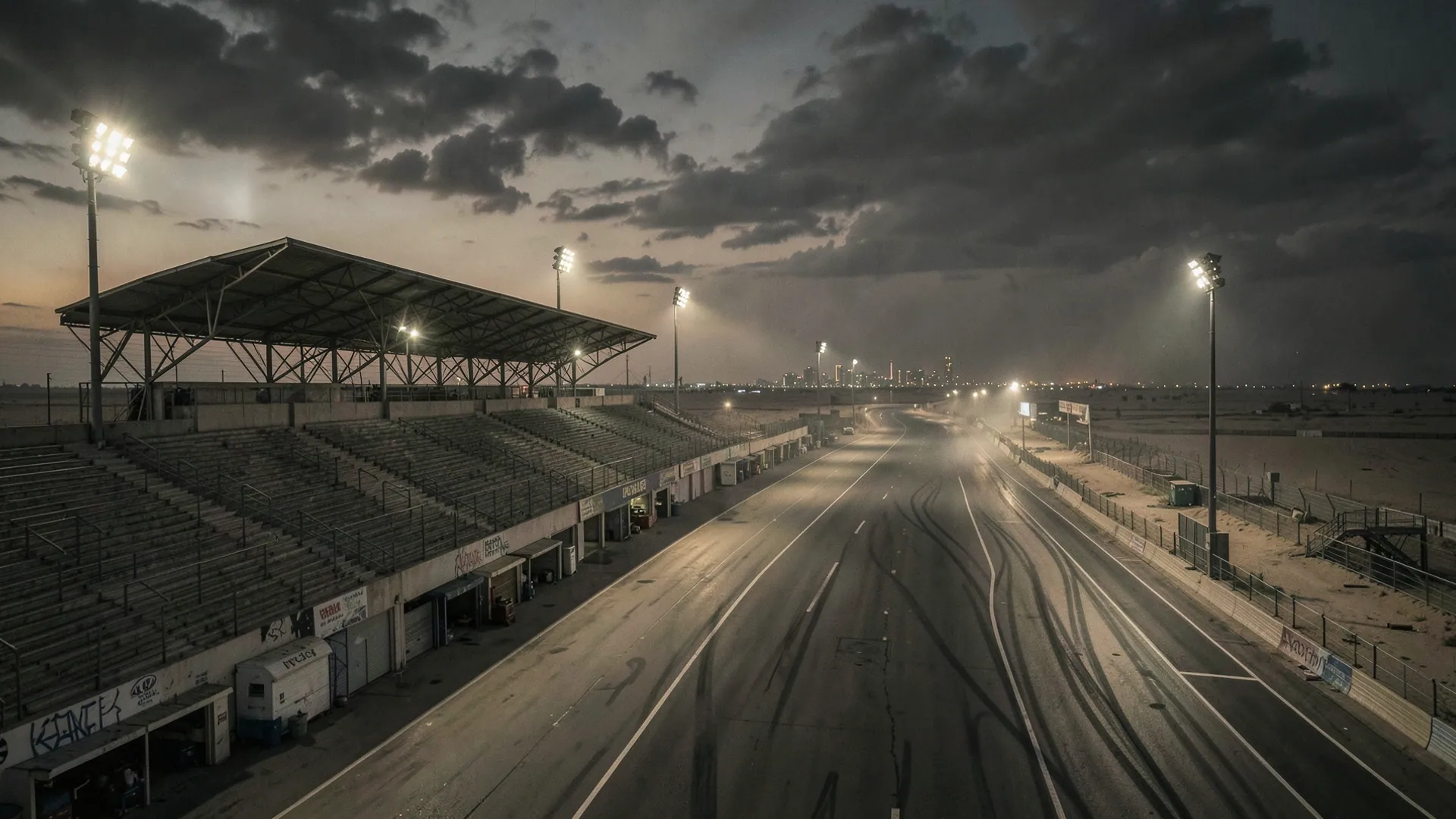
Formula 1 still plans to close its 2026 season with back-to-back races in Qatar and Abu Dhabi, despite claims that the war in the Middle East makes the trip too risky. The Lusail circuit says its preparations remain on course, the FIA president has disputed those claims, and a decision is expected soon. It comes as the sport heads to Austin for round 18, with Andrea Kimi Antonelli 102 points clear and the order behind Mercedes more fluid than at any point this year.
The Gulf double-header waits on a decision
Six rounds remain. Austin comes first, three more follow, and the calendar then ends in Qatar at the end of November and Abu Dhabi the following weekend. Over the past few days the organisers and the governing body have been saying the same thing in different ways. Lusail has issued more than one readiness update, covering its MotoGP date as well as F1. The FIA president, meanwhile, has pushed back on the idea that the region now carries an unacceptable level of risk for the travelling paddock.
Reassurance is welcome, but it is only part of the job. Safety on race weekend matters, and so do freight routes, personnel travel, insurance and the confidence of around 2,000 people who have to get on aircraft. F1 has faced versions of this before. In 2011 the Bahrain Grand Prix was postponed and then abandoned amid unrest. In 2022 an attack on an oil facility near the Jeddah circuit during practice led to hours of late-night meetings before the drivers agreed to race. The sport learned from Jeddah that drivers expect a genuine voice, and that decisions made at midnight on a Friday satisfy nobody.
The commercial stakes are obvious. Abu Dhabi has closed every season since 2014, and both Gulf events pay substantial hosting fees. Replacing them at short notice would be harder than it was in 2020, when F1 rebuilt its calendar with European circuits that were available in late summer and autumn. A northern-hemisphere venue in late November offers cold tracks and short days, and the end-of-season freight plan is fixed months in advance.
What cancellation would do to the title
The sporting consequence deserves attention too. If both races were dropped, four grands prix would remain, worth a maximum of 100 points on Sundays. Antonelli leads George Russell by 102. Sprint points would keep the arithmetic technically open, but a championship effectively settled by cancellation would sit awkwardly with everyone, including the driver who has earned it.
The right course is to keep planning in good faith but to set a firm deadline. The decision should rest on security assessments shared openly with teams and drivers, and it should come early enough that nobody is improvising in the final week.
Mercedes is no longer untouchable, but it is still clear
Motorsport.com has set out the figures behind a trend the paddock has felt for weeks. Mercedes won the opening six grands prix of the new regulations. Across the 11 rounds since, it has won five. The other six have gone to four different drivers: Max Verstappen and Lando Norris have two each, while Lewis Hamilton and Charles Leclerc have one apiece.
This is the usual arc of a new rule set. The team that reads the regulations best banks its advantage early. Rivals then copy, learn and converge, and the cost cap limits how far the leader can outspend them to stay ahead. Mercedes also has a reason to start shifting resources towards next year, when the margins it enjoyed in spring will not be there by default.
The Singapore split showed how Mercedes is managing the balance. Antonelli kept the update package and converted fourth on the grid into third place. Russell started 19th and climbed to ninth. Comparing the two is difficult when they ran in different parts of the field, so the team has had to set its upgrade plan for Austin with less direct evidence than it would have liked.
None of this changes the overall picture. Mercedes leads the constructors’ championship by 134 points from Ferrari. Antonelli has eight wins and would become the youngest champion in the sport’s history. The more interesting question for Mercedes is no longer whether it wins these titles but how comfortably, and what the erosion of its advantage says about 2027.
Russell’s position is more exposed. He has three wins and sits second, but only nine points clear of Hamilton.
Verstappen’s tyre problem has an explanation
Verstappen took pole in Singapore and converted it into his second win of the season. That result has encouraged talk of Red Bull as the team to beat. Pierre Waché, Red Bull’s technical director, has now explained the weakness that held the RB22 back for much of the year. He describes the car’s degradation as a chain in which aerodynamic wear, mechanical grip and suspension behaviour are linked.
The logic is familiar to any engineer. If the suspension cannot hold the car on its intended aerodynamic platform, downforce varies through a corner. A car short of mechanical grip in slow corners slides, and sliding overheats the tyres. Once the rubber overheats, it loses grip, the car slides more and the cycle accelerates over a stint. A team that understands why its car eats its tyres can at least choose set-ups that interrupt that cycle, even before a hardware fix arrives.
Austin will test the explanation. The Circuit of the Americas is bumpy and combines fast changes of direction in the opening sector with slow, traction-limited corners later in the lap. It punishes a car that cannot keep a stable platform.
Ferrari’s caution is reasonable
Ferrari has disputed the “team to beat” label, and its scepticism has substance. Singapore rewards qualifying position heavily because overtaking is so difficult, and Leclerc followed Verstappen home from second on the grid. Hamilton started third and finished sixth, which says as much about Ferrari’s race pace as about Red Bull’s.
Red Bull’s form has also lifted its second car. Isack Hadjar climbed from 22nd to 10th. That point matters, because Red Bull trails McLaren by only seven points in the fight for third in the constructors’ championship, a gap worth real prize money.
My view is that Red Bull has earned the right to be taken seriously in the final six rounds, but not to be called favourite. One win from pole on a street circuit is a strong signal. A win at a high-degradation track would settle the argument.
Ferrari hires from Mercedes as the fight for second tightens
Ferrari has recruited a senior engineer from Mercedes who worked with Hamilton during his title-winning years there. For Hamilton, the hire brings a familiar method and a shared technical vocabulary into a team where he is still building his own structure around the car.
Moves between rival teams at this level usually involve notice periods or gardening leave, so the hire is a statement about next season rather than this one. It does show intent. Ferrari is second in the constructors’ standings, and its strategy appears to be to add proven Mercedes experience rather than wait for its own organisation to mature.
In the short term, the drivers’ championship is where Ferrari has something to play for. Behind Antonelli, 23 points cover four drivers:
- Russell (Mercedes), 238 points
- Hamilton (Ferrari), 229 points
- Verstappen (Red Bull), 221 points
- Leclerc (Ferrari), 215 points
Second place in the championship is a modest prize, but it is a real one, and the battle for it should colour every race between now and the finale.
Cost-cap enforcement and an early V8 debate
Policing the cap from both ends
Two stories this week came at the budget cap from opposite directions. The FIA has added a new article to next season’s operational regulations designed to stop teams having staff contribute to the F1 programme while those staff are formally accounted for elsewhere in the business. The rule targets the workaround that has always worried smaller teams: large organisations moving costs across the boundary of the capped entity.
Separately, Sergio Pérez has backed James Vowles’s warning about the cap. The Cadillac driver contrasted his current team with his Red Bull days, when, he said, upgrades arrived almost every weekend and the cap was never discussed. His point is that a fixed dollar figure does not produce a level playing field. An established team with mature facilities, refined simulation tools and efficient processes extracts far more performance per dollar than a newcomer still building those foundations. Cadillac has yet to score a point, and Vowles’s Williams has 12.
Both stories lead to the same conclusion. The cap’s credibility depends on rigorous enforcement, as the fine and reduction in aerodynamic testing time imposed on Red Bull for its 2021 overspend demonstrated. It also depends on recognising that equal spending limits do not create equal starting points. The new article is a sensible tightening. The harder conversation, about how a new or rebuilding team catches up within the same limits, has barely started.
The V8 conversation arrives early
The FIA has outlined a timeline for agreeing a framework to bring V8 engines back to F1. In the first season of an expensive hybrid formula, the timing is striking.
The case for a V8 is easy to make: lower cost, less weight, simpler packaging and a sound that many fans miss. The difficulty is the manufacturers. Audi arrived, Honda returned with Aston Martin and Ford partnered Red Bull on the strength of the current hybrid concept and its emphasis on electrical power and sustainable fuel. Any new formula has to keep them committed, and the existing rules have to keep delivering good racing while the next ones are written.
Setting a timeline is the responsible approach. Engine rules take years to develop, and leaving the debate until the end of this cycle would repeat the delays that slowed the current regulations. The FIA should resist turning a long-term engineering question into a referendum on nostalgia.
From Austin’s forecast to Aston Martin’s slump
- Austin’s weather. Keep an eye on the weekend forecast, because temperature changes at the Circuit of the Americas can quickly alter tyre degradation and expose cars, Red Bull’s among them, that struggle to manage it.
- A Räikkönen anniversary. On this date in 2018, Kimi Räikkönen won the United States Grand Prix in Austin. It was his first victory in more than five years and, as it proved, his last.
- Piastri’s winless season. Oscar Piastri finished fifth in Singapore and has 138 points without a win, 63 behind team-mate Norris. He has six rounds left to change that.
- Aston Martin’s slump. Fernando Alonso finished 16th and Lance Stroll retired in Singapore. With seven points all season, Aston Martin sits 10th of 11 in the constructors’ standings.
- Audi’s foothold. Nico Hülkenberg’s eighth place lifted Audi to 23 points, seven behind Haas. Overhauling them is a realistic target for a team in its first season as a works entry.
- Lindblad’s lost ground. Arvid Lindblad started ninth in Singapore but dropped to 15th, a lapped finish that undid a strong qualifying for RB.