
Câmara Joins Haas, Leaving Three 2027 Seats and Red Bull's Racing Bulls Dilemma
Haas has handed Ferrari junior Rafael Câmara a multi-year deal from 2027, shrinking the open market to three seats and sharpening Red Bull's unresolved choice over its Racing Bulls line-up.
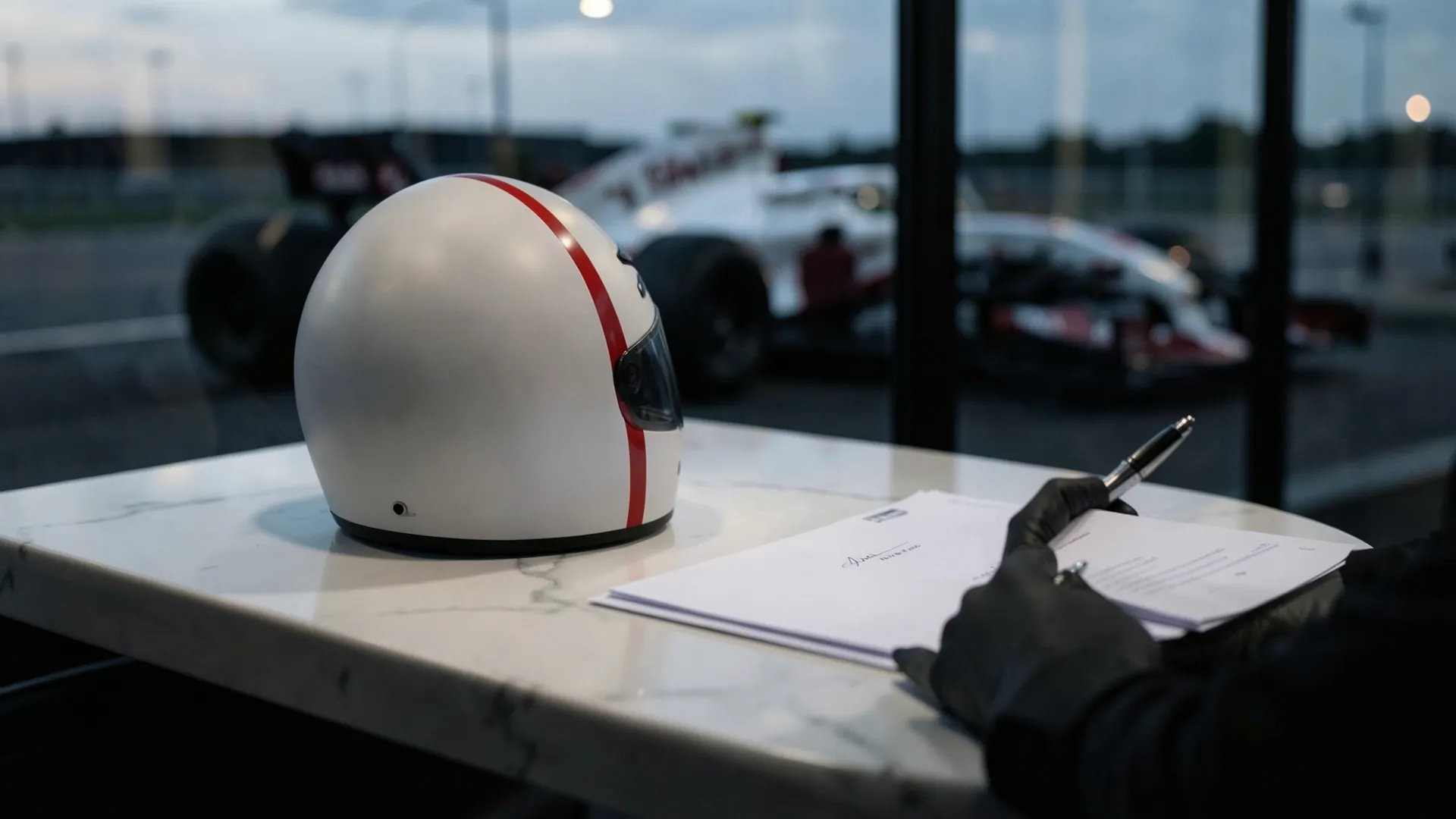
Haas has signed Ferrari junior Rafael Câmara on a multi-year contract, and the Brazilian will make his Formula 1 debut with the team next season. His arrival leaves just three seats on the 2027 grid without a confirmed occupant. The most consequential of the remaining decisions belongs to Red Bull, which has still to settle who drives for Racing Bulls.
The signing carries weight beyond Haas. Every seat that closes changes the arithmetic for the drivers still waiting, and for the teams deciding whether to keep them.
Why Haas moved early for Câmara
For Haas, the logic is simple. The team sits seventh in the constructors’ championship on 30 points, ahead of Audi (23) and Williams (12) but a long way short of Alpine’s 68. Singapore showed the scale of the gap. Oliver Bearman and Esteban Ocon finished 12th and 13th, both lapped, on a night when the midfield points went to Liam Lawson and Nico Hülkenberg. A team in that position has to find an edge somewhere, and a highly rated junior on a long contract is one of the few edges it can buy.
The Ferrari connection makes the move familiar. Haas runs Ferrari power and has long served as a finishing school for Maranello’s academy, first with Mick Schumacher and then with Bearman. A customer team gets a promising driver with backing behind him. Ferrari gets a place to put that driver against the full field, where his racecraft can be judged rather than projected from junior results. The arrangement suits both parties because neither has to gamble alone.
The commercial side matters as well. PlanetF1 has framed Câmara as a potential commercial windfall for the team, and a young Brazilian with Ferrari’s name behind him has obvious sponsorship appeal. For a team of Haas’s size, that is not a side issue. It funds development.
The multi-year term is the detail that stands out. Haas has rarely committed to rookies beyond a season or two, and a longer deal signals that the team sees Câmara as a foundation for its next phase rather than a stopgap.
A market down to three chairs
GPfans reports that only three seats remain open for 2027. That number shapes everything that follows. When the market is this tight, leverage moves almost entirely to the teams. A driver without a contract has few alternatives, and a driver who loses his seat this late in the year may have none at all.
Mercedes has shown why teams are willing to back youth. Andrea Kimi Antonelli, a 20-year-old in only his second season, leads the drivers’ championship on 340 points with eight wins, 102 clear of team-mate George Russell with six rounds remaining. Mercedes took a public risk when it promoted him straight from the junior categories, and that risk now looks inspired. Rival teams have noticed. If an untested teenager can become a title leader inside two seasons, the case for holding a seat for a proven but unspectacular veteran gets harder to make.
The result is a market that rewards potential and punishes waiting. Haas did not wait. Red Bull, so far, has.
Lawson, Lindblad and the Racing Bulls question
Crash.net reports that Red Bull still has a significant decision to make about its 2027 line-up at Racing Bulls. On the evidence of this season, the choice is less obvious than Red Bull’s history of decisive cuts might suggest.
Lawson has given the team a strong case for continuity. He is ninth in the championship on 75 points, the best of anyone outside the four leading teams. In Singapore he started eighth and finished seventh, a tidy, mistake-free drive on a circuit that punishes the smallest lapse. This is a driver who was moved out of the senior Red Bull seat after two rounds in 2025 and has since rebuilt his standing with consistency, which is the quality Red Bull’s management has most often said it wanted.
Arvid Lindblad’s case is different. He is 11th on 38 points in his first season, a respectable return for a rookie, but Singapore was a harder evening. He started ninth and finished 15th, lapped. One race proves little, yet it illustrates the variance that comes with a first year in F1. Some weekends show the speed that earned him the seat. Others show how much he still has to learn.
The team itself is having a solid year. Racing Bulls is fifth in the constructors’ championship on 100 points, 32 clear of Alpine. That position is worth money, and a stable line-up has helped secure it. Any change for 2027 has to be weighed against the risk of giving that up.
Then there is the question of succession at the senior team. Isack Hadjar, promoted to Red Bull this year, is eighth on 97 points and showed his racing in Singapore by climbing from 22nd on the grid to tenth. Max Verstappen, fourth in the standings and the winner in Singapore, will not race forever, and Racing Bulls exists to produce the driver who eventually replaces him. Whoever sits in its cars next year is auditioning for the most important drive in the organisation.
Red Bull’s record of quick cuts
Red Bull has always been willing to make hard calls quickly. Daniil Kvyat was demoted mid-season in 2016 to make way for Verstappen. Pierre Gasly went back to the junior team mid-season in 2019, and Alexander Albon was dropped from the senior seat at the end of 2020. Lawson’s two-race stint at Red Bull last year fits the same pattern.
Some of those decisions were justified. Others look different with hindsight. Carlos Sainz, Gasly and Albon all left the Red Bull system and went on to show their quality elsewhere, Sainz with several race wins. Red Bull’s ruthlessness has produced champions, but it has also handed rivals capable drivers for nothing.
That cost is higher now. In a market with three open seats, a driver released by Red Bull may find no other place on the 2027 grid. That gives Red Bull more power over the decision, but it also makes a wrong call harder to undo. A driver who leaves now may not come back, and his development will happen somewhere else.
The trade-off is clear. Keeping Lawson rewards a driver who is producing results and gives the team stability. Keeping Lindblad for a second season protects an investment at the stage where most young drivers make their largest gains. Promoting another junior keeps the pipeline moving but restarts the learning curve at a team that is currently performing well.
Why Red Bull should keep Lawson and Lindblad
The evidence points to keeping both drivers. Lawson has earned his place with results, not reputation. Lindblad has done enough to justify a second year, which is where Red Bull will find out whether his best weekends can become his normal weekends. Six races remain, starting at the Circuit of the Americas on 25 October, and both drivers have time to strengthen their cases.
Haas, by contrast, moved early and secured the driver it wanted. Red Bull’s position is different because it controls both teams, but it should not mistake control for unlimited time. Its decision should rest on what Lawson and Lindblad show in the six races that remain, not on its old habit of reshuffling drivers at the first sign of trouble. If it delays and then defaults to change, it risks losing another capable driver to a rival, at the moment when the market has almost no room left for second chances.