
What Verstappen Knew About Red Bull's Upgrade When He Committed His Future
Verstappen's pole-to-flag win in Singapore suggests Red Bull's major upgrade is real, and it raises the question of how much he could see coming when he signed his new deal.
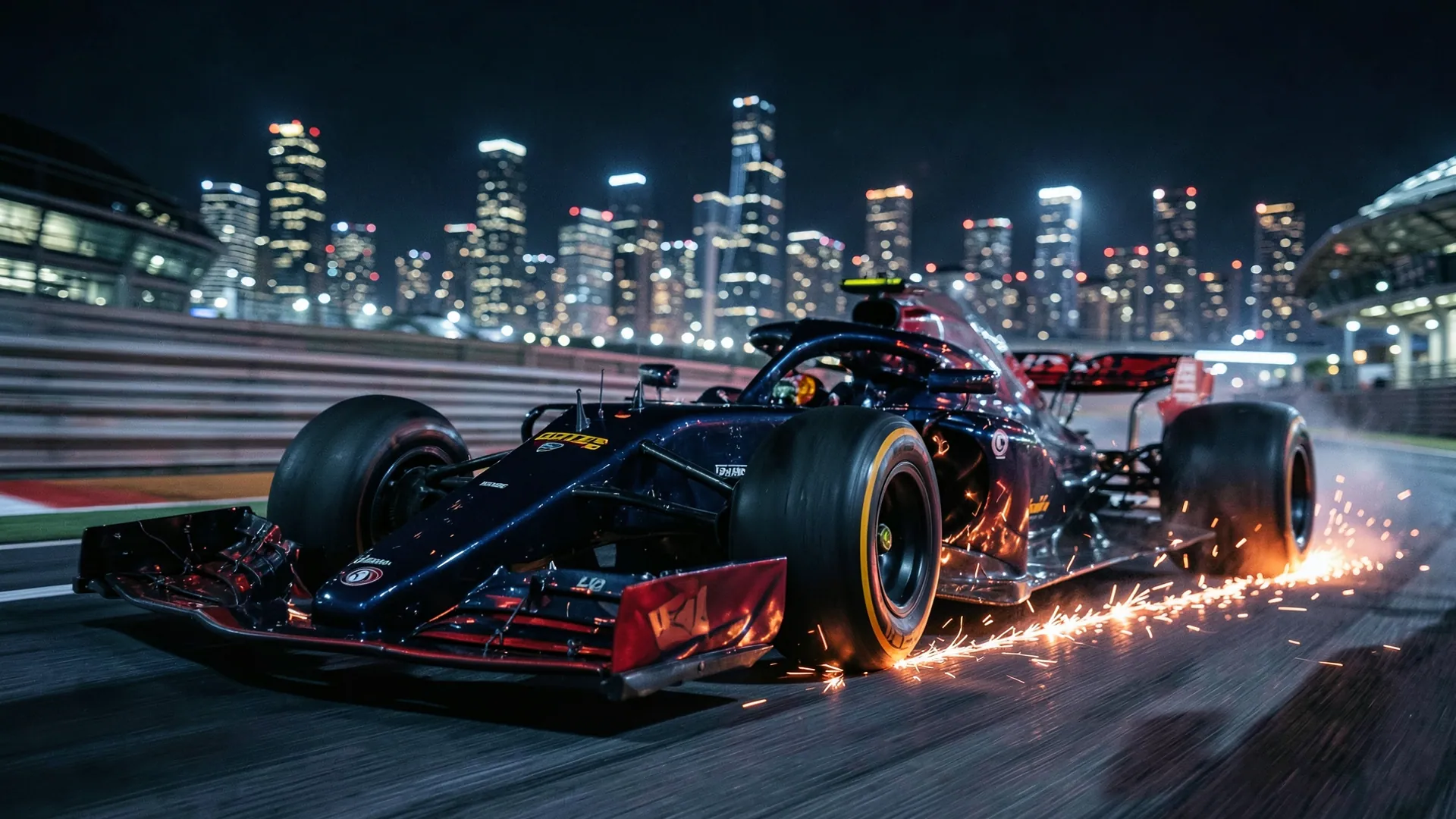
Max Verstappen won the Singapore Grand Prix from pole position on 11 October, taking his second victory of the 2026 season. Charles Leclerc finished second for Ferrari and championship leader Andrea Kimi Antonelli was third for Mercedes. The result is the clearest evidence yet that Red Bull’s major upgrade has changed Verstappen’s year. It also raises an obvious question about his new contract: whether he signed because he had seen this coming.
From Monza doubts to a Marina Bay win
Recent reporting from Autosport and Motorsport.com has recalled where Verstappen stood at Monza. He was openly considering the possibility of finishing the season without a single win. Given the shape of 2026, that was a realistic assessment rather than false modesty.
Mercedes have won 11 of the 17 rounds so far. Antonelli has eight of those wins and George Russell three. Ferrari, McLaren and Red Bull have two each. For most of the year, the Mercedes pair have been the only drivers able to win routinely, and everyone else has picked up what was left.
Verstappen now has two victories. Marina Bay is a circuit where overtaking is difficult and track position decides most races. A driver who starts from pole there usually controls the race if the car can manage its tyres over a long, hot stint. Verstappen did exactly that. Leclerc started second and finished second, so the challenge from directly behind never came to anything.
Further back, the field moved around more. Lewis Hamilton slipped from third on the grid to sixth. Russell recovered from 19th to ninth, and Isack Hadjar took the final point from 22nd. Verstappen’s race had none of that disruption, which is what a car in the right operating window gives you.
What a driver can see before the stopwatch does
Did Verstappen know the upgrade would transform his season when he committed his future? I think he knew the numbers, but nobody could have known the outcome.
A driver of his standing does not sign on faith alone. Before a major package reaches the track, it exists as wind-tunnel results, CFD predictions and simulator correlation. The team can show its lead driver the expected downforce gains, the projected balance changes and the lap-time predictions for different types of circuit. Verstappen spends a lot of time in the simulator and is known for giving blunt technical feedback. He would have felt the predicted car long before he drove the real one.
The problem is that predictions are only as good as the correlation behind them, and that has been Red Bull’s weak point in the recent past. In 2024 the team brought upgrades that looked good on paper but made the car harder to balance. Verstappen went from his win in Spain that June to his win in Brazil in November without another victory. For long stretches, the development path made the car worse.
So the real question is whether Verstappen believed the data. Recent history gave him reasons both to doubt it and to trust it.
Why Red Bull’s promise was worth believing this time
The case for trusting it comes from 2025. After Laurent Mekies replaced Christian Horner in the middle of that season, Red Bull’s development started to deliver what it predicted. Verstappen turned a large deficit into a title fight that went to the final round, before losing narrowly to Lando Norris. That recovery showed the current technical group could predict a gain and then produce it on track. A driver who has seen that once has reason to believe it can happen again.
The case for doubt is the size of the 2026 challenge. This is a new regulation cycle, and Red Bull are building their own power unit with Ford for the first time. In the first year of a rules set, cars usually develop quickly but unpredictably. Teams are still learning which parts of the car matter most, and a package that works on one type of circuit can fail on another. Committing to a team in that position, during a season Mercedes have dominated, involves real risk.
F1 history shows how these decisions can go either way:
- Lewis Hamilton joined Mercedes for 2013 on the strength of what he was told about its 2014 engine programme. The result was six titles.
- Fernando Alonso joined McLaren-Honda for 2015 on a similar promise. He never stood on the podium with them.
- Sebastian Vettel moved to Ferrari for 2015 believing the team was on the rise. He won races but never the title.
In every case, the driver could see the data and the people. What he could not see was whether the organisation would turn the data into a winning car. Verstappen’s choice belongs in the same category, with one important difference: he is not moving. Staying with a team you already know removes most of the uncertainty that hurt Alonso. Verstappen knows how Red Bull’s engineers report numbers and how far to trust their optimism.
That is why I don’t accept the idea that he simply got lucky. His decision is better described as an informed bet, made with more inside knowledge than almost any driver has had when committing to a team. Singapore does not prove he knew the upgrade would work. It shows he was right to believe the people who said it would.
The 2027 view behind the 2026 signature
The timing matters for a reason that goes beyond this season. Verstappen’s title chances in 2026 are mathematically alive but realistically gone. He is fourth on 221 points, 119 behind Antonelli, with six Grands Prix left and a maximum of 150 points available from them. Antonelli would have to collapse completely for the numbers to come into play.
A contract decision is not really about the current season, though. It is about the development curve. Under stable regulations, a team that learns how to improve its car in year one usually carries that knowledge into year two. If Red Bull have finally solved the correlation problem that undermined their 2024 car, that matters far more for 2027 than any result this autumn. Verstappen was not signing for Singapore. He was signing for a team that might start next season with a better understanding of these rules than everyone except Mercedes.
There is also leverage to consider. Had Verstappen waited until after Singapore, he could have negotiated with proof in hand. Signing earlier gave up some of that bargaining power in exchange for certainty and goodwill. That trade makes sense only if he was confident in what he had already seen. His willingness to commit early is probably the strongest sign of how convincing Red Bull’s internal case was.
What the upgrade can still win in Austin and beyond
Even if the drivers’ title is out of reach, Red Bull’s upgrade still has plenty to play for over the last six rounds.
| Driver | Team | Points | Gap to leader |
|---|---|---|---|
| George Russell | Mercedes | 238 | 102 |
| Lewis Hamilton | Ferrari | 229 | 111 |
| Max Verstappen | Red Bull | 221 | 119 |
| Charles Leclerc | Ferrari | 215 | 125 |
| Lando Norris | McLaren | 201 | 139 |
Verstappen is 17 points behind Russell in the fight for second place, with Hamilton eight points ahead of him in between. That gap could close in a single weekend if Mercedes have a bad race. The constructors’ battle is closer still: Red Bull, on 332 points, are seven behind McLaren in the fight for third. Hadjar’s recovery to a point in Singapore could end up being worth more than it looked at the time.
The United States Grand Prix at the Circuit of the Americas on 25 October will be the first real test of the upgrade. Singapore is slow, bumpy and dependent on traction. Austin’s fast first sector demands a stable aerodynamic platform at high speed, which is exactly where Red Bull’s earlier upgrades went wrong. If the car is quick through the esses, the package is a genuine all-round improvement rather than a Singapore-specific gain.
My expectation is that it will be. A team that converted its data into a pole-to-flag win at the most demanding street circuit on the calendar has probably got its correlation right. If so, Verstappen should finish the season second in the championship, and the bet he made at the contract table will look like a well-informed decision rather than a gamble.