
Verstappen Wins Mexico City Grand Prix as Antonelli Seals Title and Ferrari Falter
Max Verstappen won from fifth on the grid in Mexico City after Ferrari's drivers fought each other, while Andrea Kimi Antonelli's third place secured the 2026 drivers' title with four rounds to spare.
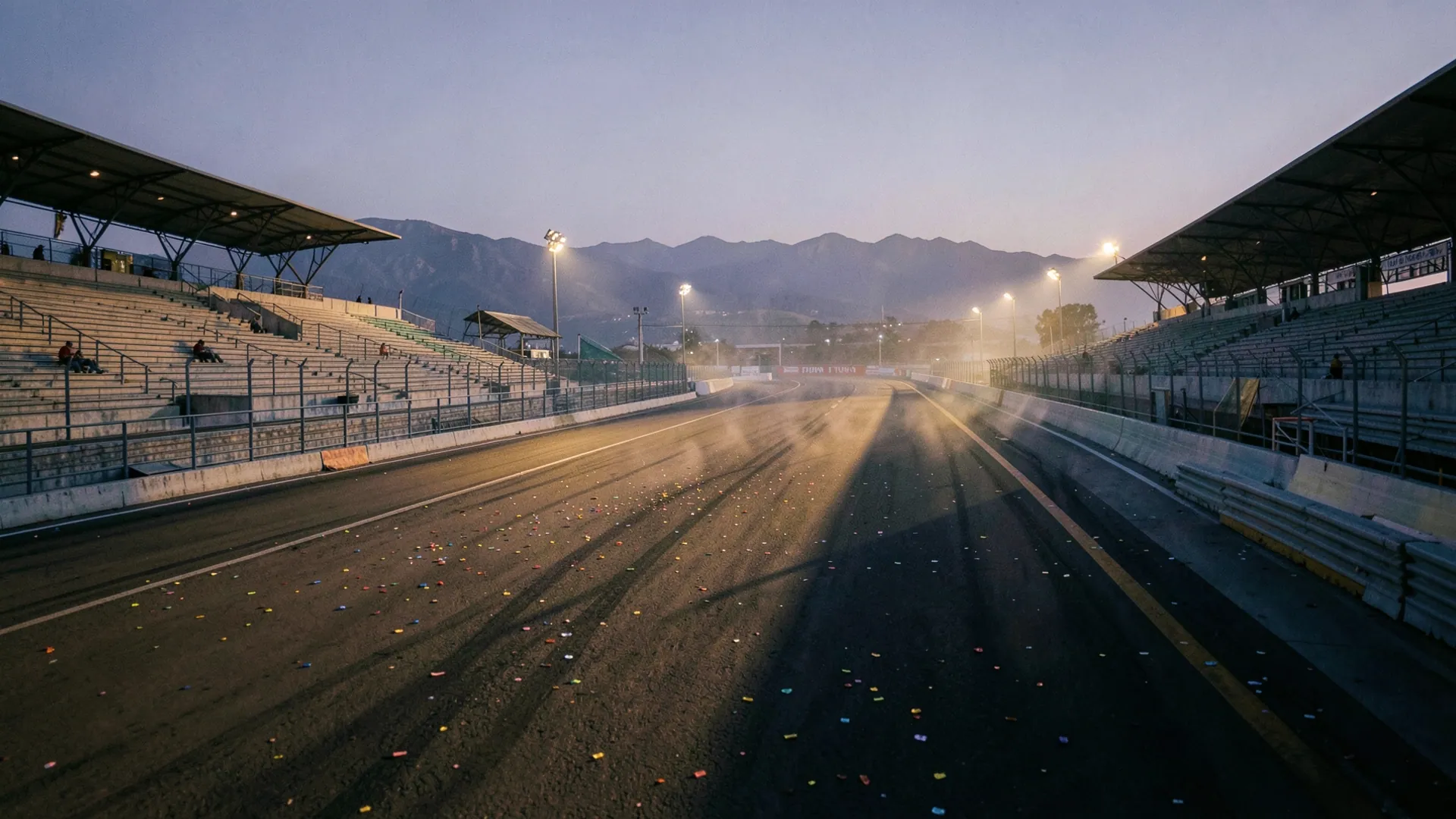
Max Verstappen won the Mexico City Grand Prix at the Autódromo Hermanos Rodríguez on Sunday, starting fifth and beating pole-sitter Lewis Hamilton to the flag by 0.799 seconds. Andrea Kimi Antonelli finished third, and those 15 points made him the 2026 world champion with four rounds still to run. On a day that should have belonged to Ferrari, the team left with second and fourth and an uncomfortable inquest into how its drivers raced each other on the opening lap.
Antonelli takes the title without forcing it
Antonelli did not need to win in Mexico, and he never looked as though he was trying to. He started fourth and finished third, 4.006 seconds behind Verstappen. He left with 380 points and a 119-point lead over the Red Bull driver that cannot be overturned. At 20, he is the youngest champion in the sport’s history and the first Italian to take the drivers’ title since Alberto Ascari in 1953.
Nine wins from 19 rounds is the headline statistic of his season. The clinching drive, though, was about restraint. This circuit sits more than 2,000 metres above sea level, where thin air strips downforce and makes cooling and braking harder to manage. The run to Turn 1 is one of the longest of the year and routinely produces first-lap trouble. With the championship available simply by finishing near the front, third was the right result to chase. Antonelli banked it cleanly, while his team-mate’s afternoon showed how quickly a front-row start can come apart here.
How a Ferrari pole became a Red Bull win
The grid promised Ferrari a great deal. Hamilton took pole, with George Russell alongside just 0.009 seconds slower, Charles Leclerc third, Antonelli fourth and Verstappen fifth. Within a lap, Ferrari’s advantage had been compromised by a fight between its own two cars.
Juan Pablo Montoya, working as an F1 TV pundit, argued that the first-lap battle probably cost Ferrari the win and that there must be “consequences” for both drivers. The first half of that argument is hard to dispute. Hamilton set the fastest lap of the race, a 1:19.268, and still finished less than eight-tenths of a second behind Verstappen. When the quickest car on the day loses by under a second, the race is usually lost to circumstance rather than pace, and the circumstance Ferrari controlled most directly was the one it created at the start. Leclerc, who started third, finished fourth and 10.707 seconds adrift.
The reason it happened matters more than any punishment. Hamilton and Leclerc arrived in Mexico with no realistic hope of the title, but both are in a tight contest for second in the championship. That gives each driver a personal reason to race hard that does not quite match the team’s interest, which is winning races and protecting second in the constructors’ standings. When a driver’s incentives and a team’s diverge, the team needs a clear first-lap rule. Ferrari evidently did not have one that both drivers understood in the same way. Benching or fining drivers would be theatre. Agreeing before Brazil who has priority when the two cars share the opening corners would be management.
Verstappen’s part should not be lost in the Ferrari story. He took the opportunity the fight opened up, kept a car that started fifth ahead of everything that had started in front of it, and held off a faster Ferrari to the finish. It was his third win of the season, and it showed the race management that has long been his strongest weapon.
| Pos | Driver | Team | Grid |
|---|---|---|---|
| 1 | Max Verstappen | Red Bull | 5 |
| 2 | Lewis Hamilton | Ferrari | 1 |
| 3 | Andrea Kimi Antonelli | Mercedes | 4 |
| 4 | Charles Leclerc | Ferrari | 3 |
| 5 | Lando Norris | McLaren | 6 |
| 6 | George Russell | Mercedes | 2 |
| 7 | Oscar Piastri | McLaren | 12 |
| 8 | Franco Colapinto | Alpine | 11 |
| 9 | Liam Lawson | RB | 22 |
| 10 | Pierre Gasly | Alpine | 9 |
Seventeen cars finished, covered by just 30.695 seconds from first to 17th. Arvid Lindblad, Oliver Bearman and Valtteri Bottas retired, and neither Aston Martin reached the finish, leaving the team on seven points for the season.
Lawson leads the drives that earned their points
The best drive of the day came from the back of the grid. Liam Lawson started 22nd and finished ninth, gaining 13 places on a circuit where overtaking is far from easy outside the main straight. His two points mattered too. With team-mate Lindblad retiring from eighth on the grid, Lawson’s result was all RB had to show for the afternoon.
Oscar Piastri recovered from 12th on the grid to seventh, a solid repair job after a difficult qualifying. Lando Norris gained a place, from sixth to fifth, and finished barely a second behind Leclerc. That kept McLaren in contention for third in the constructors’ standings on a day when Red Bull won the race.
Alpine had one of its better afternoons. Franco Colapinto climbed from 11th to eighth, and Pierre Gasly slipped only one place, from ninth on the grid to tenth. Five points from a double score is the sort of return that shapes the midfield order at this stage of the year.
Ryo Hirakawa deserves a mention as well. Drafted into the Haas for the race, he started 18th and finished 13th, ahead of both Williams cars. It was a tidy, unflustered run in difficult circumstances.
Russell, Hadjar and a Cadillac scare
George Russell’s afternoon was the hardest to watch. He qualified 0.009 seconds from pole and finished sixth, 12.263 seconds behind the winner, with Leclerc and Norris among those ahead of him. Toto Wolff described the race as a “catastrophic moment” for Russell and explained why the driver did not appear before the media afterwards. Eight points leave Russell fourth in the championship, 11 behind Verstappen, in a fight for runner-up that a front-row start should have helped him lead.
Isack Hadjar’s race was the other significant disappointment. He started seventh and finished 12th, scoreless on the day his team-mate won. In isolation it is a bad afternoon. In the context of the constructors’ fight it is expensive, because Red Bull’s margin over McLaren for third is now only nine points. A second Red Bull in the points would have turned that into a buffer.
Cadillac’s weekend ended with an alarming failure. Bottas was at top speed approaching Turn 1 on lap 46 when the problem struck. Because the thin air cuts drag, the run into that corner produces some of the highest speeds of the season, so a failure there leaves a driver with very little margin. Bottas’s angry reaction was understandable. Marcin Budkowski has said Cadillac will investigate and is committed to ensuring such accidents “do not happen again”. For a new team still without a point, reliability at that speed is the first thing that must be fixed. Sergio Pérez brought the other car home 17th at his home race.
Haas faces a different kind of fallout. The decision to replace Esteban Ocon with Hirakawa for the Mexican race came as a shock, and Peter Windsor has predicted that Ocon will take legal action against the team. Removing a contracted race driver mid-season is rare, and Haas will be judged on how it handles the next few weeks.
Mercedes on the brink of the double
With the drivers’ title settled, the most interesting fight in that championship is for second place, where 16 points separate four drivers:
- Max Verstappen (Red Bull): 261 points
- Lewis Hamilton (Ferrari): 259 points
- George Russell (Mercedes): 250 points
- Charles Leclerc (Ferrari): 245 points
Lando Norris, on 221, is 40 points behind Verstappen and needs others to falter to join that group.
In the constructors’ championship, Mercedes leads with 630 points to Ferrari’s 504. Ferrari outscored Mercedes 30 to 23 in Mexico, cutting the gap to 126 points, but Mercedes can still seal the title at Interlagos this weekend. Doing so in São Paulo would give Antonelli’s championship year a team title to match.
Below them, the battle for third is close. Red Bull has 380 points and McLaren 371, and Mexico showed how one scoreless car can swing it. RB holds fifth on 104 points, but Alpine’s double score has taken it to 74, and a 30-point gap is no longer safe with four rounds left. Further back, Haas (30) leads Audi (23) for seventh, while Williams (12), Aston Martin (7) and Cadillac (0) are fighting to avoid finishing last.
Interlagos rewards exactly what Ferrari showed in Mexico: raw pace, traction out of slow corners and a car that looks after its tyres. If the team arrives with a clear rule on how Hamilton and Leclerc race each other, it has the speed to win in Brazil and delay Mercedes’ celebration. If it does not, Mercedes could complete the double in São Paulo, and Ferrari’s 2026 will be remembered as the season it beat itself.