
Bearman Left Waiting as Haas Holds Firm in Contract Stand-Off
With three rounds left and no Haas deal beyond 2026, Oliver Bearman's public frustration and Ayao Komatsu's refusal to budge raise doubts over whether Haas sees him as its future.
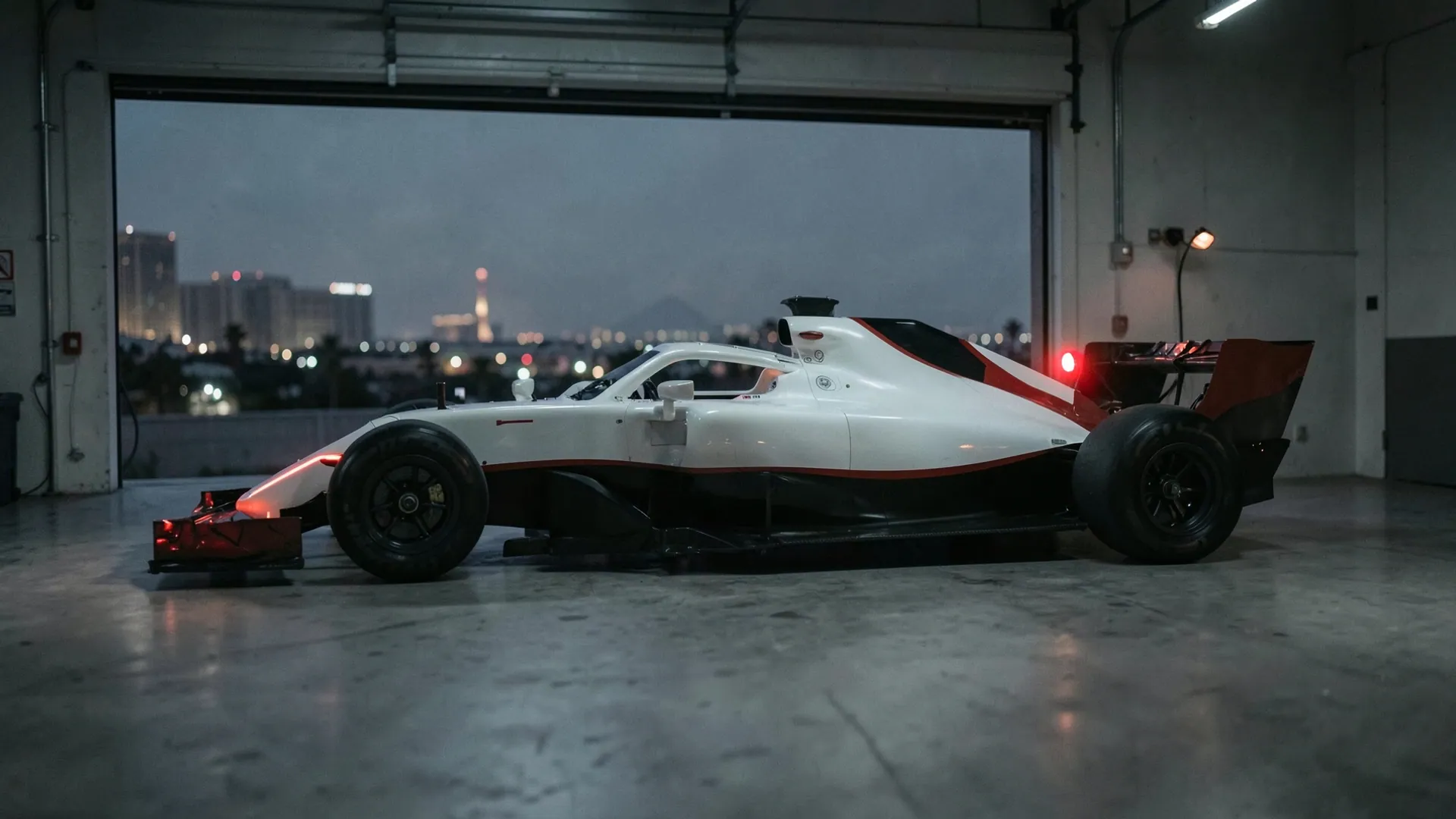
Oliver Bearman still has no contract to drive for Haas beyond the 2026 season, and with three rounds left he has said publicly that he is disappointed by the delay. Team principal Ayao Komatsu has responded without giving ground, according to RacingNews365 and PlanetF1. The two sides are now in a stand-off over a driver Haas has spent two seasons developing. That should concern anyone who assumed Bearman was the team’s long-term cornerstone.
A deal that should have been done by now
Timing is what turns this from a negotiation into a story. The Las Vegas Grand Prix on 22 November is round 21 of 23. Most of the 2027 grid was settled months ago, as is normal. Teams set their driver plans in the summer, and the good seats are taken before the autumn flyaways. A driver without a deal in late November either has enough leverage to wait for the right offer, or is being made to wait.
Bearman’s decision to go public points to the second. Drivers seldom talk openly about contract frustration when talks are going well. When a 21-year-old with a Ferrari Driver Academy background says he is “disappointed”, he is trying to move the conversation along. He may also be telling the rest of the paddock that he is listening.
Komatsu’s reply, as reported, offered nothing new. He has not suggested that a signature is close, and he has not said Bearman is the man Haas is building around. A team principal who wanted to settle things would normally say so in public, even while the details were still being agreed. Komatsu’s silence on that point is a message in itself.
What Bearman’s Brazil weekend does and doesn’t prove
The case for Bearman’s value is harder to make from the 2026 numbers alone. Haas has 31 points and sits seventh in the constructors’ championship. Audi is only three points behind on 28, Alpine is well clear in sixth on 69, and Williams, Aston Martin and Cadillac trail some way behind. Neither Haas driver is in the top 12 of the drivers’ standings, where 12th place belongs to Franco Colapinto on 27 points.
Brazil showed the problem clearly. Bearman qualified sixth at Interlagos, a strong result for a midfield car and the kind that wins attention. He finished 17th, a lap down. His team-mate Rafael Camara started 11th and finished 20th. Nico Hülkenberg, by contrast, turned fourth on the grid into 10th place and a point for Audi. With Haas leaving São Paulo empty-handed, the fight for seventh is now separated by three points with three races to go.
None of this proves anything against Bearman. Turning a sixth-place grid slot into 17th usually says as much about race pace, tyre wear and strategy as it does about the driver. Haas’s race-day performance has been the team’s recurring weakness under the 2026 regulations. Still, if Haas wanted reasons to delay, strong qualifying followed by thin points hauls would give it some. Results are what a team’s commercial and technical partners notice first.
The fair reading is that Bearman has shown the raw speed that made him a driver worth having. He first did that as an 18-year-old stand-in for Ferrari in Saudi Arabia in 2024, when he scored points on debut. Haas has not given him a car that consistently turns that speed into results. Holding the car’s limits against the driver in contract talks would be a hard argument for any team to defend.
Komatsu’s logic, and Ferrari’s shadow
Why would Haas hold firm? There are at least three reasonable explanations, and none requires bad faith.
The first is price. A driver with two seasons of F1 behind him, regularly qualifying near the front of the midfield, is worth more than the rookie Haas signed for 2025. Haas has historically run a lean operation and may simply be resisting the cost of keeping him. Driver salaries sit outside the cost cap, but the money still has to come from somewhere, and Haas does not have a works team’s budget behind it.
The second is Ferrari. Bearman’s career has been built through the Maranello academy, and Haas runs Ferrari power units. Camara, his team-mate, is another academy product. Haas’s driver decisions have rarely been made in isolation from Ferrari. If Ferrari has not settled its own long-term plans for Bearman, Haas may be unwilling, or unable, to commit for several years. A Haas contract that tied Bearman up into 2028 or beyond would limit Ferrari’s options as well as his.
The third is that Komatsu genuinely wants to keep his options open. Since succeeding Guenther Steiner at the start of 2024, he has rebuilt Haas around a more engineering-led approach and a technical partnership with Toyota. That partnership has brought Ryo Hirakawa into the team as a reserve. A team principal reshaping his organisation might prefer one more look at the market before giving any driver long-term status.
All three are reasonable. Taken together, they suggest Haas sees Bearman as a valuable driver it would like to keep, but not as a leader it must keep whatever the cost. That is a meaningful difference.
How teams treat the drivers they believe in
Recent history is fairly clear about what commitment looks like. McLaren extended Oscar Piastri’s contract during his rookie season in 2023, well before it needed to, because it judged that waiting carried more risk than paying. Williams tied Alexander Albon to a multi-year extension while rival teams circled. Mercedes went further, moving Andrea Kimi Antonelli straight from Formula 2 into Lewis Hamilton’s seat. This season Antonelli has repaid that faith with nine wins and a 111-point lead over Max Verstappen.
Teams that believe a driver is their future usually remove any doubt early, because uncertainty unsettles drivers and invites approaches from rivals. Haas has done the opposite before. Under Steiner, Kevin Magnussen and Hülkenberg often found their futures still open late in the year. By the time the team turned to youth for 2025, Hülkenberg had already arranged his move to Sauber. The difference now is that Bearman is supposed to be the youth.
There is also a risk Haas may be underestimating. A driver who qualified sixth in Brazil, and who has Ferrari ties and two full seasons of experience, is attractive to any team planning for 2027 and beyond. Few seats are open at this stage. But the longer Bearman is left in limbo, the more his loyalty becomes something Haas has to keep earning, rather than something it can take for granted.
Three races to settle Bearman’s future
Neither side gains anything from letting this run into the winter. Bearman needs clarity to plan his next step. Haas needs a settled line-up so its 2027 engineering and simulator work has a fixed reference point. It also needs both drivers concentrating on keeping Audi behind in the constructors’ championship, where the gap between seventh and eighth makes a real difference to prize money.
The most likely outcome is still a deal, probably a shorter one than Bearman wanted. It may include terms that reflect Ferrari’s interest in his longer-term future. That would be a sensible compromise. It would also confirm what the stand-off already suggests: Haas values Bearman, but has not yet chosen to build around him.
Komatsu is entitled to negotiate hard. He should recognise, though, that the way a team treats its brightest young driver is noticed by the next one it wants to sign. If Haas wants to be the place where Ferrari’s best juniors become established F1 drivers, it should end this before the season does. If Bearman is still unsigned after the final round, the likeliest explanation is that Haas, or Ferrari, is weighing another option.