
Norris Warns a Wet Las Vegas Would Be 'Scary' on Current Rain Tyres
Lando Norris wants a much-improved Pirelli wet range for 2027, arguing that the current tyres would not work properly at a cold, low-downforce venue like Las Vegas.
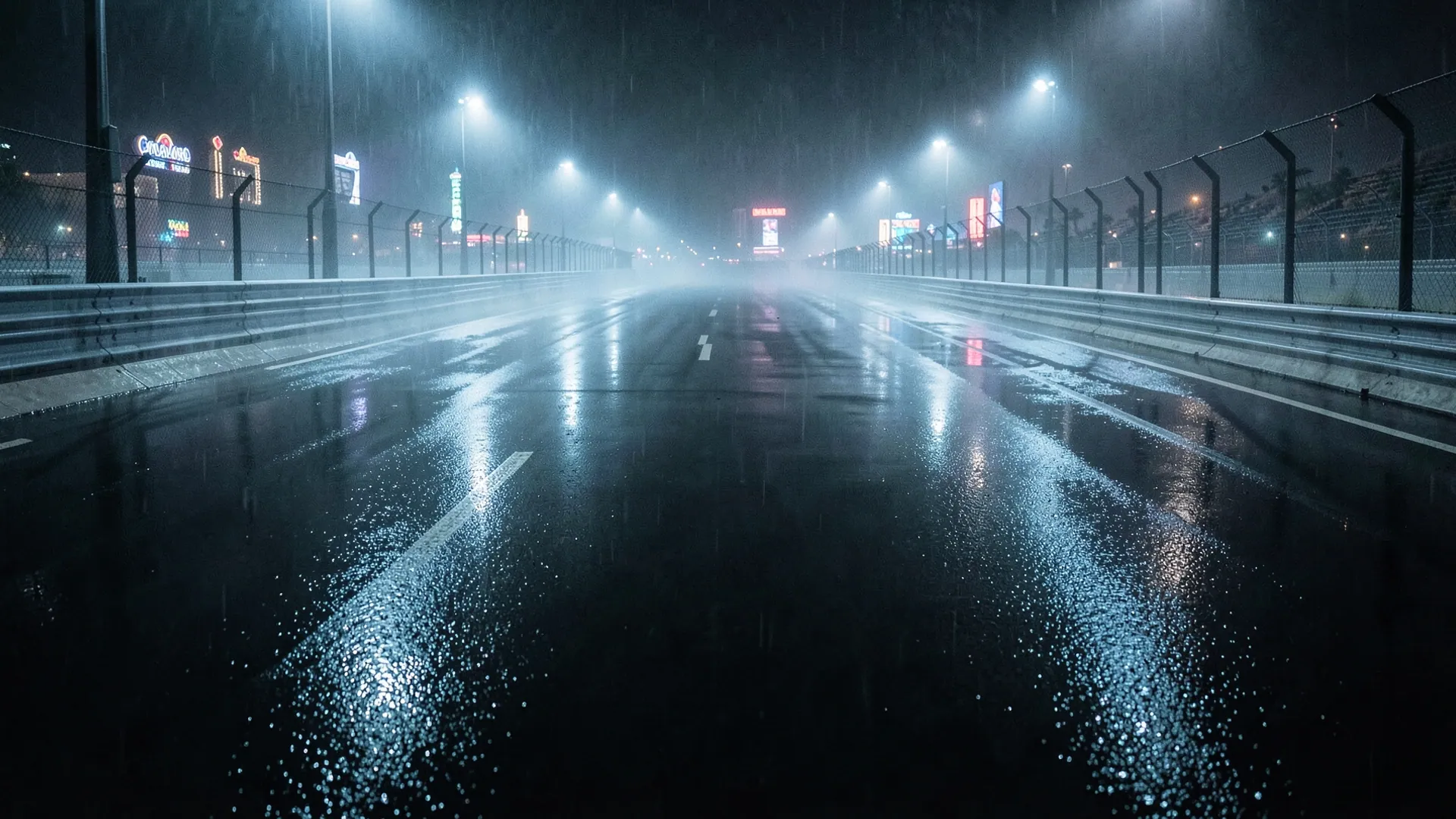
Lando Norris has warned that a wet Las Vegas Grand Prix on Formula 1’s current rain tyres would be “scary”, and he wants Pirelli to deliver a much-improved wet-weather range for 2027. In comments reported by Motorsport.com and Autosport, the reigning world champion said he does not expect the existing intermediates and full wets to work properly at a low-downforce circuit like the Strip, where Round 21 takes place on 22 November.
Norris arrives in Nevada after converting pole into victory at Interlagos. With this year’s title out of his reach, his concern is the next generation of tyres rather than this weekend’s result, and that is why his warning deserves attention.
Why the Strip starves a wet tyre
A rain tyre is a compromise built around heat. Its compound is soft and its tread is cut deep so it can clear water. Those tread blocks only grip properly once they are warm, and they get warm by being worked: squeezed, flexed and loaded through corners. The main source of that load in a Formula 1 car is downforce.
Las Vegas takes most of that load away. Teams trim their wings for a straight of nearly two kilometres along the Strip. The corners are mostly slow, so the aerodynamic load arrives late and briefly. Every lap ends with a long run at full speed in cold night air, which pulls temperature back out of the rubber. The race runs late in the evening in November, and recent editions have seen air temperatures of around 10°C. The street surface carries traffic for 51 weeks of the year and has very little rubber laid down on it when the cars arrive.
Even dry tyres have struggled there. The slicks have grained badly in the cold, and several teams spent the 2023 and 2024 races trying to get the front tyres to switch on. Add standing water and the margin shrinks further. A wet tyre that never reaches its working window does not grip. A car with less weight pressing down on it is also more likely to aquaplane, because less vertical force is pushing the tread through the water film.
Norris has seen this at first hand. When rain affected part of last year’s Las Vegas weekend, he still put his McLaren on pole, but a damp qualifying session is a very different proposition from 50 laps in the wet.
Narrower tyres and less downforce in 2026
The current regulations have made the situation worse. The 2026 cars were designed to produce less downforce than the ground-effect machines they replaced. Their tyres are also narrower: the 18-inch rims stayed, but the fronts lost 25mm of width and the rears 30mm. A smaller contact patch with less load on it is a difficult starting point for a tyre that depends on load for heat.
Active aerodynamics add another variable. The cars shed drag, and with it downforce, on the straights, which at Las Vegas means most of the lap. The concept was built for dry-weather efficiency, and it does nothing to help a rain tyre hold its temperature.
Pirelli has also been working partly blind. Its 2026 range was developed largely on modified older cars, because the new machines did not exist when testing began. Wet testing has long been the weakest part of that process, even with representative cars. Artificially watered circuits cannot reproduce rain falling during a lap, rivers running across a track or a field of cars throwing up spray. Doing that at a cold, low-grip venue is harder still. Norris is asking, in effect, for the next range to be designed around the worst case rather than the average one.
A wet-weather problem F1 keeps putting off
Las Vegas is a sharp example of a long-standing weakness. Formula 1 has a full wet tyre that rarely gets raced. When rain is heavy enough to need it, spray usually cuts visibility so badly that race control holds the field behind the safety car or stops the session. When conditions ease enough to race, drivers switch to intermediates as quickly as they can, because the full wet is much slower once the standing water clears.
The consequences are familiar. Spa in 2021 produced a result with no racing laps. Suzuka in 2022 reopened painful memories of Jules Bianchi’s 2014 accident when Pierre Gasly passed a recovery vehicle at speed in heavy spray. The delayed start at Spa in 2025 renewed the old argument about whether caution had tipped into over-caution. The FIA’s 2024 trials of wheel-arch spray guards showed that the governing body accepts visibility is the real limit. Tyre performance and spray are linked problems, and fixing one without the other will not get cars racing in the rain.
Las Vegas combines those weaknesses with a few of its own. It is a street circuit lined by walls, with little run-off. Spray under floodlights is unlikely to help drivers see. Rain in the desert is rare, but when it falls on roads that have been dry for weeks, the surface can become extremely slippery. Rare is not the same as never, and the sport cannot plan on the forecast being kind.
Second place and third in the constructors’ at stake
The drivers’ title is settled. Andrea Kimi Antonelli has 390 points and nine wins, and his 111-point lead over Max Verstappen is more than anyone can recover with three rounds left. Behind him, though, the standings are as tight as they have been all season:
| Position | Driver | Points | Gap to 2nd |
|---|---|---|---|
| 2 | Max Verstappen (Red Bull) | 279 | – |
| 3 | George Russell (Mercedes) | 262 | 17 |
| 4 | Lewis Hamilton (Ferrari) | 261 | 18 |
| 5 | Charles Leclerc (Ferrari) | 249 | 30 |
| 6 | Lando Norris (McLaren) | 246 | 33 |
Five drivers are covered by 33 points in the fight to finish second. In the constructors’ championship, Red Bull (415) are just 17 points ahead of McLaren (398) for third, a position worth real prize money.
Brazil showed how much a single race can change. Verstappen climbed from 21st on the grid to second, and Hamilton recovered from 20th to ninth. Recoveries like those are part of the sport’s appeal when they come from racecraft and strategy. A rain-hit Las Vegas would decide places by something less satisfying: which car happens to generate enough energy to switch its tyres on. That would be a lottery driven by tyre temperature, with walls on both sides of the track. It is a legitimate safety concern as well as a sporting one, and Norris’s word “scary” seems measured rather than dramatic.
What Pirelli’s 2027 range has to deliver
Norris’s request is reasonable, and it can be broken down into clear requirements.
- A wider working window at low energy. Both the intermediate and the full wet need to reach a usable temperature with light loads, cold air and long straights. A wet tyre that only works at high-downforce, high-load circuits is an incomplete solution.
- A full wet worth using. If the extreme tyre cannot clear enough water to be faster than racing behind the safety car, it is effectively an insurance policy that is never claimed. It needs to shift more water without being so slow that drivers abandon it at the first chance.
- Testing that reflects the real problem. That means representative cars, cold temperatures and low-grip surfaces, rather than a watered circuit in mild conditions.
- Coordination with the FIA on spray. A better tyre will not help if drivers still cannot see the car in front. Spray-reduction work and tyre development should be planned together, with an agreed view of how the cars’ aerodynamic settings should behave in the wet.
The responsibility does not sit with Pirelli alone. The tyre maker builds to the specification and test programme it is given, and the 2026 cars have made that brief harder than it was. If the regulations reduce load, the governing body and the teams must provide the testing time and representative cars needed to design tyres for it.
The right standard for the 2027 wets is not a good showing at Silverstone or Spa, where high-speed corners generate plenty of heat. It is whether a driver could race on them safely on a cold night on the Las Vegas Strip. If Pirelli meets that test, its wet tyres will work almost anywhere on the calendar. If it does not, Formula 1 will simply be hoping for dry Novembers in Nevada.