
Red Bull Were Ready to Order Verstappen Behind Hadjar at Interlagos
Laurent Mekies has confirmed Red Bull were prepared to order Max Verstappen to give second place back to Isack Hadjar in Brazil, a striking call with only 17 points separating Verstappen from George Russell.
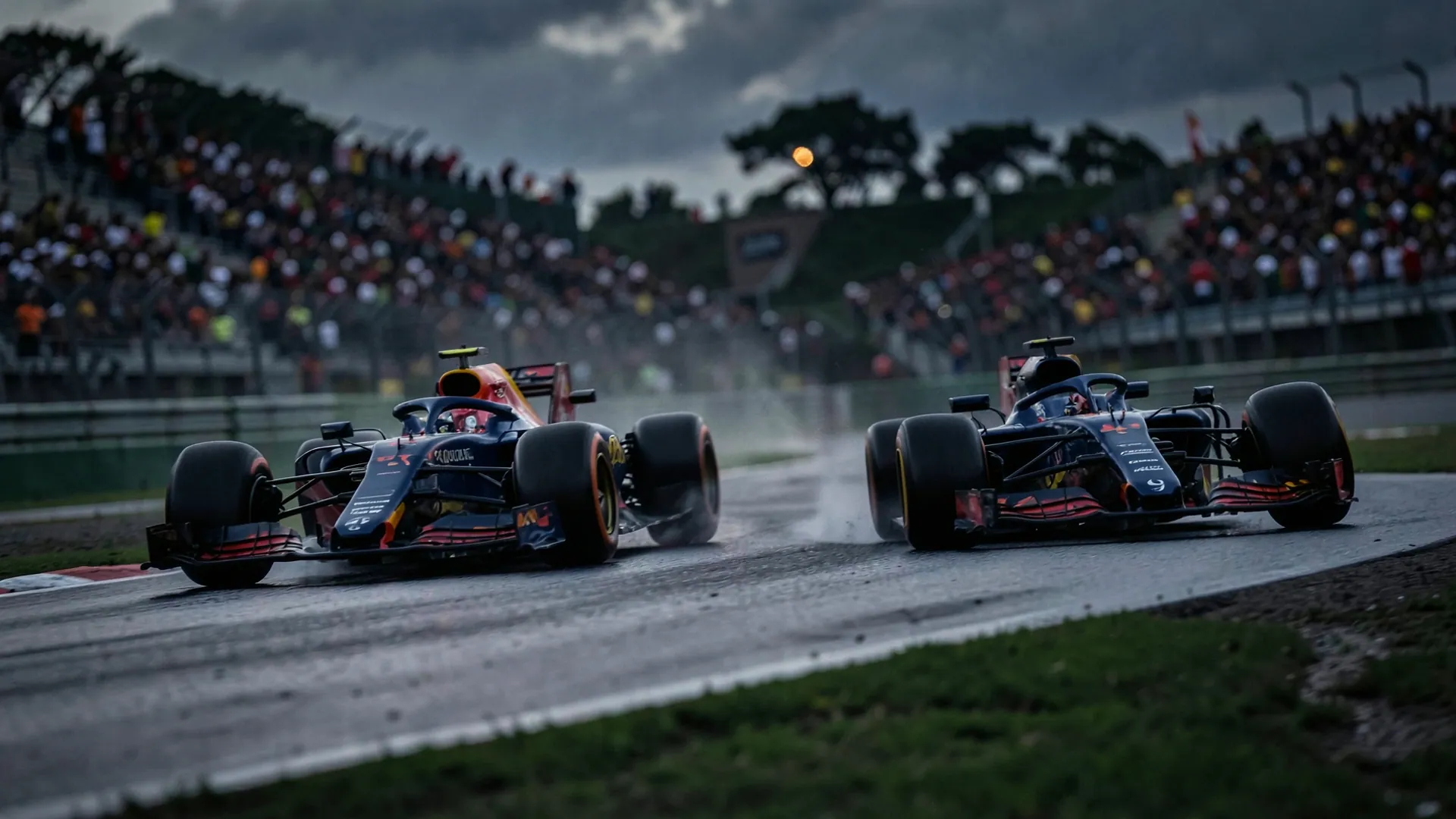
Red Bull were prepared to order Max Verstappen to hand second place back to Isack Hadjar during Sunday’s Brazilian Grand Prix, team principal Laurent Mekies has confirmed. In the end the positions stood, with Verstappen finishing second after starting 21st and Hadjar third from fifth on the grid. Hadjar has since apologised for what he called an “awkward” situation with his team-mate.
On the face of it, this is a story about a podium that went the way of the result sheet. The more revealing part is the intent. Red Bull were willing to take three points from Verstappen just as he is trying to hold off Mercedes and Ferrari for second in the championship, and Mekies has said so publicly.
A swap that would not have touched the constructors’ table
The first thing to understand about the planned order is what it would not have changed. Second and third are worth 18 and 15 points, and both would have gone into Red Bull’s constructors’ total regardless of which car crossed the line first. The team’s 33-point haul from Interlagos, which moved them to 415 points and 17 clear of McLaren in the fight for third, was fixed the moment the two cars ran second and third.
That makes this a rare kind of team order. Most instructions from the pit wall are about maximising the collective result: holding position to protect tyres, stacking a pit stop, or swapping cars because one driver has the pace to attack the car ahead. None of that reasoning applied here. The only ledger the swap would have altered was the drivers’ championship, and there it would have worked against Red Bull’s leading driver.
So why would a team even consider it? The most plausible answer is that Red Bull regarded the place as Hadjar’s under the terms agreed for the race, and judged that honouring those terms mattered more than three points in Verstappen’s column. Teams set out rules of engagement before every Grand Prix, and drivers are expected to respect them even when the stopwatch tempts otherwise. By confirming the plan, Mekies has signalled that those rules apply to Verstappen as well.
Seventeen points and a crowded runner-up fight
Andrea Kimi Antonelli’s 111-point lead with three rounds remaining has removed any doubt about the title. What remains open is the fight behind him, and it is unusually tight.
| Position | Driver | Team | Points | Gap to second |
|---|---|---|---|---|
| 2 | Max Verstappen | Red Bull | 279 | – |
| 3 | George Russell | Mercedes | 262 | 17 |
| 4 | Lewis Hamilton | Ferrari | 261 | 18 |
| 5 | Charles Leclerc | Ferrari | 249 | 30 |
| 6 | Lando Norris | McLaren | 246 | 33 |
Had the swap gone ahead, Verstappen would have left Brazil on 276 points, 14 clear of Russell and 15 clear of Hamilton. That is not a decisive difference with 75 points for victories still to come from Las Vegas onwards, but it is not trivial either. Five drivers are covered by 33 points, and Norris, who won from pole on Sunday for his third victory of the season, is still mathematically in play.
The Interlagos result itself showed how quickly the order can shuffle. Russell took fourth and 12 points, Antonelli was fifth, Leclerc eighth and Hamilton ninth after starting 20th. Verstappen’s drive from 21st to second was the performance of the afternoon, turning a weekend that could have cost him the runner-up spot into one that extended his advantage. In that context, Red Bull’s readiness to give three of those points away shows how seriously they took the principle at stake.
Second place in the standings has no trophy attached, but it matters. For Verstappen, it would be a clear statement in a season dominated by Mercedes, who lead the constructors’ table on 652 points with 12 wins. For Red Bull, it is the best headline available from a year in which they have won three races.
Interlagos has seen this argument before
Any Red Bull team-order story in Brazil invites comparison with 2022. At the same circuit that year, Verstappen ignored a request to let Sergio Pérez past for sixth place, a moment that soured the relationship between the two drivers and became one of the defining images of Verstappen’s single-mindedness. Pérez was then fighting for second in the championship, and the refusal was read as Verstappen putting personal grievance ahead of team interest.
The circumstances on Sunday were different, and the parallels should not be stretched. But the memory explains why the episode drew such a strong reaction. RacingNews365’s round-up of international coverage included framing of Verstappen showing his “true colours”, alongside a charge of hypocrisy involving Liam Lawson and the RB team. That second strand matters. With four drivers spread across two teams, any decision on team orders within the Red Bull family is quickly measured against how the others have been treated.
Formula 1’s history offers the opposite example, too. At the 2017 Hungarian Grand Prix, Mercedes allowed Lewis Hamilton through to attack the Ferraris on the understanding that he would return the place to Valtteri Bottas if he made no progress. Hamilton gave the position back on the final lap and dropped three points in a title fight with Sebastian Vettel. Toto Wolff argued at the time that the team’s credibility with both drivers was worth more than the points. Hamilton won the championship anyway, and Mercedes’ reputation for fair dealing between its drivers held up for years afterwards.
Red Bull’s own history includes the Multi-21 affair at Sepang in 2013, when Vettel overtook Mark Webber against instructions. The damage from that episode came less from the lost position than from the team’s inability, or unwillingness, to enforce what it had agreed. That is the trap Mekies appears determined to avoid.
Why Hadjar’s apology matters as much as Mekies’ admission
Hadjar’s apology is the other half of the story, and arguably the more telling one. A driver in his position, eighth in the standings on 122 points and in his first season alongside Verstappen, could easily have taken the line that he was owed a place. Instead, he moved quickly to smooth things over and to acknowledge his part in an uncomfortable moment.
That says something about the balance within the team. Hadjar’s third place was a fine result, but he understands that his standing rests on being a team-mate Verstappen can work with, rather than one who creates friction in the closing weeks of a season. Red Bull’s recent history with second drivers, from Pierre Gasly and Alexander Albon to Pérez and Lawson, shows how quickly that relationship can define a career.
Mekies’ openness points in the same direction. A team principal who confirms he was prepared to order his star driver aside is sending a message about governance that reaches beyond this one race. It tells Hadjar that his interests are protected. It tells Verstappen that agreements apply to him. It also gives Red Bull cover if a similar decision arises in Las Vegas, Qatar or Abu Dhabi.
The test still to come
The awkward truth for Red Bull is that this principle will be easier to defend in November than it might be in December. If Verstappen arrives in Abu Dhabi with Russell or Hamilton within a handful of points, the case for treating both cars equally will collide directly with the case for securing second place. Mekies has set a standard publicly, and he will be held to it.
My view is that Red Bull were right to plan the swap and right to say so. Three points are a modest price for a team-mate’s trust and a pit wall whose instructions mean something. But the policy has not yet been tested in a race where it truly cost Verstappen something, and that moment may well arrive. If Hadjar finds himself ahead on the Strip on 22 November, how Red Bull manage their running order will show whether Mekies’ admission was a statement of principle or simply a convenient one.