
Hamilton's First Ferrari Grand Prix Pole Is a Thin Barrier to Antonelli's Mexico Coronation
Lewis Hamilton's first grand prix pole for Ferrari puts him at the front in Mexico City, but the arithmetic means Andrea Kimi Antonelli needs only ninth place today to become Formula 1's youngest world champion.
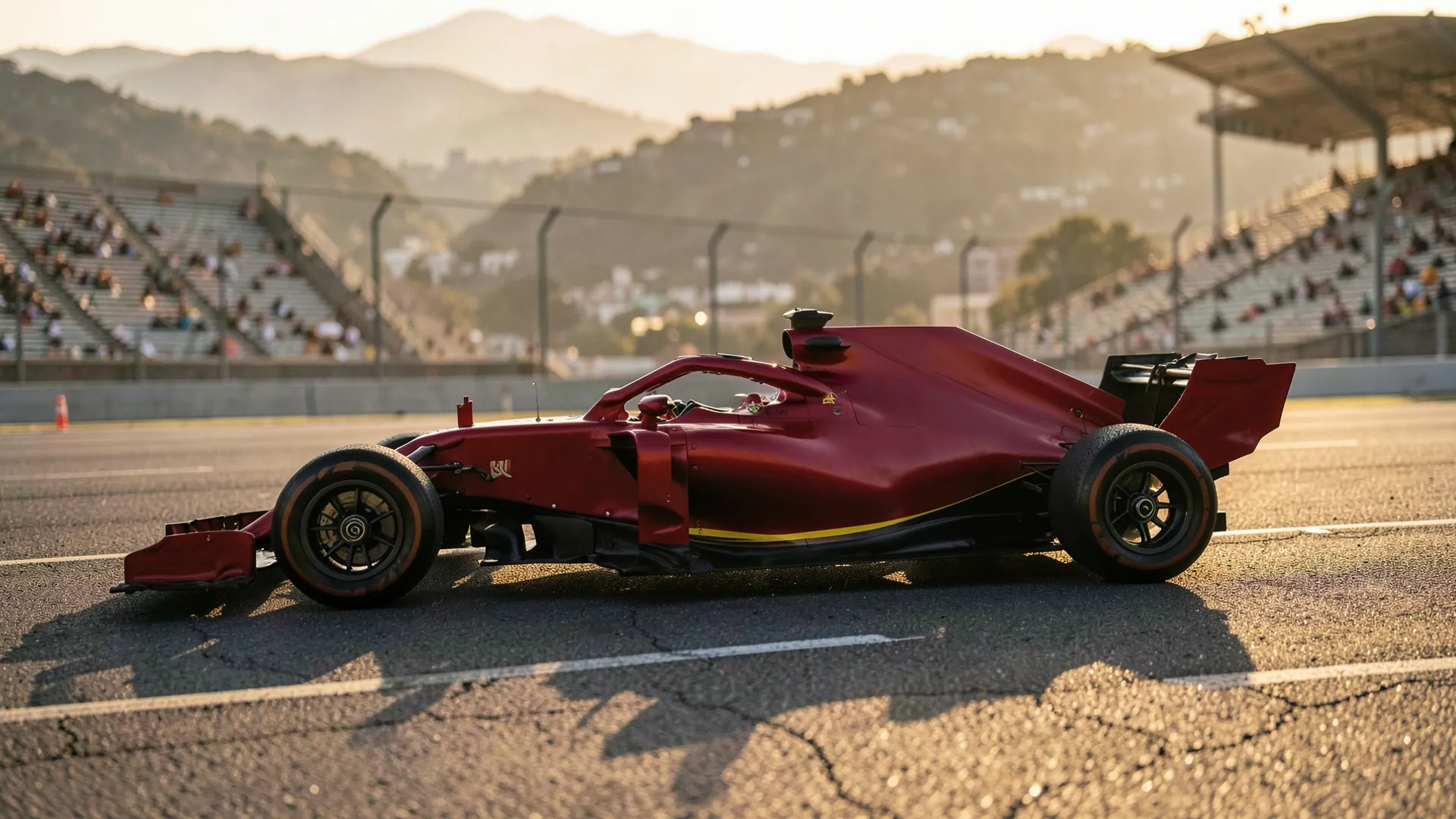
Lewis Hamilton took his first grand prix pole position as a Ferrari driver in Mexico City on Saturday, beating his former Mercedes team-mate George Russell to the top spot. It is the 105th pole of his career, and it comes in his second season at Maranello. It also puts the seven-time champion at the head of the grid on the afternoon Andrea Kimi Antonelli can clinch the 2026 title.
The pole is a story in its own right. Its effect on the championship is far smaller, and the reasons for that say a good deal about how completely Antonelli has controlled this season.
The pole Hamilton built on a broken Friday
Hamilton’s weekend did not begin well. He was forced to stop his car during Friday practice, and RacingNews365 reported that the lost running left him relying on estimates for parts of his race preparation rather than a full set of long-run data. At a circuit where the thin air at more than 2,000 metres changes cooling, braking and aerodynamic behaviour, that is a significant handicap.
Yet by Saturday evening he was on pole. Speaking afterwards, as reported by Autosport, Hamilton credited the result to changes he had made in his approach to this weekend. He is 41, has won more grands prix than anyone in the sport’s history, and could be forgiven for trusting routines that delivered seven titles. That he is still willing to adjust them says something about how hard the transition to Ferrari has been, and how seriously he has taken it.
The contrast with last year is sharp. Hamilton’s first season in red brought no grand prix podiums, and the questions about whether the move had come too late in his career were legitimate. This season he has a win, 241 points and third place in the standings, one point behind Russell. Ferrari, meanwhile, sit second in the constructors’ championship on 474 points, 119 clear of Red Bull and McLaren, who are tied on 355. The pole fits a pattern of steady recovery rather than standing out as a one-off.
Why ninth place is enough for Antonelli
Antonelli arrives at Round 19 on 365 points with nine wins from 18 races. Five rounds remain, including today’s, so 125 points are still available. That arithmetic has already settled most of the field.
- Max Verstappen (236 points, 129 behind), Charles Leclerc (233, 132 behind) and Lando Norris (211, 154 behind) cannot catch Antonelli even if they win every remaining race.
- Russell (242, 123 behind) and Hamilton (241, 124 behind) are the only drivers still mathematically in contention.
After today, four grands prix and 100 points will remain. Antonelli becomes champion if he leaves Mexico at least 100 points clear of both men. A lead of exactly 100 is enough because a tie would be decided on wins, and neither Russell (three) nor Hamilton (one) can reach Antonelli’s nine.
In practice the conditions are simple:
- If Antonelli finishes ninth or better, he is champion regardless of what anyone else does.
- If he finishes 10th, he is champion unless Russell wins.
- If he fails to score, he is denied if either Russell or Hamilton wins. Second place for either of them would not be enough.
So Hamilton’s pole is a start, nowhere near a solution. To delay the coronation himself, he has to win, and he needs the championship leader to finish outside the points. Ferrari can influence the first part. The second depends on Antonelli having his worst afternoon of the year.
The history here has a neat symmetry. Hamilton clinched his fourth title in Mexico in 2017 despite finishing ninth after first-lap contact with Sebastian Vettel, and wrapped up his fifth at the same circuit a year later with fourth place. On both occasions Verstappen won the race and it barely mattered. Antonelli, the driver who inherited Hamilton’s Mercedes seat, now faces an almost identical threshold.
Why a Mexico pole is a fragile asset
Even the first condition, a Hamilton win, is less assured than pole position suggests. The run from the grid to Turn 1 at the Autódromo Hermanos Rodríguez is one of the longest on the calendar, and pole-sitters here have a history of leading for a few hundred metres and no further.
Verstappen built much of his Mexico record on that run. He took the lead from Vettel’s pole in 2017 and from Daniel Ricciardo’s in 2018. In 2021 he started third and went around the outside of both Mercedes into the first corner. In 2023 he again started third and was ahead of pole-sitter Leclerc before the first braking zone. The tow down that straight is powerful, and the driver in second or third often has the better of it.
The counterpoint is recent. Carlos Sainz converted pole into victory for Ferrari in 2024, and Norris did the same for McLaren last year. When the pole-sitter gets a clean launch and positions the car well, the advantage holds.
Hamilton’s immediate problem is the man alongside him. Russell starts on the same row, and he is the bigger threat to Antonelli’s coronation because a Russell victory would keep the title open even if Antonelli scraped a point in 10th. That creates an awkward dynamic at Mercedes, who would celebrate either driver winning but naturally want the championship sealed. It also means Hamilton must defend against a car that has won 12 of 18 races this season, driven by a man with his own reasons for wanting to be first into Turn 1.
A runner-up fight that hinges on today
If the title is likely to be decided today, the battle behind Antonelli is wide open. Four drivers are separated by nine points:
| Position | Driver | Team | Points |
|---|---|---|---|
| 2 | George Russell | Mercedes | 242 |
| 3 | Lewis Hamilton | Ferrari | 241 |
| 4 | Max Verstappen | Red Bull | 236 |
| 5 | Charles Leclerc | Ferrari | 233 |
This is where Hamilton’s pole carries real weight. A win today would take him to second in the standings with four rounds left, and finishing as runner-up in his second Ferrari season would be a meaningful marker after the difficulties of his first.
Momentum is not evenly distributed. In Austin last weekend, Leclerc finished second and Hamilton fourth, while Russell slipped from sixth on the grid to eighth and took four points. Verstappen, third in Texas, rarely leaves Mexico without a strong result. Russell’s front-row start therefore matters for his own position as much as for the title. Another weekend like Austin would leave him exposed to three drivers who are all scoring more heavily.
For Ferrari, the stakes are about direction as well as points. Second in the constructors’ championship looks secure, but having a driver finish second in the drivers’ standings would give the team a firmer basis for arguing that it, rather than Red Bull or McLaren, is the closest challenger to Mercedes under these regulations.
Antonelli’s crown, Hamilton’s statement
The probabilities point one way. Antonelli has won half the races this season and needs only ninth place. He will very likely leave Mexico City as Formula 1’s youngest world champion, three years younger than Vettel was when he set the previous record in 2010.
That does not make Hamilton’s pole irrelevant. If he converts it, he will have beaten a Mercedes on the front row at a circuit where pole is notoriously hard to defend, and he will lead the fight for second with four races to go. If Antonelli also fails to score, Hamilton will have kept the title alive for another week. The championship is not the realistic prize this afternoon. The more consequential question is whether Hamilton, at 41, can beat the best car of the season in a straight fight. Do that today, and he goes into the final four rounds as the favourite for second.