
Grid Penalties Set to Reshuffle Austin as Antonelli Eyes the Title
Two drivers face heavy grid drops for the United States Grand Prix and a third awaits a verdict, on a weekend when Andrea Kimi Antonelli can clinch the championship if his rivals falter.
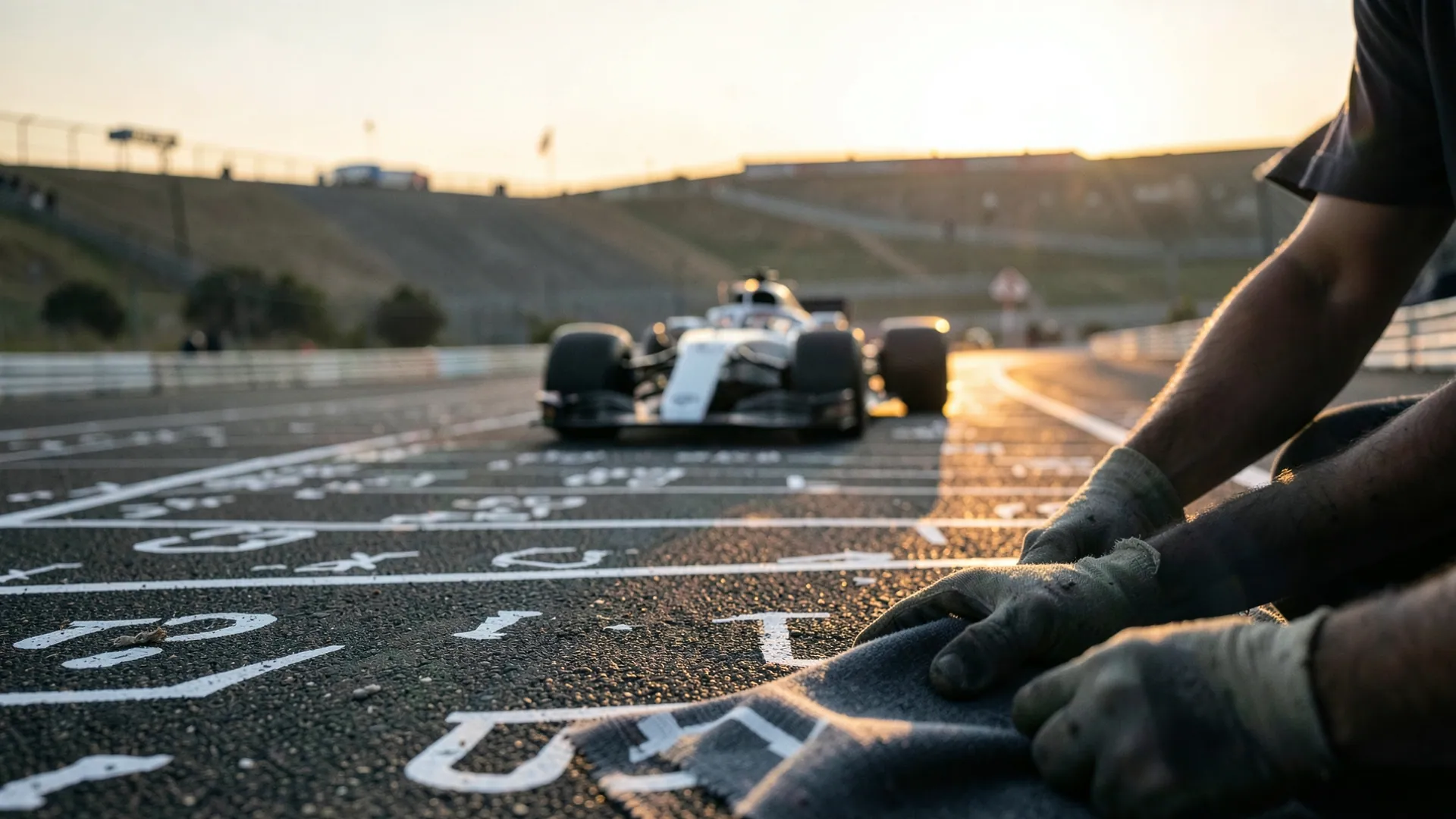
The FIA has confirmed heavy grid penalties for two drivers at Sunday’s United States Grand Prix, with a third still at risk of punishment, GPfans reported ahead of qualifying at the Circuit of the Americas. The penalties arrive on the weekend Andrea Kimi Antonelli can win the 2026 drivers’ championship. In Austin his title hinges as much on where his pursuers finish as on his own result, so any reshuffle of the starting order carries more weight than usual.
Two drops confirmed, a third still pending
A Formula 1 grid is set in two stages. The stopwatch produces the order, and the stewards then apply penalties to produce the official starting grid. Every car behind a penalised driver moves up a place for each slot that driver loses. A driver whose drop exceeds 15 places is sent to the back regardless of the exact number.
That makes Saturday evening’s paperwork as significant as Saturday afternoon’s laps. A driver who qualifies sixth can start fourth because of decisions taken in a factory or a stewards’ room, without his car getting any quicker. It also means the provisional grid published after qualifying is exactly that. Until the outstanding case is settled, nobody in the paddock can be certain where the field will line up.
Penalties of this size are usually technical rather than sporting. Drivers rarely collect double-digit drops for driving infringements. Components are the more common cause, because the regulations limit how many power unit elements and gearboxes a driver may use over a season. This is the first year of a new engine formula. Audi is running its own works power unit, Red Bull is building engines with Ford, Honda has moved to Aston Martin and Cadillac has joined the grid, so pressure on component allocations late in the year comes as no surprise.
The arithmetic Antonelli needs on Sunday
Antonelli arrives in Texas with 340 points and eight wins from 17 rounds. He leads his Mercedes team-mate George Russell by 102 points. Lewis Hamilton is 111 behind, Max Verstappen 119 and Charles Leclerc 125. Lando Norris, sixth on 201, is 139 adrift and only just alive mathematically.
After Austin, five Grands Prix will remain, worth a maximum of 125 points to any driver. If Antonelli leaves Texas at least 125 points clear of everyone, the title is his. A tie on points would go to the driver with more wins, and Antonelli would hold that countback. Russell could reach at most eight wins by sweeping the remaining five races, whereas Antonelli would already have nine if he wins on Sunday.
That gives a precise set of conditions:
- Antonelli must win. Second place adds only 18 points, which cannot take the gap over Russell to 125 even if Russell scores nothing.
- Russell must finish ninth or lower. A win, combined with Russell scoring two points or fewer, pushes the margin to at least 125.
- Hamilton must finish fifth or lower. Fifth is worth 10 points and would leave Hamilton exactly 125 behind, which is enough for Antonelli on countback. Fourth would keep the Ferrari driver mathematically alive.
Verstappen, Leclerc and Norris fall away automatically if Antonelli wins. Verstappen could finish no higher than second, which would leave him 126 behind, and Leclerc and Norris would be further adrift still.
The conditions are demanding. Russell has finished outside the top eight in a Grand Prix this season, but not often in a Mercedes that has won 11 of 17 races. That is why the grid penalties matter so much. Antonelli’s own result is in his hands. Where Russell and Hamilton start, and how much traffic lies between them and the points, is not.
The constructors’ title will not be settled in Austin either way. Mercedes lead Ferrari by 134 points, and with a one-two worth 43 points per race, Ferrari can still mathematically outscore them over the six remaining rounds.
Why a deep grid slot is no longer a death sentence
Singapore showed that starting and finishing positions have drifted apart this year. Russell started 19th at Marina Bay and finished ninth. Isack Hadjar started 22nd in the second Red Bull and took the final point in 10th. Both recoveries came on a street circuit lined with walls, where a car’s pace is hardest to convert into places.
The Circuit of the Americas is far more forgiving. The climb to Turn 1 rewards a late lunge on the brakes. The long back straight into Turn 12 offers the clearest overtaking chance on the lap, and the esses and the stadium section allow a faster car to stay close enough to attack. DRS is gone this season, replaced by an electrical overtake mode for a chasing car and active aerodynamics for the whole field. Austin’s long full-throttle runs still give an attacking driver room to use that extra deployment.
Recent history shows what a fast car can do from out of position. Verstappen won at Spa in 2022 from 14th on the grid after an engine penalty. Hamilton won in Brazil in 2021 after starting the Grand Prix 10th, following a disqualification from qualifying and a five-place drop for a fresh engine. Teams know this. When a component change becomes unavoidable, they choose tracks where the penalty costs least, and Austin has long been near the top of that list.
The flip side matters for the title permutations. A penalised front-runner does not simply vanish from the fight; he reappears in the middle of it. A quick car carving through the midfield takes points from whoever is holding seventh, eighth and ninth. In a race where Russell’s finishing position could decide whether the championship ends on Sunday, that traffic carries a lot of weight.
A blunt instrument on a decisive weekend
Grid penalties have always been a compromise. Component limits exist to control costs and stop teams fitting fresh engines whenever it suits them, and without a sanction those limits would be meaningless. The difficulty is who pays. A driver can lose 10 or 20 places because a part failed on the dyno or a supplier miscalculated its mileage. The championship table records that as his result, not his team’s.
The alternatives have their own flaws. Docking constructors’ points leaves the drivers’ table untouched. Financial penalties mean little to the biggest teams, and tighter cost-cap accounting is slow and opaque. A grid drop is at least visible and immediate, and fans in the grandstand understand it. It is a defensible rule. It is also a poor fit for the first year of a new engine formula, when reliability problems are more likely to stem from unfamiliar hardware than from any attempt to gain an advantage. The FIA could reasonably consider a more generous allocation in the opening season of future engine rule sets, rather than letting component counts shape the closing rounds.
None of this alters Antonelli’s position, which he has earned. Eight wins in 17 races for a driver in his second season is a dominant return, and a 102-point lead reflects consistency as much as speed. Mercedes do not need him to force the issue in Austin. With six rounds left, the risk of a pointless afternoon matters more to him than the prize of clinching a week or two early.
Why Austin probably won’t crown him
The penalties add a wildcard to the weekend, but an Austin coronation remains the less likely outcome. Antonelli has to win. Russell has to have a genuinely bad afternoon in a car that rarely produces one, and Hamilton has to finish no higher than fifth. All three conditions have to hold, and the grid penalties could help the drivers chasing Antonelli as easily as they hurt them.
Expect Antonelli to leave Texas with a larger lead rather than the trophy. The more revealing test is whether Russell, Hamilton and anyone else starting out of position can carve efficiently through a reshuffled field. If they can, the title will most likely be decided at the next round or the one after. If one of them gets stuck in the midfield on Sunday, the championship could end in Austin.