
Honda Pins Down the Hidden Power Unit Fault That Only Alonso Could Feel
Honda's diagnosis of the elusive fault Fernando Alonso reported after Singapore is a small technical win, but it shows how far Aston Martin's works project has fallen in a seven-point season.
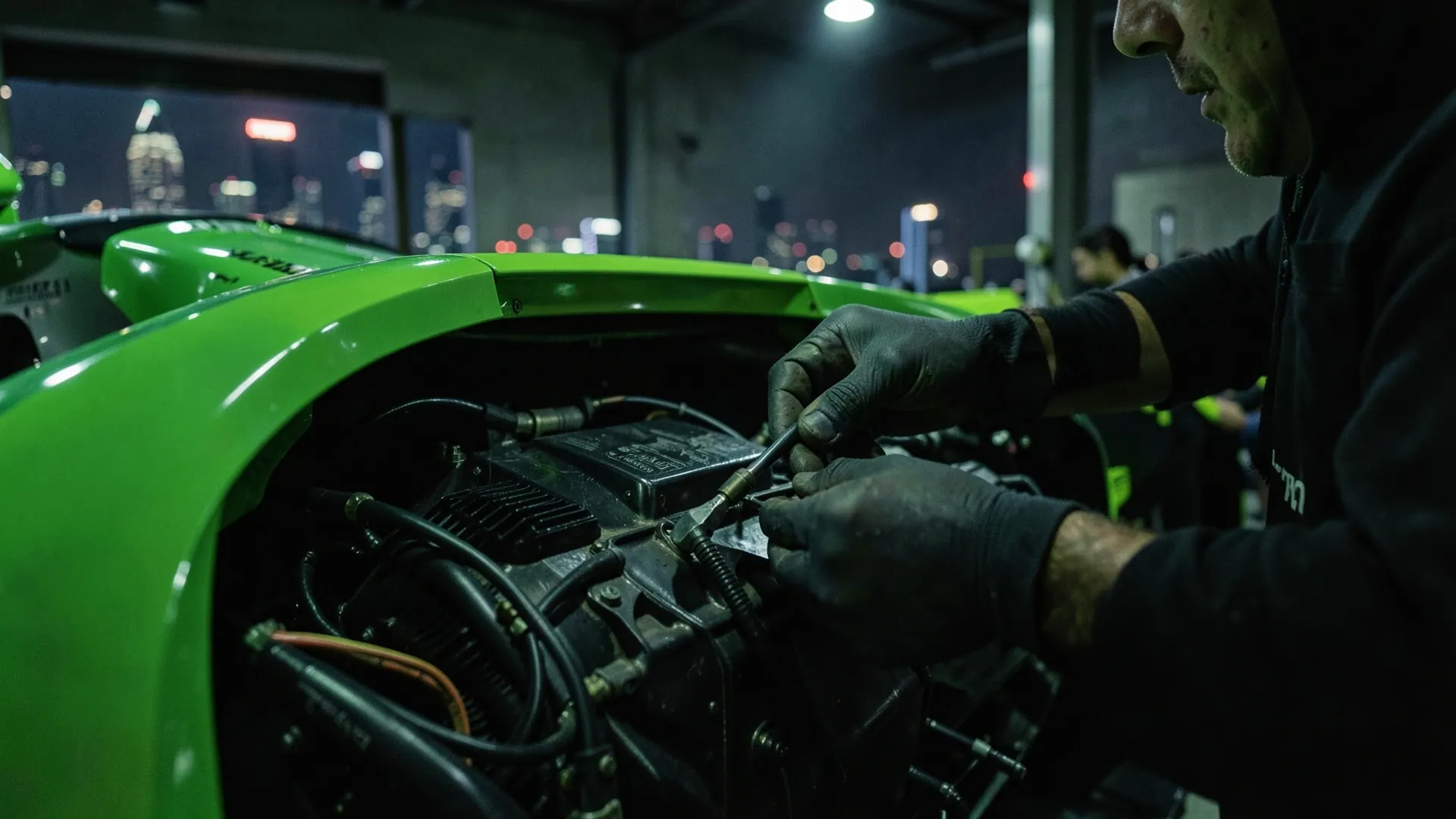
Honda says it has found the cause of the power unit problem Fernando Alonso reported at the Singapore Grand Prix on 11 October. The fault had troubled Alonso across recent races, and it was elusive enough to earn the label “phantom”. Shintaro Orihara, Honda’s chief engineer and trackside general manager, has confirmed that the manufacturer has now got to the bottom of it. With Aston Martin on seven points after 17 rounds, that diagnosis is the closest thing to good news the team has had in months.
What Alonso felt at Marina Bay
Singapore was another grim weekend for Aston Martin. Alonso started 20th and finished 16th, a lap down, ahead of only the two Cadillacs among the finishers. Lance Stroll started 21st and retired. After the race Alonso said something had not felt right with the Honda unit around Marina Bay, and the team began an investigation.
The result sheet shows how little the car had to give. George Russell started 19th in the Mercedes and finished ninth. Isack Hadjar came from 22nd on the grid to score a point for Red Bull. One started a place ahead of Alonso and the other two places behind, and both reached the top 10 on a street circuit where overtaking is hard. Alonso made up four places and was still lapped.
None of that makes the engine the whole story. A lapped finish from 20th points to a car short of pace in several areas, and the chassis carries as much of the blame as anything behind the driver’s back. But a driver of Alonso’s experience does not raise a power unit complaint lightly. When Honda says the fault was real, it confirms that he was reading the car correctly, even when the data took longer to agree.
Why a fault can hide from the telemetry
It sounds odd that a modern F1 power unit, covered in sensors and watched by engineers in Sakura and at the track, could have a problem only the driver notices. The 2026 regulations make it more plausible than it once was.
This year’s units dropped the MGU-H and moved to a split of close to 50/50 between combustion and electrical power. The MGU-K now delivers far more power than before. That makes energy management central to lap time. How the system harvests under braking and lift-off, and how it deploys on the straights, shapes the car’s behaviour as much as peak output does. A small irregularity in how power arrives, or in how the rear axle feels while the system recovers energy, can upset a driver’s confidence at corner entry and exit. On a channel-by-channel trace, the same irregularity may barely show.
Drivers notice patterns before engineers can isolate them. A sensation that comes and goes, or appears only in certain corners, fuel loads or energy states, is the hardest kind of problem to chase. The engineers need it to happen again, under controlled conditions, before they can trace it to a cause. Singapore is a long, hot, stop-start lap with heavy braking and little straight-line relief, and it pushes energy systems hard. It is also the kind of venue where an intermittent fault is most likely to show itself.
Honda has a history here that should reassure Aston Martin. The company’s second era with Red Bull was built on patient, methodical problem-solving. It went from a difficult start in 2018 to its first win of the hybrid era in Austria in 2019, then to Max Verstappen’s first title in 2021 and a run of championships after that. Finding a fault that only one driver could feel fits the culture that rebuilt Honda’s reputation. The question is why it took several races to pin down. Each of those races was another weekend of an already poor car running below its potential.
Seven points and the shape of a lost season
The championship table explains why this matters beyond one driver’s comfort.
| Position | Team | Points |
|---|---|---|
| 8 | Audi | 23 |
| 9 | Williams | 12 |
| 10 | Aston Martin | 7 |
| 11 | Cadillac F1 Team | 0 |
Aston Martin sits 10th of 11, ahead only of the new Cadillac entry. Williams, one of the teams Aston expected to beat comfortably, is five points clear. Audi, also in its first season as a works operation, has more than three times Aston’s total. Mercedes leads the constructors’ championship on 578 points and has shown what a strong 2026 engine can do: Andrea Kimi Antonelli has eight wins and a 102-point lead over Russell with six rounds left.
That is the context for Honda’s diagnosis. This was supposed to be the year the pieces came together. Aston Martin has spent heavily on a new Silverstone factory and wind tunnel, and it secured an exclusive works deal with Honda for the new rules. Instead, both cars were starting from the last two rows in Singapore. A team with those resources should not be fighting Cadillac to avoid last place.
The engine is not the only cause, and it would be unfair to Honda to suggest otherwise. The car’s deficit is too large for one component to explain. But in a new rules cycle, chassis and power unit cannot be judged separately. Aerodynamic efficiency affects how much energy the car spends on the straights. Packaging and cooling affect how hard the unit can run. If one half of the partnership is chasing a fault, the other half cannot be sure its own development is heading the right way. Finding the problem gives the team a cleaner baseline. That may be the most useful thing it gets from the remaining six races.
Alonso, Honda and an old argument settled differently
There is an obvious irony in Alonso being the driver who found this. His previous time with Honda, at McLaren from 2015 to 2017, produced one of the most famous radio messages of the hybrid era. At Suzuka in 2015, in front of Honda’s own management, he called the unit a “GP2 engine”. That partnership ended badly, and Honda’s later success with Red Bull only made the McLaren years look worse in hindsight.
This time the relationship looks different. Alonso described a problem, Honda investigated, and the engineers have publicly credited him with identifying the fault. That is how a works partnership should operate, with the driver’s feedback treated as evidence rather than complaint. At 45, Alonso’s sensitivity to the car has become one of Aston Martin’s most valuable assets. In a season with few points to show, his feedback may be worth more to the team’s long-term recovery than any single result.
The episode also shows what the team needs from its drivers in a rebuilding year. Stroll’s retirement in Singapore left Alonso’s car as the only one to provide a full race’s worth of data from the weekend. When the car is this far off, the team needs two drivers producing consistent, comparable feedback to separate engine behaviour from chassis behaviour and set-up choices. A problem that only one driver could feel is, by definition, harder to confirm.
What Austin has to prove
The United States Grand Prix at the Circuit of the Americas on 25 October is the first chance to see whether the fix holds. Austin is a better test than Singapore for the 2026 power units. Its long back straight and heavy braking zones put sustained demands on energy deployment and recovery, so any remaining irregularity should show itself quickly.
The realistic aims are modest. Five points separate Aston Martin from Williams in ninth, and the difference between those positions is worth real prize money. If Honda’s diagnosis turns into a car that Alonso can push with confidence, a couple of finishes in the lower points over the final six rounds are within reach, especially in races where the leading teams have problems. A podium or a regular top-10 place is not.
The bigger prize is next season. Aston Martin’s 2026 is beyond rescue as a championship campaign. What can still be saved is the team’s understanding of how its chassis and Honda’s unit work together, and confidence that problems can now be found in days rather than weeks. Honda has shown it can solve a hard problem. It now needs to show it can do so quickly, because a works team that took several races to find a fault its lead driver had already described will not catch Mercedes in 2027.