
Honda's Alonso Engine Investigation Exposes the Depth of Aston Martin's Struggles
Honda has vowed to explain a mysterious problem with Fernando Alonso's power unit, but seven points from 17 rounds show Aston Martin's works project is short of pace as well as reliability.
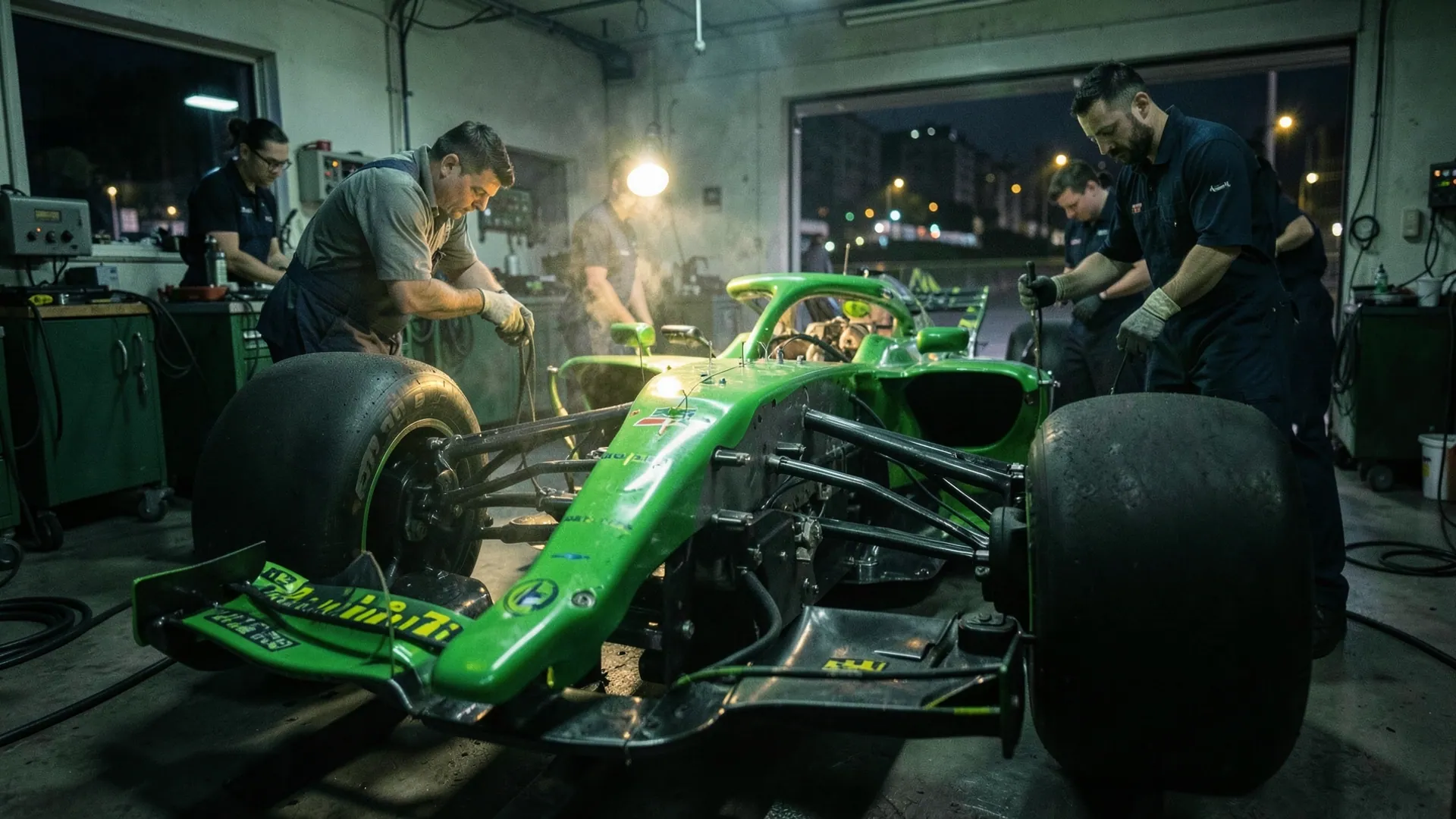
Honda has promised to find the cause of an unexplained problem with Fernando Alonso’s power unit, days after the two-time world champion finished 16th and a lap down from 20th on the grid at the Singapore Grand Prix. Team-mate Lance Stroll started 21st and retired. That leaves Aston Martin on seven points after 17 rounds, 10th of 11 in the constructors’ championship and ahead only of newcomers Cadillac.
The pledge, reported by RacingNews365, is the right thing for Honda to say. That it needs saying this late in a season that was meant to launch Aston Martin into contention tells you more about the state of the project than any single result.
Honda’s promise is also an admission
A known fault is an engineering problem. An unexplained one, deep into the season, is an organisational one. When a manufacturer has to promise publicly to get to the bottom of something, it is effectively conceding that its trackside telemetry, dyno correlation and post-race analysis have not yet produced an answer. After 17 rounds, those tools should be mature.
Part of the explanation is structural. Honda supplies one team, which gives it two cars’ worth of running data each weekend. Mercedes, by contrast, powers its own team plus McLaren, Williams and Alpine, which means eight cars and four sets of engineers reporting back to Brixworth. Ferrari has six cars across its own team, Haas and Cadillac. When an intermittent fault appears, the manufacturer with the bigger sample is far more likely to see it repeat, isolate the conditions that trigger it and test a fix. Honda’s two-car dataset makes a rare problem rarer still, and much harder to pin down.
The 2026 regulations compound the difficulty. With roughly half the power unit’s output now coming from the electrical side, the interaction between combustion engine, energy recovery, battery and control software is far more complex than in the previous era. A problem that presents itself as a loss of power could originate in any of those systems, or in the way they talk to each other. That is plausibly why a fault can stay mysterious for longer than anyone at Sakura or Silverstone would like.
None of this excuses the situation. Honda chose the single-customer works model precisely because it promised total integration with Aston Martin. The flip side of that intimacy is that there is nowhere else to look for answers.
Singapore showed the gap is pace as well as reliability
The temptation is to treat Alonso’s issue as the headline problem and assume that solving it unlocks the car. The Singapore classification argues against that.
Look at the drivers who started around the Aston Martins. George Russell started 19th and finished ninth. Isack Hadjar started 22nd and finished 10th, taking the final point. Alonso, from 20th, gained four places and was lapped. Stroll, from 21st, did not see the flag. On a street circuit where overtaking is difficult and strategy, safety cars and tyre management usually reward the patient, a Mercedes and a Red Bull both carved through the field while the green cars stayed rooted near the back.
That comparison is not entirely fair. Russell drives for the runaway constructors’ leader, a Mercedes team that has won 11 races this year, and Hadjar’s Red Bull team-mate won in Singapore. But it is the right benchmark for a team that spent heavily to join that group. Aston Martin’s own target was the front, not the lower midfield.
The foot of the constructors’ table makes the scale of the shortfall plain:
| Position | Team | Points |
|---|---|---|
| 7 | Haas | 30 |
| 8 | Audi | 23 |
| 9 | Williams | 12 |
| 10 | Aston Martin | 7 |
| 11 | Cadillac | 0 |
Haas, with customer Ferrari power, has more than four times Aston Martin’s tally. Audi, also in the first season of a brand-new power unit programme, has scored more than three times as much. This is the comparison that should trouble Honda most. Audi faced the same blank sheet of paper under the same rules and has produced a more competitive package, albeit one still well short of the front.
The McLaren-Honda echo Alonso knows too well
For Alonso this has a grim familiarity. In 2015 Honda returned to Formula 1 with McLaren, a year after Mercedes, Ferrari and Renault had begun the hybrid era. The power unit was underpowered and unreliable, and the partnership produced three miserable seasons before McLaren walked away at the end of 2017. Alonso’s “GP2 engine, GP2!” radio message at Suzuka in 2015, in front of Honda’s home crowd, became shorthand for the whole period.
What happened next matters just as much. Honda moved to Toro Rosso in 2018, then to Red Bull in 2019, and by 2021 its power was behind Max Verstappen’s first world championship. Honda-developed engines underpinned Red Bull’s constructors’ titles in 2022 and 2023. The company has shown it can recover from a bad start and build a class-leading power unit.
The catch is the timescale. That recovery took the best part of four years, and it relied on a partner, Red Bull, that was willing to absorb short-term pain because it trusted the long-term trajectory. It also benefited from a stable rule set that rewarded patient, incremental gains.
On paper, Aston Martin is that kind of partner. Lawrence Stroll has invested in a new factory and wind tunnel at Silverstone, Adrian Newey joined in 2025 to lead the technical direction, and the Honda deal was designed as the final piece of a works-team puzzle. Few teams have ever been more committed to a power unit partner.
Alonso does not have four years. He is 45. In his first season with Aston Martin, in 2023, he scored eight podiums, and the 2026 regulation reset was meant to give him one last shot at a competitive car. Instead he has spent the past 17 rounds in the same part of the grid where he spent his McLaren-Honda years. This time there is no rival manufacturer to switch to and no time to wait out a rebuild.
Austin is a checkpoint, not a cure
The United States Grand Prix at the Circuit of the Americas on 25 October opens the final run of six rounds. Realistic objectives for Aston Martin and Honda look modest from here.
The first is diagnosis. Honda’s credibility now rests on explaining the Alonso problem rather than quietly hoping it does not recur. If the cause can be identified and confirmed before Austin, that is a meaningful step, because it shows the diagnostic chain works. A further unexplained failure at COTA would be far more damaging than the original incident.
The second is ninth place. Williams sit five points ahead on 12, a gap small enough to close with a single good afternoon. Constructors’ positions carry real prize money, though for a team with Aston Martin’s ambitions the difference between ninth and 10th matters more for morale than for the balance sheet. Beating Williams would at least give the factory a small reason to feel the car is moving forward.
The third, and most important, objective cannot be measured in Austin at all. Every weekend between now and Abu Dhabi is a source of data for the 2027 power unit and chassis. The 2026 rules include provisions to give manufacturers that fall significantly behind extra room to develop, and Honda appears to be a candidate for that help. But extra development allowance is only useful if the manufacturer knows what to develop. A power unit with an unexplained fault is a moving target, and chasing performance on top of an unresolved reliability question means building on uncertain foundations.
The verdict, then, is straightforward. Aston Martin’s season is beyond rescue, and nobody at Silverstone should pretend otherwise. What the remaining six rounds can still decide is whether Honda enters the winter understanding why its power unit fails, or merely knowing that it does. If Honda reaches Abu Dhabi with that answer, the McLaren years suggest a recovery is possible. If it does not, Alonso’s final chance at a competitive car will probably have gone before the problem is even explained.