
Piastri Admits McLaren Have No Fix Coming as Red Bull Close In on Third
Oscar Piastri's admission that McLaren are unlikely to solve their car's problems this season leaves the double champions defending a seven-point lead over Red Bull for third with a stalled development curve.
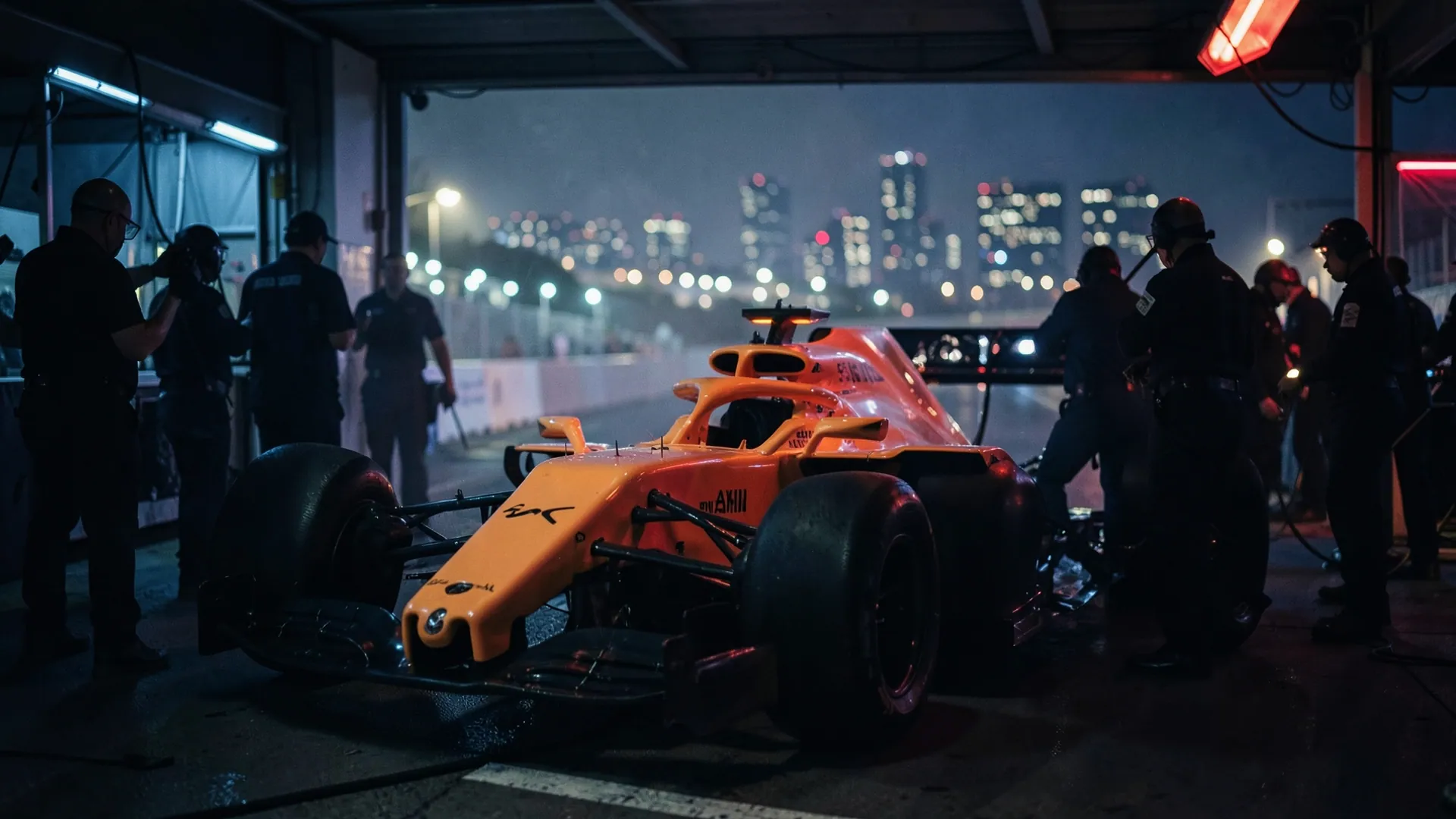
Oscar Piastri has admitted that McLaren are unlikely to find a fix for their car’s problems before the 2026 season ends, with six rounds left to run. The Australian told Motorsport.com that he believes the car has reached its limit, a striking concession from a driver whose team won the past two constructors’ championships. It comes at an awkward moment: Max Verstappen has just won in Singapore, and McLaren’s margin over Red Bull for third place has shrunk to seven points.
Seven points and a car that has stopped improving
The constructors’ table reads Mercedes 578, Ferrari 444, McLaren 339, Red Bull 332. The top two are out of reach. Mercedes have banked 11 wins from 17 rounds, and Ferrari sit 105 points clear of McLaren. That leaves the fight for third as McLaren’s realistic objective for the remainder of the year, and it is a fight they are now conducting with a car their own driver says will not get better.
Singapore showed how quickly the margin can move. Lando Norris and Piastri finished fourth and fifth, from fifth and sixth on the grid, for a tidy 22 points. Red Bull took 26, with Verstappen converting pole into victory and Isack Hadjar climbing from 22nd on the grid to the final point in 10th. Before the weekend McLaren led by 11. They left it leading by seven, and they had not done much wrong. They were simply beaten by a faster car at the front and a resilient one at the back.
The pattern is the worry. A clean weekend with both cars in the top five still cost McLaren ground. Without new performance on the way, their only lever for the last six races is execution: qualifying positions, strategy, reliability and avoiding the kind of first-lap contact that turns a 20-point weekend into a 10-point one.
Why a Mercedes customer is losing to Mercedes
The most telling detail of McLaren’s season is the badge on the back of the car. McLaren run a Mercedes power unit under the new 2026 regulations, the same hardware that has carried Andrea Kimi Antonelli to eight wins and a 102-point championship lead over his team-mate George Russell. Whatever McLaren’s shortcomings are, they are not primarily about the engine.
That narrows the diagnosis to the areas McLaren control: chassis, aerodynamics, and how the car manages the energy deployment and active aerodynamic demands of this rule set. The 2026 regulations reset almost everything at once, and the cars that emerged have proved sensitive to how teams interpreted the balance between straight-line efficiency and cornering load. McLaren’s previous design philosophy, which produced a car that was kind to its tyres and quick through medium- and high-speed corners in 2024 and 2025, has not translated into a comparable advantage this year.
Norris has extracted two wins from the package, and his 201 points put him sixth in the drivers’ standings, 20 behind Verstappen. Piastri has 138 and no wins, 63 points adrift of his team-mate. Twelve months ago he was a genuine title contender. The gap between the two McLaren drivers this year suggests the car has a narrow operating window, one that Norris has found more often. That is also consistent with Piastri’s verdict: a team chasing a fundamental characteristic rather than a missing upgrade cannot bolt a solution on in October.
There is a practical logic to his candour, too. Every hour of wind tunnel time and every pound of cost-cap budget spent on this car now is an hour and a pound not spent on its successor. Heading into the second year of a new rules cycle, the gains available from a better starting concept dwarf anything a late-season patch can deliver. If McLaren have concluded that their problem is conceptual, freezing development and redirecting resources to 2027 is the rational call, and Piastri is simply describing the consequence aloud.
Red Bull’s one-car problem is McLaren’s lifeline
McLaren’s lead rests heavily on their second driver. Compare the pairings:
| Team | Lead driver | Second driver | Team points |
|---|---|---|---|
| McLaren | Norris, 201 | Piastri, 138 | 339 |
| Red Bull | Verstappen, 221 | Hadjar, 97 | 332 |
Verstappen has outscored Norris by 20 points. Piastri, in a season he would rather forget, has outscored Hadjar by 41. On the drivers’ tallies alone, that gap in the second seat accounts for the whole of McLaren’s cushion, and then some.
It also explains why Piastri’s form matters more than any upgrade McLaren will not bring. If Red Bull’s second car keeps scoring the way Hadjar did in Singapore, recovering into the points from the back, the arithmetic tilts quickly. Red Bull have their own development constraints in their first year of building a power unit in partnership with Ford, but Verstappen remains capable of winning whenever the car is close. His two wins match McLaren’s tally for the season. With a driver of his calibre, a single strong weekend can swing 15 points between the teams.
McLaren’s counter is consistency. Two cars finishing in the top six every weekend would likely be enough, because Red Bull have rarely put both cars in that zone. The risk lies in tracks that expose McLaren’s weaknesses, or in a weekend where one car drops out. With the gap at seven, a single retirement could hand Red Bull third.
The 2024 mirror, and what third place is worth
There is an obvious historical echo, and it should unsettle McLaren. In 2024, Red Bull began the year with the class of the field and then hit a development wall. The RB20 stopped responding to upgrades, its balance narrowed, and Sergio Pérez’s collapse in form left Verstappen carrying the team. McLaren, improving race by race, overhauled them to win the constructors’ title, and Ferrari pushed Red Bull down to third.
This year the roles are partly reversed. McLaren are the team with a stalled car and a second driver performing below expectations, although Piastri’s deficit is nowhere near as stark as Pérez’s was. Red Bull are the team picking up results. The difference is that Red Bull’s development has not obviously surged either; it is Verstappen’s ability to maximise opportunities like Singapore that keeps closing the gap.
The other precedent cuts the other way. In 2023 McLaren showed how fast a team can recover when the problem is understood, transforming a car that started that season near the back into a regular podium contender within months. That recovery was built on a clear diagnosis and a substantial upgrade package. Piastri’s comments suggest that, this time, either the diagnosis is incomplete or the solution is too fundamental to deliver before the season is out.
Third versus fourth is not a vanity contest. Prize money is distributed by constructors’ position, and the difference between adjacent places runs into millions, which matters under a cost cap that limits what teams can spend but not what they can earn. There is a slight offsetting benefit to finishing lower, since the aerodynamic testing restrictions grant more wind tunnel and CFD allocation to teams further down the order. Between third and fourth that gain is marginal. No team would trade the money and the standing for it, least of all one that won the title 12 months ago.
Austin, and a season that becomes a test of operations
The United States Grand Prix at the Circuit of the Americas on 25 October opens the final stretch. Six rounds remain, and McLaren must defend third without the help of new parts. That turns the rest of the season into a test of the team’s operational strength rather than its engineering, an area in which McLaren were excellent in 2024 and 2025.
Piastri’s honesty is welcome, and it is probably correct. Pretending a fix is coming would only raise expectations the car cannot meet. But it also leaves McLaren with a narrower margin for error than at any point in the past two years. My judgement is that McLaren hold third, narrowly, because Red Bull still cannot rely on two cars scoring every weekend. The real verdict on this season will come in March, when it becomes clear whether McLaren’s decision to stop chasing this car bought them the 2027 machine they need.