
Hamilton and Verstappen Want Marina Bay Rethink After Another Pole-to-Flag Singapore Win
Lewis Hamilton and Max Verstappen say Marina Bay needs a longer straight or a proper hairpin, and four consecutive pole-to-flag wins suggest the layout is the root of Singapore's problem.
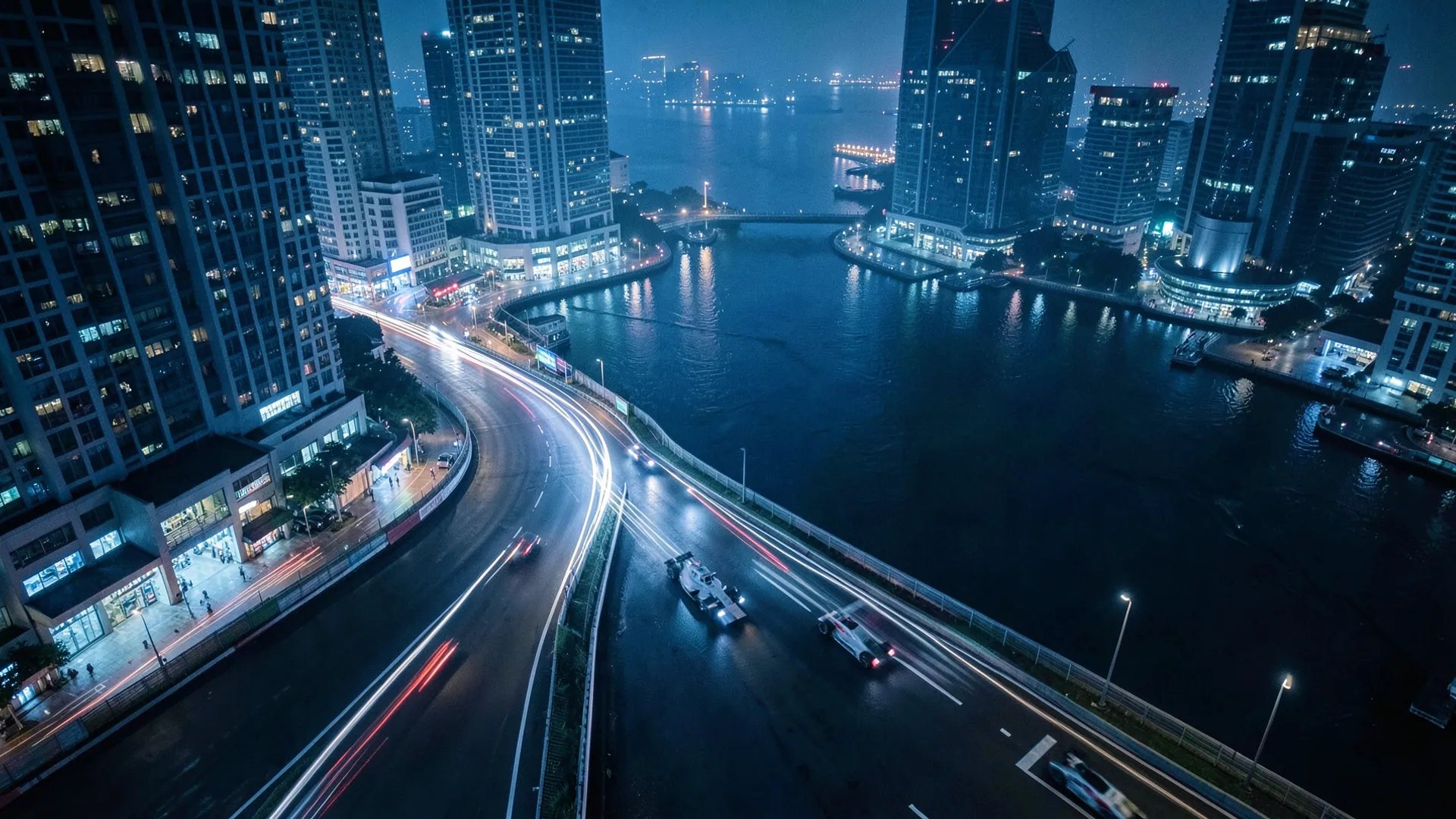
Lewis Hamilton and Max Verstappen have called for changes to the Marina Bay Street Circuit, arguing that Singapore needs a longer straight or a proper hairpin if it is to become a great racing track. Their comments, reported by Motorsport.com, follow a Singapore Grand Prix on 11 October that Verstappen won from pole position. It was the fourth consecutive edition of the race won by the driver who started first.
The sequence is hard to dismiss. Carlos Sainz converted pole in 2023, Lando Norris in 2024, George Russell in 2025 and now Verstappen in 2026. That is four different drivers in four different cars, yet the result is the same: whoever controls Turn 1 on Sunday controls the race. When the outcome survives changes of team, driver and an entirely new set of technical regulations, the circuit becomes the obvious suspect.
A race settled on Saturday night
The front of the Singapore classification reads almost like the qualifying sheet. Verstappen started first and finished first. Charles Leclerc started second and finished second. Andrea Kimi Antonelli, Norris and Oscar Piastri lined up fourth, fifth and sixth and finished third, fourth and fifth. The only change in that group came from Hamilton falling from third on the grid to sixth at the flag.
The significant movement happened further back. Russell climbed from 19th to ninth and Isack Hadjar from 22nd to 10th, two fast cars recovering through a field of slower ones. That is a familiar pattern at street circuits: a big pace advantage will eventually find a way through. Among cars of similar speed at the front, however, the order barely moved.
The consequences for the championship were real all the same. Antonelli’s third place against Russell’s ninth stretched the gap between the Mercedes team-mates from 89 points to 102, with six Grands Prix left. Verstappen’s second win of the season lifted him to 221 points, fourth in the standings and eight behind Hamilton. Saturday’s qualifying session shaped all of that more than anything that happened over the following 62 laps.
Why the winner is complaining too
The intervention carries weight because of who is making it. A driver who has just lost three places has an obvious reason to criticise a track, and Hamilton’s afternoon could easily be read that way. Verstappen has no such motive. He won the race. A four-time champion standing on the top step and arguing that the circuit should be harder to win on from the front is making a case against his own short-term interest.
Between them, Hamilton and Verstappen have raced at Marina Bay across almost the entire history of the event, through multiple layouts, tyre generations and car concepts. When the seven-time champion and the man who has defined the past half-decade agree on a specific remedy (a longer straight or a genuine hairpin), it amounts to more than a vague grumble about the show. It is a technical diagnosis from the people best placed to make one.
Their view also matches what the grid has said, privately and publicly, for years. Singapore is admired as a spectacle and respected as perhaps the most physically punishing race on the calendar, with its heat, humidity and relentless sequence of corners. Very few drivers would describe it as a place where they expect to overtake.
What a hairpin would actually change
Overtaking on a modern Formula 1 circuit generally needs two ingredients in sequence. The first is a run long enough for a following car to close the gap, using the tow and whatever deployment tools the regulations allow. The second is a heavy braking zone into a slow corner, where a driver can commit to a late lunge and the defender has limited options to cover both lines.
Marina Bay is short on both. Its lap is built from a succession of 90-degree bends linked by brief straights, the legacy of a circuit laid over a city grid. A chasing driver spends most of the lap in turbulent air through one corner after another, rarely getting a clean run to set up a move. The walls punish any lunge that goes wrong, and the heat makes tyre and temperature management a higher priority than attack. Drivers sensibly settle into a rhythm, and the race becomes a question of strategy and pit-stop timing.
The 2026 regulations were supposed to help. The new cars are smaller and lighter, with active aerodynamics and an energy-based overtaking aid replacing DRS. But those tools work by reducing drag and adding power along a straight, and they can only do so much when the straights are short. Singapore’s result suggests the new rules have not altered the basic geometry of the problem.
Compare that with the next stop. The Circuit of the Americas offers a steep climb into the Turn 1 hairpin and a long back straight ending in another tight left-hander at Turn 12, precisely the combination Hamilton and Verstappen are describing. Baku’s run to Turn 1 and the Strip straight in Las Vegas work on the same principle. All three are circuits where the pole-sitter cannot assume the race is won.
Singapore has changed before, but not enough
Marina Bay is not a fixed monument, and the organisers have shown a willingness to adapt. The awkward Singapore Sling chicane at Turn 10 disappeared in 2013. For 2023, construction work at the waterfront forced the removal of the twisting section beneath the grandstand, merging what had been several corners into a longer flat-out run. The lap became quicker and flowed better.
The racing at the front did not change. That 2023 race did produce a tense finish, but the tension came from strategy: Mercedes gambled on a late stop for fresh tyres, while Sainz used Norris as a buffer to hold position. The circuit itself did not create the overtaking. Since that layout change, every Singapore Grand Prix has been won from pole. The lesson is that removing a slow section is not the same as adding a passing opportunity. A longer straight only helps if it ends in a braking zone that invites a move.
There is also a cautionary tale from the other end of the street-circuit spectrum. Monaco’s response to its own processional racing in 2025 was a sporting fix, a mandatory two-stop rule, rather than a physical one. Teams responded by having one car drive slowly to build pit-stop gaps for its team-mate, which manipulated the race without improving it. Rule tweaks applied to a circuit that cannot support passing tend to produce gamesmanship rather than overtaking.
That is why the drivers are right to focus on geometry. Singapore’s constraints are physical: public roads, fixed landmarks, the cost of reprofiling city infrastructure and the limited time available to build the circuit each year. None of that is trivial. But the organisers found room to reshape the lap in 2023 when circumstances required it, and the waterfront around the Marina has been redeveloped repeatedly since the race arrived in 2008. A single tight corner at the end of an extended straight is a far smaller ask than a wholesale redesign.
The case for acting before the next rebuild
Singapore does not need to imitate Austin or Baku. Its identity as a night race in the heart of a city, demanding to drive and spectacular to watch, is secure. What it lacks is a single place on the lap where a driver with a faster car can realistically pass a rival of similar pace. Four consecutive pole-to-flag wins show that, as things stand, Saturday decides the result and Sunday mostly confirms it.
The organisers should treat this intervention as a brief rather than a complaint. When a race winner and a seven-time champion name the same fix, the work of identifying a viable corner and a longer approach to it should start now, so that it can be built into the next round of construction instead of being improvised around it. Austin this weekend will offer a useful reference point. If the Turn 1 and Turn 12 braking zones produce the kind of racing Singapore has not seen at the front since its last layout change, the argument for a proper Marina Bay hairpin will be very hard to resist.