
Hamilton and Leclerc's Lap-One Fight Opens the Door for Verstappen in Mexico
Ferrari turned pole and third on the grid into second and fourth after Lewis Hamilton and Charles Leclerc fought each other on lap one, and the team must now decide how its drivers race.
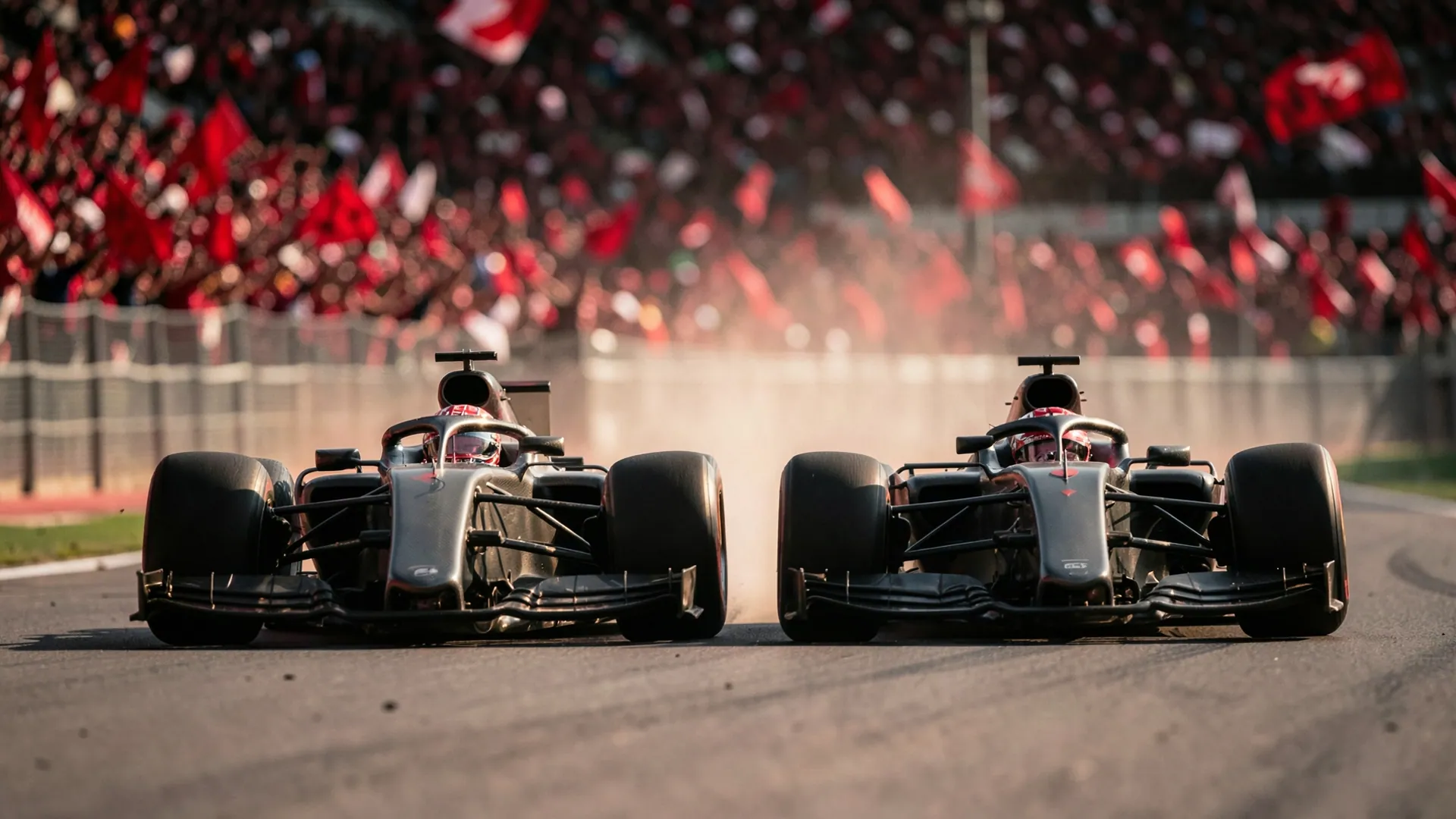
Max Verstappen won the Mexico City Grand Prix on Sunday from fifth on the grid, after Lewis Hamilton and Charles Leclerc spent the opening lap fighting each other rather than protecting Ferrari’s grip on the front of the race. Hamilton, who started from pole, recovered to finish second. Leclerc, who lined up third, came home fourth behind Andrea Kimi Antonelli. Ferrari left with 30 points from a weekend that had offered a realistic shot at 43.
How first and third became second and fourth
Ferrari arrived at the start with the best hand it has held all season. It had pole, a second car one row back, and a Red Bull starting from the third row. The Autódromo Hermanos Rodríguez has the longest run from the grid to the first braking zone on the calendar. The slipstream down that straight turns every start into a drag race, so the opening lap is where races there are won and lost.
For a team with two cars near the front, that geometry demands a plan. Ferrari’s drivers instead treated the first lap as a private contest. By the time the order settled, Verstappen was through and gone, and he went on to win his third Grand Prix of 2026. Hamilton’s second place was a decent recovery, but a decent recovery from pole is still a defeat.
The aftermath has been as revealing as the incident. RacingNews365 reports that Hamilton criticised what he called Leclerc’s “do or die” approach, and describes the episode as the latest clash between the pair. PlanetF1’s Monday round-up put the blame on Hamilton. Juan Pablo Montoya, speaking as an F1 TV pundit, called for “consequences” for both drivers, arguing that the first-lap battle probably cost Ferrari the win. At Crash.net, Lewis Larkam accused the team of lacking backbone and warned of open war.
Informed observers have reached opposite verdicts on who was at fault, and that points to the deeper problem. When blame is genuinely arguable, it usually means the rules of engagement were never clear enough to judge the incident against.
Why neither driver was ever going to lift
The drivers’ title belongs to Antonelli. He has 380 points and nine wins, and his lead stands at 119. That might suggest the remaining rounds are low-stakes for everyone else. For Ferrari’s drivers the opposite is true, because the fight for runner-up is about as tight as it gets.
| Pos | Driver | Team | Points | Gap to 2nd |
|---|---|---|---|---|
| 2 | Max Verstappen | Red Bull | 261 | – |
| 3 | Lewis Hamilton | Ferrari | 259 | 2 |
| 4 | George Russell | Mercedes | 250 | 11 |
| 5 | Charles Leclerc | Ferrari | 245 | 16 |
Going into Mexico, those four drivers were covered by nine points. Russell held second on 242, Hamilton was a point behind and Leclerc trailed his team-mate by eight. Every position on that opening lap therefore carried a direct championship consequence for both Ferrari drivers.
Second place would be Hamilton’s best championship finish since 2021, and a statement about his Ferrari move in its second season. Leclerc’s best remains his runner-up finish in 2022, and he has spent much of this year as the driver expected to lead the team. Neither man has a reason to concede ground to the other, and each can argue, with some justification, that he is the better-placed Ferrari.
This is why “let them race” is not a policy. It is the absence of one. Two competitive drivers with a shared target and no agreed limits will keep finding each other, and the start is where they are most likely to meet.
Second in the constructors’ standings is safe on paper
The constructors’ table looks comfortable for Ferrari. It sits on 504 points, 124 clear of Red Bull and 133 ahead of McLaren. The maximum a team can score in a Grand Prix is 43 points, so Red Bull would need to outscore Ferrari by 125 over the four remaining rounds. That is an average of more than 31 points a weekend.
That is improbable, but not impossible. The scenario that keeps it alive is precisely the one Mexico hinted at. If Ferrari’s drivers collide and both fail to score at Interlagos while Verstappen wins, the gap drops by at least 25 in a single afternoon. Repeat that once more and the season’s closing weekends become far more uncomfortable than they should be.
The more serious cost is longer-term. Mercedes leads Ferrari by 126 points and has won 12 of the 19 rounds, so first place was gone long before Mexico. Ferrari’s 2026 has become a season of being best of the rest and preparing for 2027. A team that cannot manage two drivers when the title is out of reach will not suddenly manage them when it is within reach. Its drivers, its rivals and anyone weighing a future seat at Maranello will draw conclusions from how Ferrari handles the next week.
Precedents from Interlagos to Singapore
Ferrari does not need to look far for precedent, and Leclerc does not need to look far at all. At Interlagos in 2019, he and Sebastian Vettel touched while fighting over fourth with a handful of laps to go, and both Ferraris were out. The team’s response at the time was to talk about trust and clarity. Within a year, Vettel was told his contract would not be renewed.
The defining modern example belongs to Mercedes. In Barcelona in 2016, Hamilton and Nico Rosberg took each other out on the opening lap while fighting for the lead. Toto Wolff had already been through the aftermath of their contact at Spa in 2014. After Barcelona, he made clear that the team would act on further collisions and tightened the rules the drivers raced under. Mercedes did not stop its drivers racing, but it defined what racing meant and what would follow if they ignored that definition.
Red Bull’s 2010 season offers the cautionary version. Vettel and Mark Webber collided while running first and second in Istanbul, and Hamilton won. The team’s handling of the aftermath was widely read as favouritism, and the resentment shaped the relationship for years, through to the “Multi 21” order Vettel ignored in Malaysia in 2013.
McLaren’s experience in 2025 is the most relevant, because it involved two drivers fighting for a championship inside the same garage. Its framework for Lando Norris and Oscar Piastri was often mocked as overcomplicated, and it was tested when Norris made contact with Piastri on the opening lap in Singapore. But there was a framework. Disputes were judged against something agreed in advance, and McLaren won the constructors’ title.
The pattern across all four cases is consistent. Teams that set clear limits before an incident can absorb it. Teams that improvise afterwards turn each incident into an argument about loyalty.
The rule Ferrari should set before São Paulo
Montoya is right that there should be consequences. But consequences imposed after the fact, without an agreed standard, are simply punishment, and both drivers already believe the other was to blame. Fred Vasseur’s job this week is to replace the argument with a rule.
Ferrari should not pick a favourite. With 14 points between its drivers and second in the championship open to both, ordering one to support the other would be unfair and would poison the final rounds. What it can do is define the first lap. Team-mates leave each other a car’s width through the opening sequence of corners. Whoever is ahead at the end of lap one is not attacked by the other in the first stint unless strategy has separated them. A clear breach is corrected by giving the position back.
That keeps the fight for second in the drivers’ championship intact. It removes the one phase of the race where a team-mate battle can wipe out both cars, and it gives Ferrari a standard to apply whatever the names involved.
The timing makes this urgent. The Brazilian Grand Prix is on 8 November. Interlagos has a short, downhill run into the Senna S, where the opening lap is routinely crowded and messy. Leclerc and Ferrari have already lost both cars there to a team-mate collision once.
Ferrari should hold second in the constructors’ standings whatever happens. Whether it leaves 2026 as a team ready to fight Mercedes in 2027 depends on what it tells Hamilton and Leclerc before they line up in São Paulo. If they arrive without knowing exactly what is permitted into the first corner, Ferrari is relying on two drivers chasing the same prize to each choose restraint. Mexico has just shown how that bet tends to land.