
Verstappen Hits Back at Former Drivers as Red Bull Shakes Off 'Scary' Start
Fresh from victory in Singapore, Max Verstappen has defended his criticism of F1's 2026 engine rules and described Red Bull's recovery from a 'scary' start, sharpening a debate that winning has made harder to dismiss.
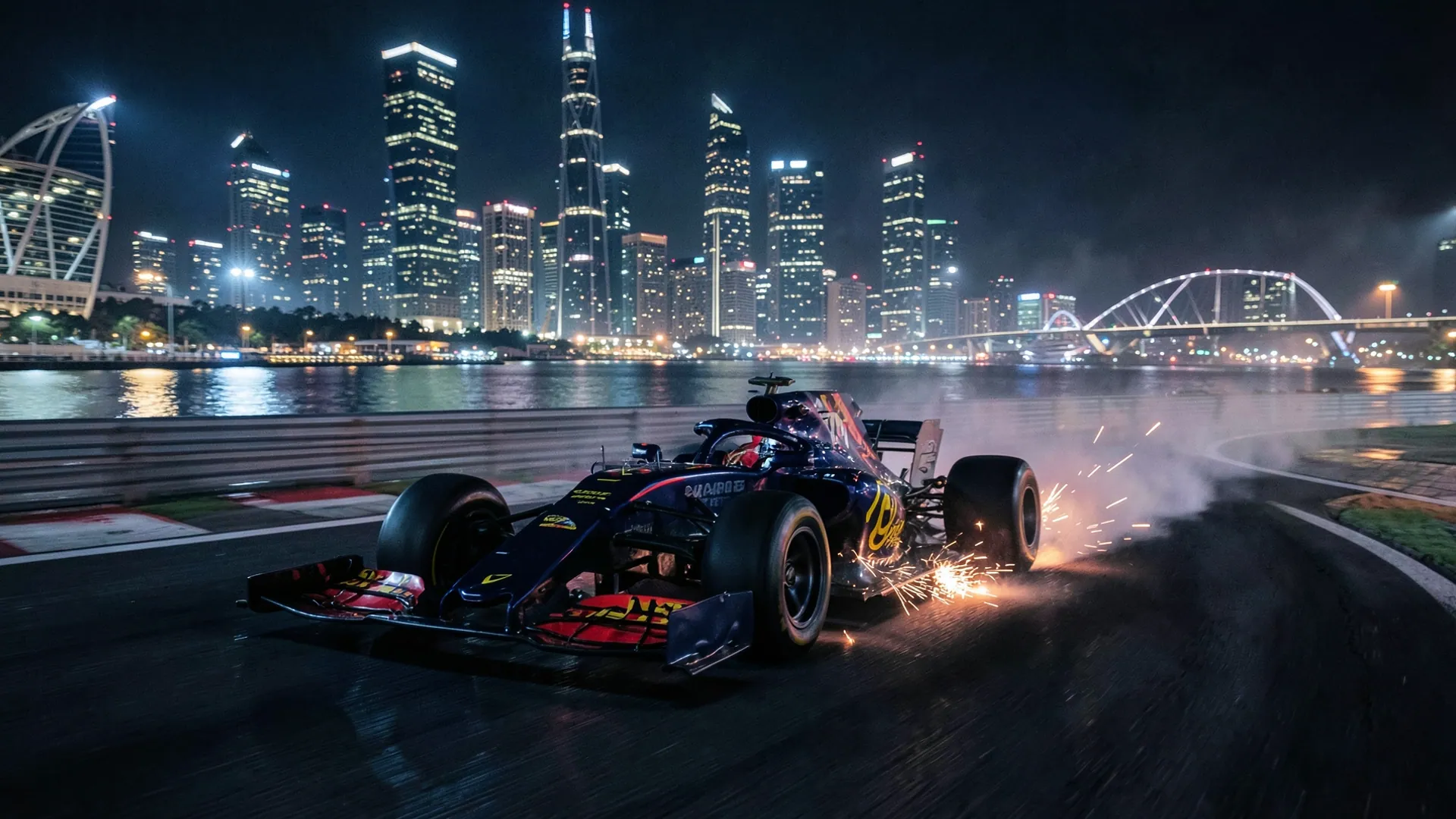
Max Verstappen has hit back at former Formula 1 drivers who criticised his stance on the 2026 regulations, days after he won the Singapore Grand Prix from pole position on 11 October. According to GPfans, the Red Bull driver said his critics “don’t know how the engine works”. He has also told RaceFans that his car was “scary” to drive in the early part of the season, and that Red Bull has since transformed it.
The two remarks belong together. The first is a defence of an argument Verstappen has made all year. The second is a reminder that he made that argument while driving a car he did not trust. He is now defending the same position from the top step of the podium.
Singapore handed Verstappen the platform
Verstappen led a front row of Red Bull and Ferrari at Marina Bay and converted it, finishing ahead of Charles Leclerc, who started and finished second. Andrea Kimi Antonelli took third from fourth on the grid to extend his championship lead. It was Verstappen’s second win of 2026, and it came on a weekend when Red Bull scored with both cars: Isack Hadjar climbed from 22nd on the grid to 10th for the final point.
That double score matters more than it looks. Red Bull took 26 points in Singapore to McLaren’s 22, and now sits on 332 in the constructors’ championship, seven behind McLaren in third. Earlier this year, a fight for third looked out of reach for a team adjusting to its own power unit and a car its lead driver found frightening.
In the drivers’ standings, Verstappen is fourth on 221 points, 119 behind Antonelli with six rounds remaining. He is eight points behind Lewis Hamilton in third and six ahead of Leclerc in fifth. Mathematically he is still in the title fight. Realistically he is not, and that frees him to speak about the rules without the suspicion that he is lobbying for an advantage in a live battle.
Marina Bay deserves a caveat, though. A street circuit with short straights and heavy braking zones gives a car plenty of opportunities to recover energy and few long stretches where it runs out. Under these regulations, that makes Singapore one of the kinder venues for an energy-limited power unit. A win there shows how far Red Bull has come. It does not settle whether the formula itself is sound.
The engine argument belongs to the people driving it
The 2026 power units are a sharp break from what came before. Output is split roughly evenly between the combustion engine and the electrical system, the MGU-H has gone, and the battery cannot sustain full deployment over a whole lap. Energy has to be harvested and spent strategically. In practice, that means drivers lifting, downshifting or losing electrical power on straights in ways that would have been unthinkable in the V10, V8 or earlier hybrid eras, when flat out meant flat out.
That is the core of Verstappen’s point. A driver who retired before these rules came in built his instincts in a world where you attacked every metre of the lap. Today a significant share of each lap is decided by deployment maps and harvesting targets that the driver works within rather than overrides. From a commentary box or a television screen, a car that slows before the braking zone can look like a driver being timid. From the cockpit, it can be the only way to reach the next straight with power to spare.
On that narrow point, Verstappen is right. The people best placed to explain how this engine behaves are the drivers and engineers working with it every weekend.
His rebuttal is broader than it needs to be, however. Former drivers do not have to understand energy recovery in detail to judge what the racing looks like, and a spectacle is ultimately something people watch rather than something they compute. Telling critics they lack technical knowledge answers one question: whether they understand the machinery. It does not answer the one fans care about, which is whether the machinery produces good racing. Verstappen’s case would be stronger if he made both arguments rather than leaning on his authority for the first.
From ‘scary’ to race winner
The RaceFans interview is the more revealing of the two. Red Bull entered 2026 with its first in-house power unit, developed by Red Bull Powertrains with Ford, and a new chassis built to a rulebook with smaller, lighter cars and active aerodynamics. When Verstappen calls a car “scary”, he should be taken literally. He is not a driver who complains about difficult handling for the sake of it, and he spent much of the previous era extracting results from cars his team-mates struggled to master.
In this formula, the sources of an unpredictable car are well understood. Active aero changes the car’s balance between configurations. Energy harvesting under braking adds an extra, variable retarding force at the rear axle. Lower downforce leaves less margin when either of those behaves unexpectedly. A car that feels different from one braking zone to the next destroys a driver’s confidence quickly, whatever its raw pace.
What makes Red Bull’s recovery notable is how badly the transition has gone for others. Audi, in its first season as a works entrant, has 23 points. Aston Martin, in the first year of its Honda partnership, has seven. Cadillac has yet to score. Against that backdrop, a debutant power unit project that is winning grands prix by October looks like a success, and Verstappen’s account of how bad things were at the start only reinforces that.
Mercedes and the echo of 2014
Any discussion of an engine-led rule change runs into the obvious precedent. In 2014, Mercedes mastered the first hybrid regulations and won 16 of 19 races, while Red Bull, then the reigning four-time champions, spent the early part of the year struggling with its Renault power unit. The advantage lasted for years.
This season has a similar shape. Mercedes has won 11 of the 17 races so far. Antonelli has eight victories and 340 points, and leads his team-mate George Russell by 102. Mercedes’ 578 points in the constructors’ championship are 134 more than Ferrari’s. Russell’s Singapore weekend showed both the strength of the package and how little the leaders have needed perfection: he recovered from 19th on the grid to ninth.
That is the strongest version of Verstappen’s scepticism. A formula built so heavily around the power unit rewards whoever solves it first, and those gains are hard to claw back because engine development is slower and more tightly controlled than aerodynamic work. Red Bull’s own turnaround complicates that story. If a new manufacturer can go from a frightening car to race wins within a season, the field is not as fixed as it was in 2014.
It is also why any suggestion of sour grapes misses the mark. He is restating his position after a win, not after a defeat. Whatever one thinks of his view of the regulations, it is not a convenient one he adopted when results were poor.
What Austin will reveal about Red Bull
The United States Grand Prix at the Circuit of the Americas on 25 October is a much harder test of Red Bull’s progress than Singapore. The long back straight punishes any car that runs short of electrical energy. The high-speed opening sector will show whether Red Bull has fully cured the instability Verstappen described. If he is competitive with Mercedes there, the turnaround is real. If he slips back, Singapore will look like a track that simply suited the car.
The stakes are tangible even with the title out of reach. Verstappen is eight points from third in the drivers’ championship, and Red Bull is seven points from third in the constructors’. Both are within one good weekend.
Verstappen has picked a fight he can partly win. On the engineering, he knows more than his critics, and he says so. On the racing, his argument will carry weight only if the next six rounds show that a competitive Red Bull improves the formula as a spectacle as well as his own results. The most persuasive reply he can give at Austin is a win on a circuit that exposes every weakness of the 2026 engine.